

You Can See Everything...Not
It’s not just you, kind readers, who are just about fed up with the onslaught—the media frenzy around the Elizabeth Holmes doc You Can See Everything roars on, no doubt according to parent A24’s dearest wishes, but almost too much of a good thing.
Its opening weekend of $15 million in box office, not enough to beat a standard action fantasy but still the best doc opening in 13 years, is meeting up with generally ecstatic reviews. Of course, there are some observers keeping their foot in the bucket--including the above-signed, but we’ll get to that soon enough.
With a grievously mismanaged country and the world in flames, why wouldn’t we turn to a little light voyeurism? The majority opinion from attendees is that the film’s two hours and forty-five minutes fly right by.
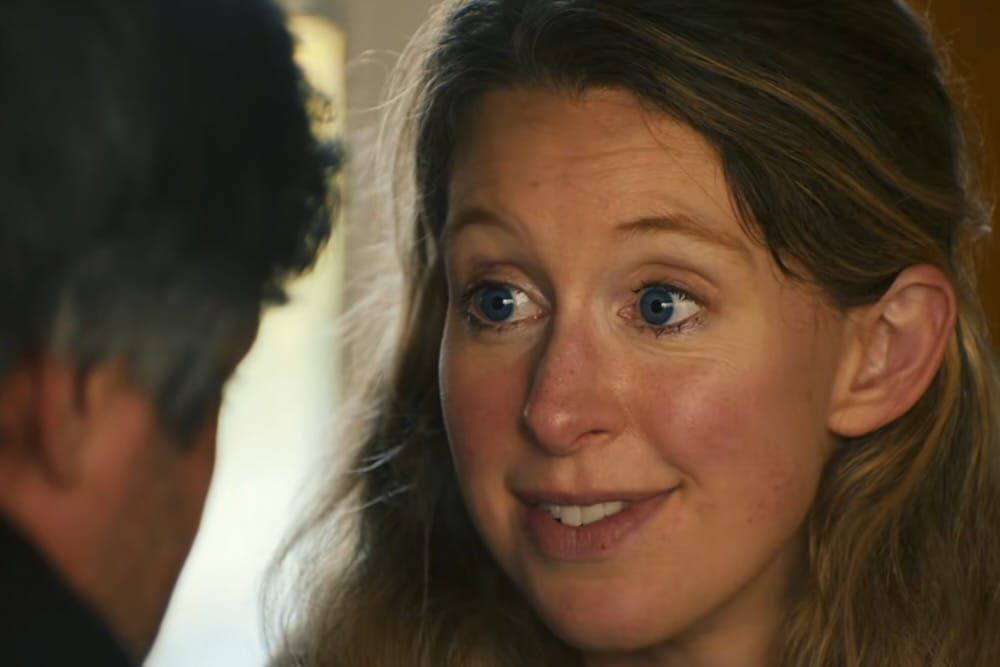
Indeed, the film’s anti-heroine Holmes has an engaging face, and she’s become our fall movie season Helen of Troy while insisting she’s Joan of Arc. “Would we care so much about Theranos founder and convicted fraudster Elizabeth Holms,” wonders Mary MacNamara in the Los Angeles Times, “If her eyes weren’t so big and blue?”
Co-directors Nathan Fielder and Lance Oppenheim seem equally taken by roften eiterating her found-footage girl-boss sashay in silky black slacks and Jobs-ian black turtleneck. It’s only when she dons that fire-engine-red lipstick and lab coat that we’re reminded there’s nothing spectacular going on in that zealously guarded basement lab where the supposedly magic blood testing apparatus is being developed. When she tries to project power pr Larry Ellison's advice, she bullies and then kicks out her top scientist Ian Gibbons, later a suicide. (The doc pays scant attention to the louche Theranos COO and Holmes mentor/boyfriend Sunny Balwani, indicted and jailed in concert with Holmes’s fall.)
The initial half of the film insists we invade her rental lodgings steps from a San Diego shoreline for 34 days beginning in May 2023, as Holmes prepares for incarceration in a Texas federal prison camp to begin serving an 11-year sentence for fraud and conspiracy in her conduct as founder and CEO of the once nine-billion dollar startup.
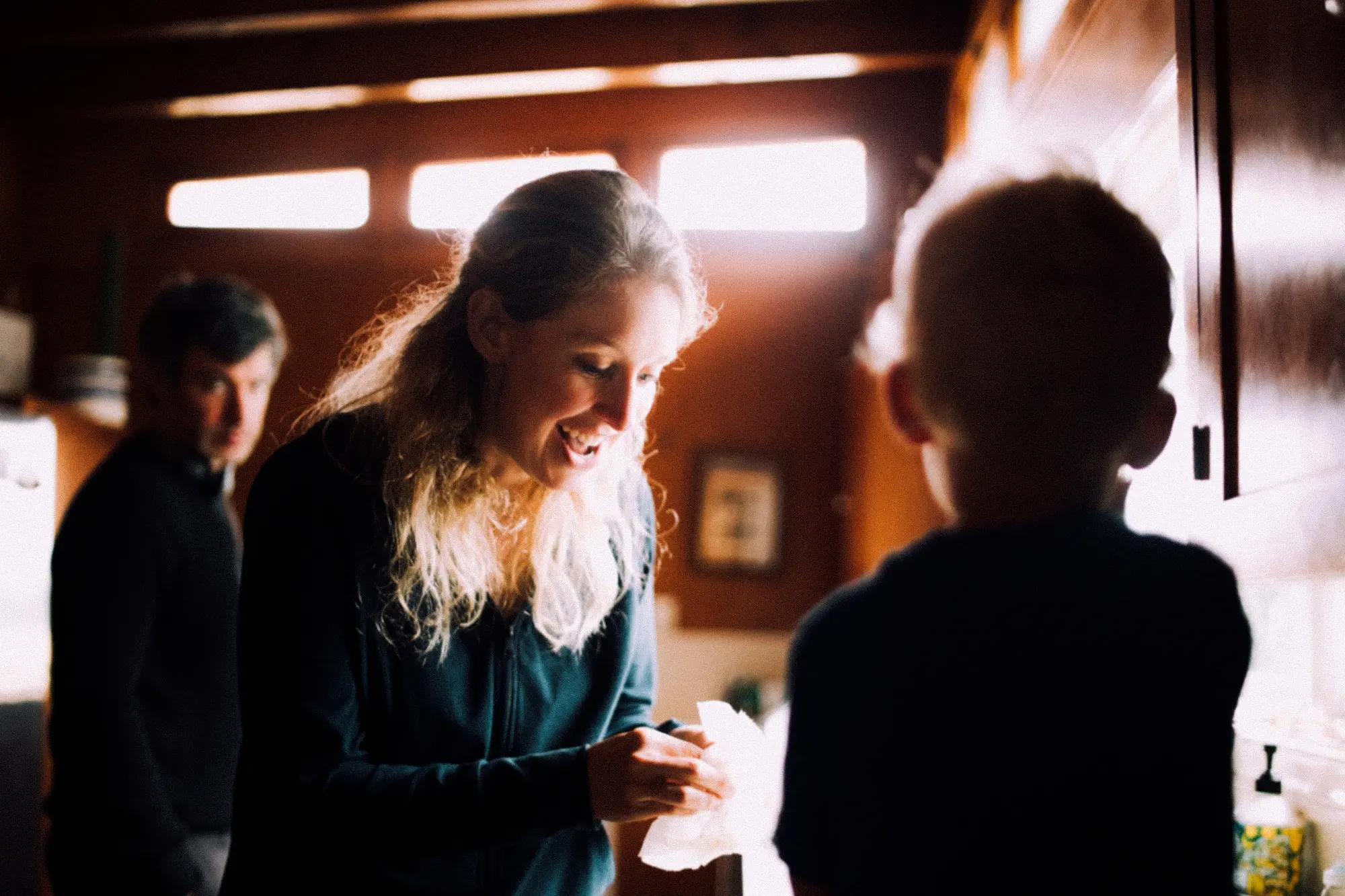
The proffer, all but whispered in our ears as an insiders’ secret, is to submit to a nearly full-access siege of interviewing and “observation”. The triggering ask was made directly to A24 by Holmes and partner Billy Evans; they signed off on bringing in the doc crew of “DOJ Cribs” scenario that would run from tentativeness to the doc maker’s suggestion, on the final day, that they could, well. “have sex” while he vegged out a bit miserably in the car. (One lingering moment has the filmmaker and post-billionaire ex-CEO seemingly contemplating a kiss? That try for a form of chemistry, for me, fell flatter than the formulating of unmagical blood box that never did work.)
The couple’s two small children—daughter Invicta, a babe in arms, and son William, then age three—are thankfully not peered at as more than atmospheric props, , thouguyh in certain slower patches I rooted for that big dog to give the A camera a sniff.
I guess the rip-snorter in what’s become a full-on media onslaught is was this week’s lead story from The Daily Beast: “I Was Elizabeth Holmes’ Prison Nurse. I saw Everything”. (Well-played on the title recall, Beast, on the way to certain details in what the story calls a “cringe-inducing” film.) Adding some crunch to the cringe was a sidebar thought that is but scantily reflected in. the film: “The steady, sparkly-eyed gaze that led some people to consider her a visionary now gave them cause to wonder if she was in fact a psychopath, capable of timing the birth of her first child to delay her trial and of the second to avoid prison time.” (The resultant ticket-selling vibe, not unlike Oppenheim’s recent scolding feature Primetime, is Fifties-style supermarket gossip sheets.) As the interviewee Noella Turnage frames it, ““I guess a lot of people figured she got knocked up so she wouldn’t have to go to prison, and maybe she did. “I guess a lot of people figured she got knocked up so she wouldn’t have to go to prison, and maybe she did. Who knows? I never asked her. But those kids are her entire world. I don’t know what she would do being separated from them any longer than she’s already gonna be.”
Of course, the relatively verdant Bryan facility is of the Club Fed level and legendarily rusticating there currently is sometime subject of public fascination, Ghislaine Maxell, for whom Trump’s Department of Justice made an exception after she agreed to a nine-hour sit-down with the deputy Attorney General Todd Blanche. (Is it just me or does Todd’s interaction with the press mob this week remind one of Breaking Bad’s Jesse Pinkman trying to talk some cartel thugs out of ripping open his nut sack with a plastic fork? Btw, I didn’t write that, I just gave Ai a prompt with a couple names and the phrase “administration weasels.”
One film scene that “nobody asked to see,” as the New York Times put it Billy Evans showing off his manhood. Oppenheim has confided that Billy blocked out is own shot by leaving the bathroom door and shower stall open to the film crew view—which seems to have cause said sex organ replacing relaced the malfunctioning blood analaysis machine as the film’s most-discussed fetish object.
Phew That trip behind bars was admittedly a bit cringe,. But it did eat up some column inches that might have been stuffed with some of the more highfalutin’ critical disquisitions that will be sampled below.
Surly and narcissistic as Billy may be, he is on camera a loving dad to his kids, when he’s not out at the gun range capping some targets with an assault rifle, or confessing to a predilection to having admired the late conservative thought leader Charlie Kirk ((buckle up for that convo with the film’s surprise guest), or sullenly telling Fielder how to make his own bed in the guest house, or you know, showering.
It's time to spare a thought for Alex Gibney’s two-hour, 2019 Theranos investigative doc documentary on HBO, which is more informative than the YCSE saga in manifold ways. The thought from here is that his current release Musk, if we want to handicap Oscar candidates, it will be richly more vital to our national discussions than the Holmes fare.
There is no real match in urgency; Musk is the danger. Start anywhere, maybe when DOGE began ripping apart several vital government agencies that were priorly essential to the more humane facets of federalism, or his sandbagging Ukraine by stilling the potency of their missile defenses as provided by Starlink, or doubling own on the expansion of the um, SuperIntelligence takeover in his client state Texas, impregnated an unfortunate harem who mostly hate him, and pouring his ill-gotten and absurd wealth into bludgeoning the electoral process with truckloads of money.
It becomes clear which doc outranks which. But hey, see both—learn how Billy is “excellent” at making love (and scrambled eggs-oh dread portent of another controlling egomaniac on the order of Balwani!) and fairly soon, if all goes well and Holmes is transferred into an Austin halfway house sometime in 2027, his thousand nights of celibacy may end.
Is this a great country or what? Thank goodness our more innovative filmmakers are keeping watch. Maybe Fielder will not be left to ponder his mood, after a confided-to-Holmes (and inevitably, to a camera) break-up, with only a bottle of doubtless fine room service red wine and a lonely vigil staring out at the grey mist of lonely Manhattan. A few SAG screenings and let’s polish up the dark-horse acting Oscar!
A look back, then, at how we arrived at this cultural moment through the stewardship of Team Fielder/Oppenheim.
The template for the trickster spine of Fielder’s approach revealed its key facets from the beginning of his career ascent in 2013, when he dropped his first episode of “Nathan for You”. Purposefully and necessarily lo-fi, in a register mixing archly satiric gags peopled by nominally real stooges who are enduring, with him, archly comic events. and less than two minutes in, he was pitching the manager of a struggling yogurt shop on a surefire traffic draw: "A crazy new flavor. The flavor is poo.” Asa tends to be the case with fielder, one wonders how he prepped the credulous merchant on the idea. As he put it: “The media responds to controversy—we know that. I feel like a poo yogurt story might be a news story to bring, like, hundreds of thousands of people in here.”
Subsequently, “The Rehearsal” series, in its HBO tranche took things all way up to Fielder piloting a plane, it showcased him as a kind of night-school-grad Borat.
The welter of admirers of You Can See Everything, an avid if slightly wary group. now filling every corner of clickable pop culture journalism, are kvelling about how he’s snatched the tablecloth out from under the documentary tradition
The trademark ethos persists: a cosplaying Nerd Shaman takes a manifestly bad idea and blows it up into a commercial and even…er, artistic success while we examine our souls for clues to what it all means.
Much has been made of the title’s possible misdirection. One might ask, as Fielder says of the inexhaustibly prevaricating Holmes when she smilingly won’t’ confess her fraud, “Why chose those words.” He posits himself (an old interviewer’s ploy) as a “bad communicator”—and maybe Elzabeth is too? It seems telling—in fact it’s a literal tell—that the actual verbiage she uses, if I can trust a note scribbled in the dark theater, is, “You can totally see everything.”
Most excellent, Deputy Van Halen! But that adverb takes some schving out of the bargain the movie hopes to make with us.
Fielder goes for originality, and we can agree that when he it gets there, and even when he overshoots, there’s a performative, tic-y flair to his work. Oppenheim is a find—he found himself, more or less, and is just 30. And at the readiest emotional level, you would need a heart of stone to fail to relate to Holmes as she fights to keep her family unified even from the slammer. (Plus, if you hold your nose over her deceptions foisted upon the general public, and without signing on a pro-fraud, do we relaly care that Rupert Murdoch will probably die before he gets squat from the. DOJ-ordered $135 million he’s owed in fraud reparations?
She’s not wrong that health care, and notably blood tests, should be democratized and streamlined. A great concept, no doubt others rather more clever than Billy and his Theranos 2.0 (dude, just no!) are trying to do the work her all-nighters couldn’t quite crack. And there’s another facet to her psyche.one her dad rightfully brings up in a filmed passage where her maximally edgy mom and blustery ex-Enron employee dad share their truths.
The one that ops out of dad is to me the film’s stunner—her reported rape by a fellow Stanford student seemingly went underinvestigated and almost surely under-punished. That to her dad was the key turning point of her life, and in a certain episode of Amanda Seyfried’s Emmy-winning performance in the 2023, eight-part Hulu Original limited series “The Dropout,”, the most impactful. (None of this is to ignore the domineering manipulative roie of Balwani, doing his own jail time for related offenses and deeply guilty of damaging schemes and behaiors in love—if that’s what it was—and commerce.
Sometimes a big bad-pitch swing can work, and at the very least YCSE is teaching us that. Digger would have no such luck, at similar length, deploying Tom Cruise in an art project from two-time Oscar winner Alejandro Iñárritu that slid down a trough of near-angry reviews (despite some pleading support from the likes of coming Cruise co-star Anne Hathaway and filmmaker savant Guillermo DelToro) into a rapidly shrinking amount of theater screens.
As to the till-now publicly occluded second half of Fielden’s extravaganza, let’s step carefully and say, here commence mild spoilers. The mere mention of Seyfried’s name, beyond her well-discharged duties bringing Holmes to robust life on the small screen, could raise issues. It introduces a rogue atomic particle, a free thinker who in this case takes over the film’s latter half.
In the Playa Del Rey theater where I went with my family focus-group, we impulsively got the last tickets available and were seated just a few yards away from Elizabeth’s unstoppable gaze (Kate MacKinnon did a scorching physical riff on that feature when visiting Seth Meyers’ show) ) as we waitied.. out… the…deliberate… beats of the fielder-Holmes stare contests.
Make sure not to express your boredom in certain company, I warned my squad. Nobody’s coming to save you from slighting the film’s embrace. Even the usually more acerbic Richard Brody of the New Yorker finished off his aria of high regard by stating, “the film is more than fascinating and ingenious; it’s strangely, poetically, poignantly beautiful… achieves something even more surprising: a rational sublimity, a twist of conceptual beauty, like an equation that proves the existence of love.”
Brody can be the best level of professorial prose stylist, but even in his hands the word “beautiful” is hard to fish out of the muck of Donald J. Trump’s mental swamp.
In the almost bewildering array of reviews and mini-features and the volley oflisticles spading up tidbits and oddments of the picture’s conception, execution and pleasures, YCSE is a hit in every sense. (At this writing it had won Monday over The Streetfighter, for a still-tallying box office of over $18 million against a budget of seven million. The rare slighting reviews, the welcoming coverage has implied, are from a a handful of sourpusses who wrecked its chance at the seldom-attainable 100 percent critical score on the aggregating sites.
One such voice was Time’s Stephanie Zacharek, who on occasion veers past the critical cossetting certain films with big thoughts may receive: ”This a dense picture—there’s almost too much to unpack, if you can be bothered to care about any of it…[YCSE] has been widely praised as a groundbreaking documentary work, one that will change the face of nonfiction filmmaking forever. Not so fast.I’ve never seen eyes like this, except on creepy European-made porcelain dolls from the 19th century. Are we seriously going to trust this woman?”
Co-director Oppenheim takes a slap, not for his recent Primetime, as for “docs like the 2020 Some Kind of Heaven, which turns a sarcastic eye on the Florida retirement community known as The Villages—the ultimate in shooting-fish-in-a-barrel filmmaking. It’s hard to say who’s more responsible for You Can See Everything’s stultifying smirkiness, at least in the first half; these two are clearly of like mind."
Zacharek buttresses the critique by name checking the genre’s pantheon of great documentary filmmakers—including Wiseman, the Maysles brothers, Agnès Varda, Werner Herzog, etc.—who in their occ occasional intrusion in their own work have “only reinforced what distinguishes a novelty from a work of genius, mere cleverness and snark from true depth of perception.”
Whatever the depth, the film keeps an intriguing surface as cinema, with cinematographer David Bolen, keeping the lens at an almost furtive distance at times, then bearing down on the moment with insidiously slow zooms. Voices come out of the ether to inculcate such moods, as Fielder keeps his headphones handy to monitor random microphones.
In any setting, the next face-to-face encounter is never far away. Fielder paws at Evans for the true history: “Weren’t you worried she was sort of, like, scamming you?” he asks, reminding Evans of the family’s real estate wealth.
Holmes is hardly spared; she and Fielder debate a quote from a 2023 New York Times profile, when she was asked about “The Inventor” in particular: : They’re not playing me. They’re playing a character I created.”
Their own “trust” and truthiness are not fungible to this couple, they’re mantras. Evans credits her insistence that she can’t remember telling a single lie: “She’s really weird,” he tells the man who himself fully knows from weird, “She’s just not normal.”
Holmes still hasn’t blinked. She has indeed broken Fielder’s stare, and in her public pronouncements since the film has hit, he frets about that. Filmmaker and subject each have their own brand of “not normal.” Which, in a world where the floor seems to be sliding away under us, may be the best explanation for our culture’s fascination with them both.
Comments ()