
Woody's Legacy Runs Straight On to Bruce in a Sharp PBS Doc
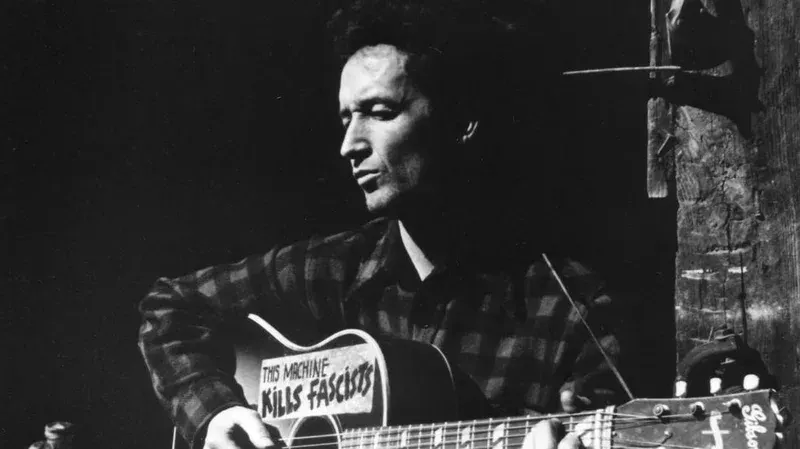
Now, Tom said, "Mom, wherever there's a cop beating a guy
Wherever a hungry newborn baby cries
Where there's a fight against the blood and hatred in the air
Look for me, mom, I'll be there
Wherever somebody's fighting for a place to stand
Or a decent job or a helping hand
Wherever somebody's struggling to be freeLook in their eyes, ma', and you'll see me"
When Greg Mitchell and I reconnected on a phone call this week it summoned up strong memories of cherished mid-Seventies history—moments from when he was a top editor and I a contributor to the fondly remembered Crawdaddy magazine. I think we both had an opening line in mind, but I think he said it first: “It’s only been fifty years or so.”
You could call it an OK-Boomer moment, but the occasion arrived not borne on nostalgia but because Greg is still doing what he began doing back then—casting a deeply informed and humane eye on matters in the arts and the body politic. I began by expressing admiration and a kind of envy at the productivity shown by his track record—14 books (including the classic Campaign of the Century, on the media assault aimed at Upton Sinclair’s 1934 gubernatorial run), a steadily re-booting conversation with his blog followers, and also, most topically for this post, his five films for PBS since 2022.
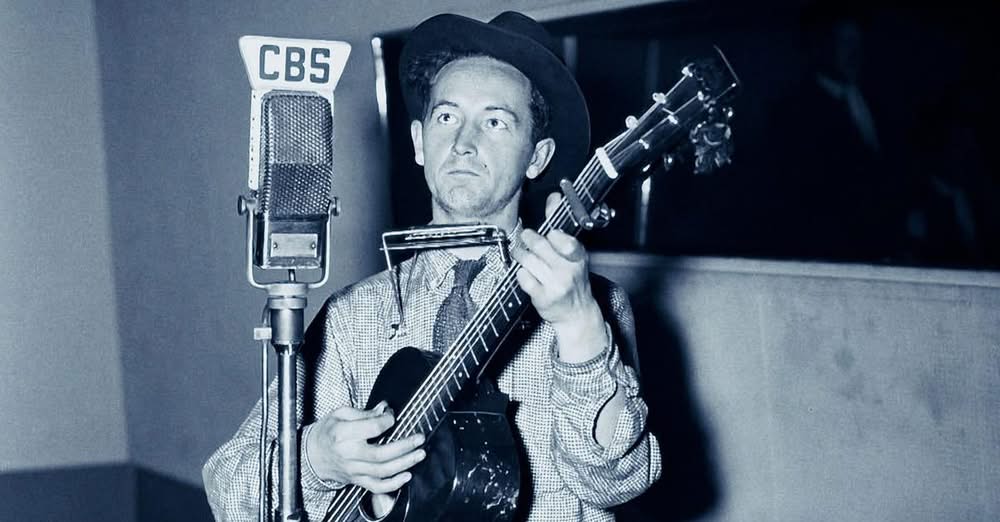
The topic today is his latest film, currently available on the PBS site and airing over PBS stations all summer:
https://www.pbs.org/show/woody-guthrie-and-the-ghost-of-tom-joad-today/
…at a compact but inspiring 56 minutes, there has been plenty of praise from the truly knowledgeable commentators.
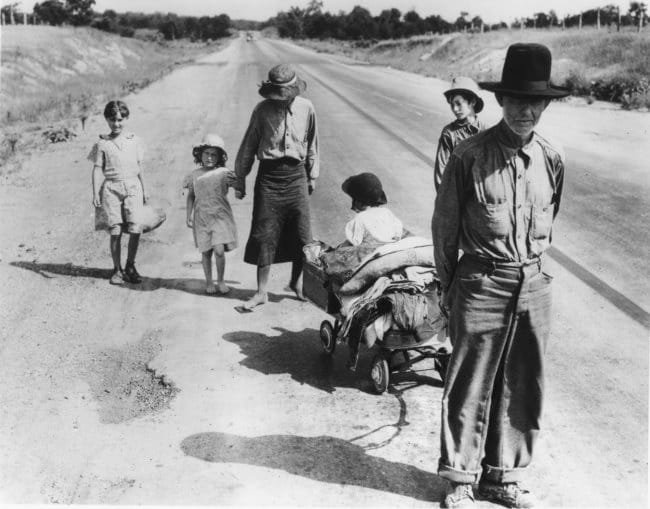
As narrated by Rosanne Cash and with a key capstone featuring the Bruce Springsteen track, “The Ghost of Tom Joad,” Mitchell’s only-too-timely doc comes in just under an hour as a visually arresting history lesson that forges link between the struggle of migrants then and the immigrant population now.
Even if you grew up knowing something of the repressive structures that exploited and all but enslaved farm workers in America’s fields and factories, you will surely find yourself moved by Mitchell’s judicious selection of visuals and he and his team’s deft editing choices, often with Guthrie singing as a sort of commentary.
The film depicts the intertwining paths of two national icons who left us lasting works to ponder--songwriter Guthrie and novelist John Steinbeck (who wrote The Grapes of Wrath, with its central figure of Tom Joad)—as they forged a bond in a campaign to ease the suffering of migrants in California, and their legacy today.
As the film traces the deep-set prejudice and greed that continue to impoverish and endanger the people who grow our crops and ask for the merest living wage and thje freedoms set out in the Constitution, the images march towards the present day of ICE terror campaigns on our streets that link Mitchell’s long-held activism back to Dust Bowl days and up to date with the current campaign that seeks to drive off the very population that is needed to keep the K-shaped economy ticking over.
As David Corn of Mother Jones notes in praising how the film captures half-buried history, "the singer-songwriter gave voice to the Dust Bowl refugees, immigrants, and itinerant workers exploited, oppressed, and assaulted in the fields of California. But the film goes beyond depicting this important history and draws a poignant connection to the plight of migrant workers today and the cruelty and brutality they currently face from ICE raids and Trump’s anti-immigration crusade.”
One citation that feels especially striking is from historian Will Kaufman, who extolled the film's “great, unfamiliar footage and song versions, the fruit of excellent research and detective work,” and found the film fearless in its contemporary critique.” Author of two extensive studies of Guthrie, not long ago in the archives of the Woody Guthrie Center inTulsa, Oklahoma—which recently celebrated the film with a screening and event—he was researching unrecorded lyrics and song ideas in the archive when he found a Guthrie work-in-progress that mocked Guthrie’s early-Fifties landlord in Brooklyn’s Beach Haven development. ,
Th unpublished lyrics by Guthrie slagged Fred Trump, (“Old Man Trump” in the songwriter’s scrawled re-jigger of “I Ain’t Got No Home”) who was sued several times over the years for alleged housing discrimination.
Sad to say, not much has changed since. It may be our nation’s bad luck to have a second—and now a third Trump generation, with the mob-boss dad and the grifting offspring growing rich. But all credit to Greg Mitchell for stirring up pushback with such passion and craft. Herewith, our talk this week:
Greg Mitchell speaks with Dogtown.press:
You were doing this before it was cool to worry about the Constitution. Now, I exaggerate, but you were holding a standard up when some people weren't bothering– all before we realized the present crisis is so overwhelming.
I’ve had a pretty straight line my whole career going back to 1970 at the legendary Zygote magazine, almost everything I've done has been involved with politics and media; even at Crawdaddy, I was the politics person and other jobs I've had since then, and books I've done, and now films. I've done five films in the last five years for PBS, and they're all, I’d say, historical/political.
So I’ve been fortunate or lucky, to be able to stay on that path--to be able to write books, or do these films, or even my own newsletter, kind of stay with it.
It never struck me as being that out of step with a lot of other people, but I guess at times it was. Just what interests me. I didn't think I was going to become kind of a quasi- historian, but I guess that's been most of my projects for many years now, with no advanced degree, that's for sure!
From those early days you—and your colleague Peter Knobler—were all in for a guy named Springsteen. So I’m not too mystified that he lent his highly topical song to the documentary.
We do have a long history, and Crawdaddy did the first national article and first cover. In past couple decades I've had great dealings with Jon Landau, and he's passed on things I've written to Bruce, and things like that. And for the book I did in 2008 on Iraq war and media failures, Bruce wrote a short preface for that book. So anyway, so just had always had good feelings and back and forth, but never really hanging out with Bruce or anything. Then I had the idea for this film, and I had hope pretty early on that I wanted to use Bruce's song, if possible.
Of course Sony had purchased the Bruce catalog and would be holders of the keys to any song rights. That could have involved some real money…
I sent the film’s early cut to Landau, who shared it with Bruce, and they thought it was fantastic. So they, let's say, eased the way so that I could afford the fee for using three and a half minutes of the song. The Guthrie family was also very very generous.
The film offers such a throughgoing and vivid sense of Woody’s life and times by digging so deeply into his music as he responded to national events and upheavals, with the film using such deep.access to his music and art and other archival treasures.
The key thing is that it's PBS, all my films have been for PBS, all my films have been self-funded. I haven't taken a grant, I haven't taken a corporate sponsorship, and they're all very low budget. They may not look low budget, they may look like, well, pro.
But I haven't taken a penny from anyone, so I have had complete independence on these films, and they've only gone to PBS, they haven't gone to Netflix or anything like that, so people see that it's an “educational” effort. So when people do charge for it, it's usually a very low rate. So that's how I've gotten around having no backing.
You’ve found some politically astute and empathetic people who lend support and materials. It saves a lot of paperwork and pitching.
For the last five years, I've done one a year; I'd rather do it than talk about it, or you know, go out and beat the bushes for it.
The Dorothea Lange pictures convey incredible power, and something you and your editors did that was so smart, the images linger a little bit on screen. With the music underneath at times, and the voice-over via Roseanne's great narration, it's so smoothly meshed.
And that’s s a good example. Dorothea Lange's photos are all free from Library of Congress, and also other Farm Security photographers, were working for the government, and so all their work went in the Library of Congress. They're completely free.
Arthur Rothstein’s pictures would be another notable example. And I understand you’re friendly with his son, Rob Stoner, who of course played guitar for Dylan on the Rolling Thunder tour, etc.
Rob is practically a neighbor. He's a good friend of mine here in Nyack, and his father, Arthur was one of the other most prominent farm security photographers. There's several of his photos in the film, and there were several of his photos in my earlier film on the Memorial Day massacre.
Something that keeps the pace rolling is the absence of er, noted commentators who typically for docs are offering what are meant to be deep thoughts.
As you may have noticed, I've never done talking heads. No one ever gets interviewed. I don't have to pay a sound man or a camera man or anything. I'd rather just search for footage and photos and work with my editor, and get a great narrator—that’s been surprisingly successful.
A through line in the doc is the interconnection of the key figures with a real shared humanity driving them—the John Steinbeck connection with Woody, and the empathetic and committed journalists and radio stations and the newspaper publishers. It’s such a reminder that that kind of cohesion can happen around people with the humane values.
Look at Springsteen doing the tour he just did. Which I was not counting on when I was doing this film, and so what becomes one of the two or three highlights of the set on of the tour, was doing “The Ghost of Tom Joad” every night, with Tom Morello.
The song has never been considered one of his greatest songs. Now, I've always been a fan of that song. I've always loved the electric version as well, and, but I had no idea it was going to like become centerpiece of this tour. Nor that Woody himself was going to have such a moment in this past year with “All You Fascists Bound to Lose,” and “This Land is Your Land” becoming practically the anthems of No Kings rallies, and the anti-ICE and anti-Trump rallies.
I think the most poignant and impactful part of your film is the attention given to Woody’s great classic “Deportee,” which still resonates so strongly and especially with Trump’s ongoing racialist moves still landing hard on immigrants, refugees, and more.
Every day there seems to be a new version. Margo Price dropped a version this week with Joan Baez, after Lucinda Williams earlier this week and many others this year. I wrote about the song last summer, even before I started this project, as one of my favorite songs ever. I wrote a piece that got a lot of pickup on the actual history of the incident that inspired it, and how and why Woody did it.
And then Rosanne Cash started doing it. I've been friendly with Rosanne for quite a few years, but we certainly re-bonded over Woody and “Deportee” and so forth, so I had the courage to ask her to narrate, and she did it, and she went way beyond the call of duty with the amount of time she put into it.
It's such a pleasure, you know, Woody is so much a part of so many musicians' lives and other people's lives, and so admired as an icon. People just love him, which makes it kind of easier for people to donate things, to make a film possible, because of the admiration for the guy.
Which particular moment in the film may have made you say, 'Oh, that's what I was shooting for, that's where I wanted my feet to land?
I knew that I had to bring it up to date, and that the film had to have relevance for today. I knew that Steinbeck and Guthrie writing about migrants and immigration would do that.
It’s a life full of deeper meanings for the country, but you also wanted to keep the man himself in close focus?
The film could have ended with a long take on this one photo of him with his family when he's obviously much older in the hospital. It could have ended there, and still a lot of people would have thought, boy, that's really relevant for today.
But I knew I wanted to, make it more explicit and powerful and dramatic, to really hit more for today. So, I always planned to have what you might call almost an epilog, bringing those issues up to the moment.
But I wasn't quite sure how I was going to do it. Then a key decision, so crucial for the film, was deciding that I really wanted to bring Bruce's song into it. Okay, how could you illustrate it, or would you have Bruce maybe to have him singing it, into the camera? And then for the three and a half minutes we used just to have photos and footage with it, and no narration or anything--just end it with that. I made those choices, and my editor executed them.
It's not didactic, you fade into it, and I think it does blow people over. It really does.
The importance of the music ties in with an accesibity it has–-it sells itself-– but did you ever have doubts as to, were these old tracks too pared-down for people who are used to 48 track, digital, squeaky clean, are people gonna feel that?
Yeah, Woody's music is pretty basic, and so the lyrics have always been the most important thing, and we saw this with, you know, the Wilco/Billy Bragg Mermaid Avenue releases, they took his unrecorded lyrics and made a lot of great-sounding songs. I think it was apt that the lyrics were out front for that.
If you dive into Woody at all, it's like going down the rabbit hole. He had produced so much cool stuff, and he was constantly writing, hundreds and hundreds of lyrics, poems, and also Bound for Glory, his sort-of autobiography,
There’s also artwork, he was always painting and drawings, and writing columns, and never ending, and then his comments on songs, you know, song books, writing about the background of various, folk songs, an incredible amount there, so I think it might be apt at least to make a claim or a reference to him as being kind of our [latter-day] Whitman.
There's just a lot to him, more than people think.
Of course Dylan was hugely influenced.by him, as the recent biopic reminds us, but their connection comes after the, shall we say, glory days of Woody coming into his own.
The film shows pivotal times, in California, and then the move to New York, and when Woody became Woody, I guess you'd say, and he's remained Woody ever since, unlike even Steinbeck, who after this kind of went in a different direction, actually became a Vietnam War hawk and more conservative.
Just the character of Woody is so appealing. Some people say Woody created the character and got good results, so he stuck with the character, but you know, I'm also a huge Will Rogers fan, and Will Rogers was God for Woody, who was on this lefty, populist, trail, I think, from the beginning.
It was interesting for me to chart that progress, because Woody did not come to California as a full-blown lefty, and he just moved along that path.
Having just finished a major effort, is it too soon to ask, what might be next?
There’ going to be a screening at the Springsteen Center in New Jersey, so talk about going full circle--don't have the date for it yet, but the great thing about PBS is, rather than just showing for a week somewhere, maybe it'll come to your town, and then, people want to know, “Well, How can I watch it?” But with PBS, it's streaming, and you can say, "Actually, you can watch it tonight if you want, and it's only 56 minutes!”
For RS subscribers who can vault the paywall,..my review of Bruce's "Tom Joad" tour from Rolling Stone in January 1996:
 Fred Schruers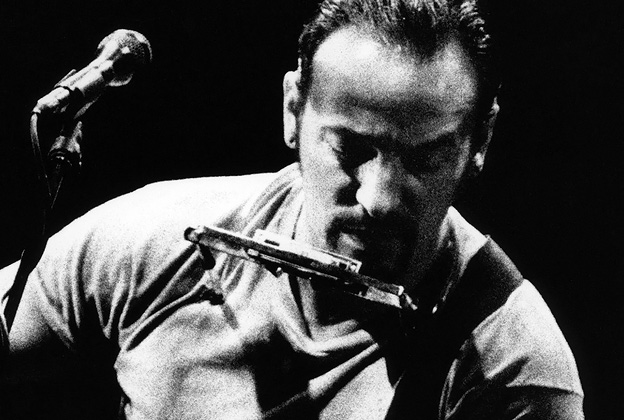
Rolling Stone
MUSIC: BRUCE SPRINGSTEEN FINDS “A SENSE OF PLACE”
On the road for 'The Ghost of Tom Joad,' Springsteen reflects on isolation and newfound purpose
By FRED SCHRUERS.
FEBRUARY 6, 1997
Bruce Springsteen
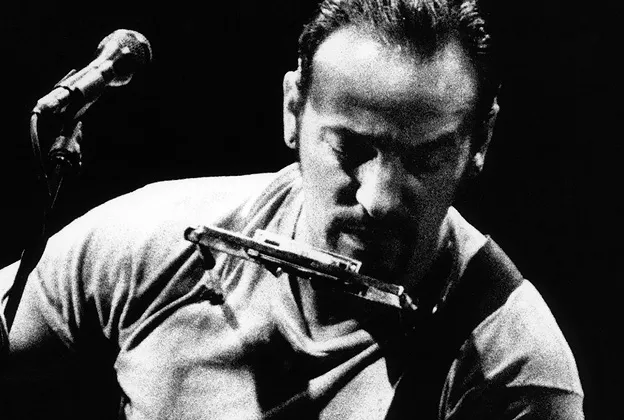
SUNRISE, FLA.: “Don’t make me come out there and slaaaap that tan off ya.” Bruce Springsteen‘s warnings to potentially restless crowds tend to have a local flavor. In September 1995, he began his tour in support of The Ghost of Tom Joad by telling a Los Angeles crowd to turn off their cellular phones. Here at the 3,968-seat Sunrise Musical Theater, in early December, some 100 shows later, he’s still asking for quiet. What’s changed is that a show he admits was initially “austere” is now a kaleidoscope of jokes, shaggy-dog stories, paeans to cunnilingus and, yes, plenty of the brooding, socially conscious fare that marks the album.
If a few fans out there still holler for “Thunder Road” (one Floridian reprovingly shouted, “Rock & roll,” mid-show, before exiting), most are attentive as Springsteen works with his 17 acoustic guitars, his harmonicas and a vocal attack that now includes an evocative, high-pitched keening. He will rock, slamming out a percussive “Johnny 99” or “Working on the Highway,” but pointedly deconstructs certain old rockers like the much-misinterpreted “Born in the U.S.A.”
Sitting backstage after a strikingly eclectic set on his second night at Sunrise, Springsteen notes, “Tonight was a bit experimental. I’ve tried to rearrange a lot of the Darkness [on the Edge of Town] stuff, because it was some of the first adult music I wrote – really about people hanging by a thread. That music fits real well into what I’m doing now.”
Springsteen has gained momentum from events along the road, including a benefit for the John Steinbeck Center, at California’s San Jose State University. Days later, he performed at a Los Angeles rally against the California state proposition blocking affirmative action. (Jesse Jacksonstood beside him as the singer warned, “The seeds of racism and injustice do not sleep.”) And in places like Fresno, Calif., and San Diego, backdrops for current, edgy songs, he jabbed at then-campaigning Bob Dole.
Springsteen is aware that some found his sobering record to be an arbitrary departure, but he explains, “[Tom Joad] wasn’t that different from the legacy of my own family. My parents struggled a lot. The material followed ideas that I started out with – things that bothered me, and I wrote about them. You’ve got to find your own isolation, your own sense of being between the road and the void. . . . After that, what else does a writer do? He looks around.”
What Springsteen found, he says, is “a sense of place” – namely his adoptive California and the long scar marking its border with Mexico. His sets close with a suite of brooding songs from Joad. The show’s reflective stretch can be “challenging,” he admits. “I’m trying to hold my place and write about the things that I felt were, and still are, important.”
The newest song in Springsteen’s repertoire was introduced with a mention of his wife, Patti Scialfa. It’s a plain, pure love song called “There Will Never Be.” “I never played anything quite like that before,” he says. “It’s been a long time coming.”
Springsteen’s last trips to his other home, in New Jersey, were for a benefit show and then a trio of homecoming gigs in Asbury Park, with one set featuring Scialfa on vocals, Soozie Tyrell on violin and Danny Federici on accordion – a possible preview, he confirms, of the next record’s instrumentation. “I’ve got probably half a record,” he says, “and I don’t know if it’s any good. I’ve got to wait and see, record it and hear it back.” His reunion with the E-Street Band was “fun” (“I love the guys – if I was going to go out and play with a rock band, that’s the one”), but don’t look for a major reunion soon: “I’m not sure exactly what I’d do that would be new.” Studio plans aside, Springsteen will play a series of shows in Japan and Australia early this year, after which he’ll probably tour further in the States. “I certainly don’t feel like stopping now,” he says. “I feel I have a chance to be a fresh force with these things . . . fundamentally drawn from my personal emotional experience.
“There was a period after 1985 where I didn’t know if I’d write about them again,” he continues. “I didn’t know if I had anything new to say. And then, with this record, I really felt a deep re-connection to that part of my own life. And, you know, 30 years down the line, I feel pretty lucky that I’ve got a job to do.”
This story is from the February 6, 1997 issue of Rolling Stone
Setting Up the Paywall
- Open the post you want to edit.
- Click the
+button in the editor or simply type/paywall(or/public preview) on a new line and press enter. This inserts a divider line. - Everything above the line remains visible to all visitors. Everything below the line will be hidden behind a subscription/paywall prompt.
- Open the Post Settings menu (the gear icon or the sidebar in the editor) and set the Post Access to Paid-members only. [1, 2, 3, 4, 5, 6]
Comments ()