
"Wild Horse Nine" Rides On the Acting
How to bear down on a movie take, on this election Day 2026?
At a time of kinetic—if botched—regime change by the Trump administration, with mutterings about a post-election cyberattack, or even, you know, limited nuclear war, is this the moment to talk about a mere movie?
Turns out the relevance of this film about regime change, Martin McDonagh’s Wild Horse Nine, is grimly on point. Is it a fell irony, or a hopeful one, to see the coming weekend play out with a buddy Western (-ish), that hews back nearly seven decades into an array of CIA-effectuated leader sackings by Empire America?
Yes, we’re also devoutly wishing that vote tallies will bring home a sane-pol landslide the day after the most promising electoral moment the nation has seen since Trump was dumped in 2020. And yet to believe that not just the House but the Senate could flip feels like a prelude to a swift slap in the head.
Whatever the vote brings, we know the Stephen Miller/Elon Musk/ Project 2025 takeover of the national agenda is rooted very deeply, if only because they’ve so profoundly cracked and strewn the governmental agencies and infrastructure that used to nurture meaningful and pluralist life in America.
The pool boy's new endless war has been joined by Trump’s la-de-da capitulation to the AI tech edgelords, who threaten an implosion even as their spending ramps up toward a cataclysm run by bots. I have never seen such pessimism among my own aging cohort. Portugal doesn’t want us, and few may chance a move to Mexico to await the post-apocalyptic kidnappings. As I was writing this, a longtime English friend called to say his countrymen had been cautioned to lay in supplies in the event of cyberattacks that might be post-election offshoots of Trump’s Iran war.
We look at the generation we’ve left to a jobless future and tell them we’re so sorry, but we gave up on the climate and you’ll never own a house. (But oh yeah--there are still some cheap rentals, that may ride out the next spate of coastal flooding while the wave of AI enhances—oh, sorry, we meant destroys—your future and fattens up the oligarchs.
McDonagh’s latest chapter in what’s been called his “Beckettian bloody buddy movie” gaggle back to what was actually a simpler time, when a few guys who went to Yale as legacies quietly controlled the fate of various Third World nations. But the throughline remains evident. It may be that Claude has taken over the strategy piece of toppling leaders, but the agenda continues: the manifest global destiny enforced by the Central Intelligence Agency, the bloody coups sponsored all but covertly in Guatemala or the Congo or Chile, as personified in the film by John Malkovich’s fading , C.I.A. covert operator Chris Carlisle.
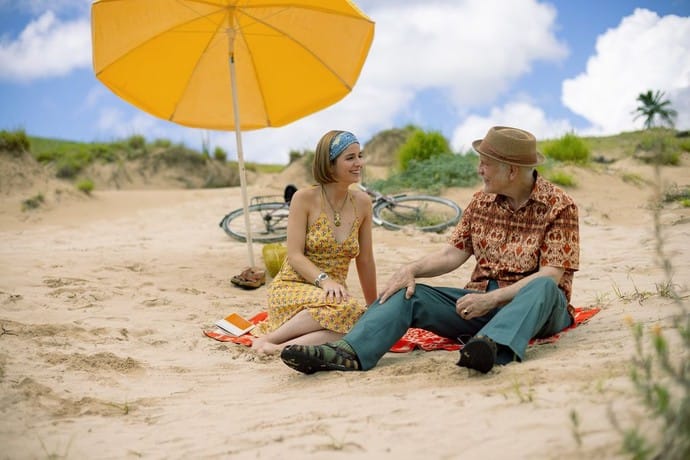
It’s Chile, in autumn 1973, just weeks away from the overthrow of Marxist Salvador Allende, where Martin McDonagh’s story is set. Malkovich has become such a symbol of mankind’s tendency toward the louche if brainy id that a mere pursing of his lips—a tic we see in scene after scene—speaks volumes about our national complicity. We’ve been beaten down by the dominations of POTUS and SCOTUS and that miserable little dick Mike Johnson to the point that we almost don’t feel the linkage with our present fears and half-ignored sense of shame.
For what is the Iran boondoggle, to repeat the thought, but a cruder, infinitely stupider stab at regime change?
And who is likelier to commit an irrevocable and moronic nuclear disaster than the Great Catastrophist, as he looks forward to senescence, revelations from not-totally-buried Epstein investigative paperwork, and the open contempt of all but his shrinking minority of idiot loyalists?
At the Venice press conference, energized by what some would call an initiation of Oscar hopes—a 13-minute standing ovation—one journalist asked Malkovich if he saw, in the film’s plot that presages the imminent fall of Allende, certain similarities to Trump’s snatch-and-grab of Venezuela’s Nicolás Maduro. Per the statements of Marco Rubio, given dismissive lip service by Trump, the scheme was to guide the country toward a return to the populist stewardship of opposition leader Machado. What the New York Times’s Michelle Goldberg called “imperialist gangsterism” was of course sooner a scheme to expropriate the stash of fuel reserves Trump wanted to control. “Yeah, we are taking the oil” was one Trump insider’s depiction of the raison d’être.
The links to wet worker Chris are thin but real. As reported by Vulture from a press conference at the Venice Film Festival:
“A Spanish journalist asked the cast and crew if they saw any parallels with the events of the film in the United States’ forcible removal of Venezuelan president Nicolás Maduro earlier this year. Malkovich sat in silence for a few seconds, before pronouncing himself unable to think at the moment. McDonagh declared the real frightening thing about these operations was that ‘they don’t seem to be making it covert anymore.’”
Elongated standing ovations at film festivals have become such an unreliable metric for assessing films that haven’t escaped the prestige terrarium that they’re almost an indication of dawning promotional hubris. A recent industry screening of the film in West Hollywood’s Pacific Design Center, for a full house of some 300 people, drew an eager crowd. As Malkovich luxuriated in delivering Chris’s cynical, all-too-confessional pronouncements, flustering Rockwell’s Lee, who sought to hush him up, there was welcoming laughter. We may all have thought we were in for a rollicking farce.
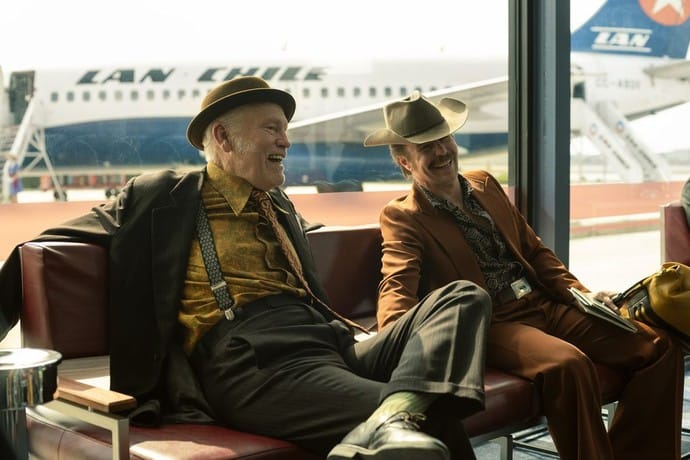
And though there were comic-monologue moments in abundance, including what’s becoming a much-remarked-upon disquisition on the better cheeses offered in “gay countries” (France and Holland, but certainly not Russia), the film labored a bit in the late middle. We realized that weaponry in a McDonagh film’s first act most certainly tends to be deployed before it all ends, Lee scarfs sandwiches, and Chris savors his own blocked remorse. (Mind you, it’s reliably near-peak Malkovich. There’s a mute poetry in how he flips a cigarette, how he drops bon mots with slightly opiated élan, even as McDonagh strains to interest us in Chris’s sporadic dictation of a memoir. The opening chapter is much about dinosaurs, but in dialog scenes Chris lends some expository detail to such tidbits as a palship with a doomed Patrice Lumumba.)
McDonagh and Rockwell have both remarked that McDonagh’s works usually have a truth-sayer, and Chris shares just glimpses of his inner truth. (There's a moment of fraternal love being reawakened by Tom Waits as his brother, right down to the John Ford open doorways overlooking Monument Valley.) We fidget in our seats and wonder if the operatives’ predictions for a gruesome takeover of Chile by Pinochet thugs is effectively aided by the work of our often-feuding besties. .
As early as the initial hop from Santiago to Easter Island for the duo, the comfortably loony Chris is spreading dirt about his own black-ops career, past and present. “We came down here to destabilize your government,” Chris blithely informs a pair of students (Mariana di Girolamo and Ailín Salas), “and it is going great.” And then he caps the bad joke: “Enjoy him while you can, ladies!”
Is the timing right for an Oscar for Malkovich, for years of time served, and yes, for another class-A portrayal? I got to meet the man on the set of The Great Buck Howard (2008)—and what better casting than to offer up a Kreskin-style illusionist?
He’s the most cordial of men, and easeful in his work (“I just get out of the way,” he recently said to the Times in describing the process of finding a character’s depths). And yet, when I was told he and I would now chat during a company move between sets, I felt unnerved. Sufficiently so that when it was time to approach, I fumbled my cell phone straight into a large cup of beverage—the Arnold Palmer at my feet..
I wasn’t sure how much he had witnessed as I fished it out, but as we seated ourselves in his assigned vehicle—a Prius, mind you, because he walks his eco-conscientiousness as he talks it—I found it gracious that his expression bespoke a private joke several layers deep.
When McDonagh debuted In Bruges as the opening-night film at Sundance in January 2008, he told the Times, “It’s kind of a black comedy about despair,” adding after a pause, “I don’t think they’re going to put that on the poster.”
He was nominated for an Oscar for the screenplay (and won the BAFTA), and perhaps didn’t realize that he’d set what’s become a template. With Colin Farrell as the tormented younger hit man and Brendan Gleeson the elder, Ralph Fiennes played the wildly angry and profane superior. By Three Billboards Outside Ebbing, Missouri (2017), Woody Harrelson steps in to share time as the mentor of sorts, with Rockwell as a bitterly haywire cop and Frances McDormand as the truth-sayer.
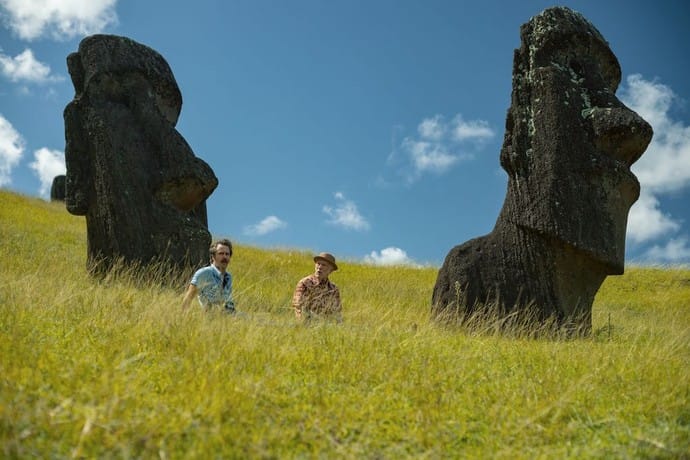
As we now know from McDonagh’s body of work, shades of what came first in his oeuvre are rampant. And Wild Horse Nine also shares a phenotype—the old dude (Brendan Gleeson) and young dude (Colin Farrell)—with the despairingly comic The Banshees of Inisherin (2022), now adding in the vibrant landscapes of Rapa Nui (or, as the initially rusticating Chris and Lee insist on un-wokely calling it, Easter Island). Much business is made of the big heads of yore, seven centuries old and the chief draw to an island that’s as remote as almost any spot on earth, a point made by Parker Posey in the panel after the L.A. screening.
The contested area of Wild Horse Nine’s reception is whether—and this is not a new struggle the pundits have had with McDonagh’s bleakness streak—real-life death and mayhem, are too dark to envision even in tragicomedy. New Yorkreviewer Bilge Ebiri found much to like but wondered if the film “possesses the complexity to really wrestle with” the deeper questions about guilt, regret, and an arc toward some kind of redemption.
The hints come early on that Chris not only knows all, but was a chaos agent in, the John F. Kennedy assassination. This is a kind of murk many Americans may not want to walk into as we suffer under the worst president ever.
Americanness, said the Guardian’s Peter Bradshaw, in contrasting that with Irish settings, “can bring out something less interesting in McDonagh: more violence, more strenuous sweary machismo, less comedy, less charm.”
The New Yorker’s Justin Chang found the Dallas thread—involving a missing rifle as the plot’s MacGuffin—means “the tragedy looms heavily, but also with an air of jokey inconsequence, over Wild Horse Nine.”
Few other reviewers—the critical metric hovers in the mid-90s—were as unaccepting as Chang: “Ostensibly, the film is about the mixed blessings of friendship, the soul-corroding nature of violence, the horrors of U.S. foreign policy, the possibility of redemption, and the inescapability of death. But it’s the stiffest, least cohesive film on those subjects you could imagine.”
Malkovich, who has performed onstage in a novel-into-play adaptation of that historical moment, had a ready answer for the Times interviewer: “Don DeLillo, who wrote the book Libra about the Kennedy assassination, referred to it as the seven seconds that broke the back of the American century.”
He added that he isn’t interested in defending Chris: “He talks about people sinking their claws into him, but these characters are the claws. So here you have people who are personally responsible for killing all kinds of rather important people.”
He’s not been precious about the trampled history: “They’re kind of these two quintessentially American jackasses.”
Deepening the potential pathos is that Chris has a clearly terminal cancer—we see the same visuals that dramatized Woody Harrelson’s Bill coughing up blood in Three Billboards Outside Ebbing, Missouri—and he’s been lobbying Lee to finish the job.
Their work together is top-notch, of course. As Rockwell said of his scene partner in a New York Times interview, “The thing that makes him really special is that he has the yin and the yang of femininity and masculinity. Meaning he’s got this almost primate masculinity and this kind of vulnerability, femininity of a ballerina at the same time.”
(Without spoiling any of it, the quite entertaining plotline involving two female stars, in a curious story algebra that intersects with Buscemi’s M.J., is stacked up quite explosively in the film's latter moments. Of a dangling threat incorporating the borderline frenzies of Parker Posey as Lee's wife doing what Parker Posey customarily does, no conclusions are offered.)
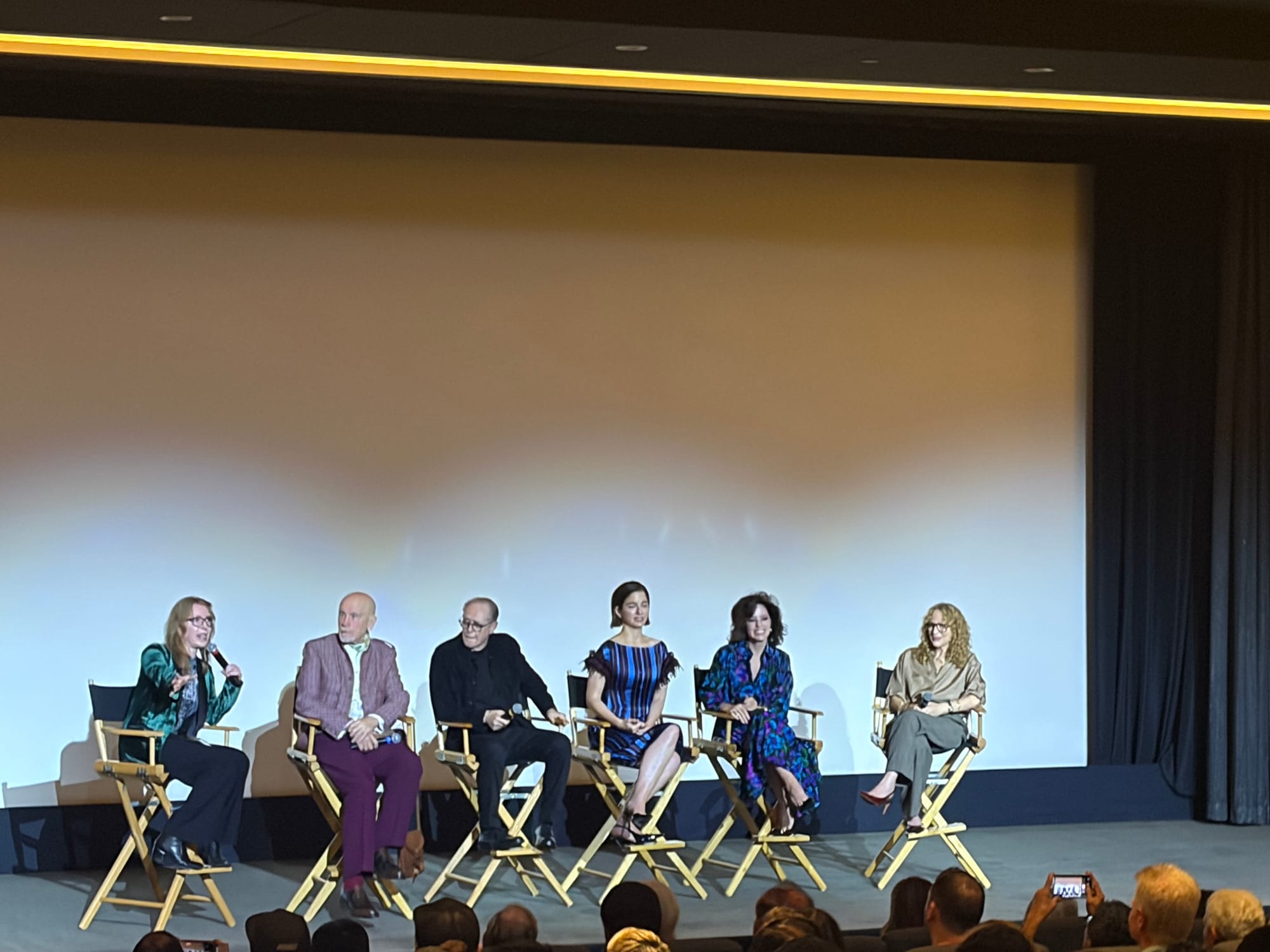
In the panel, Buscemi kindly sprinkled in a mention of his earlier history with Malkovich on the wonderful trash/classic Con Air (1997). He remains amused by a certain habit his character exhibits:
“You've seen the film, so we could talk about all the great surprises that are in it. And with my character, his coping mechanism, which John's character suspects—and it's true—is just as an actor, when you see a script with such idiosyncrasies, you want actors who are going to bring their own originality as well as their immense humanity.”
“Malkovich’s character in this movie is outrageous,” to cite Buscemi’s sincere assertion under close scrutiny from the Times interlocutor. He adds, while admitting that he has a predilection for being naughty: “But I don’t think he, or even the film, or any of my stuff, is offensive. I always feel like my heart is in the right place morally.”
Comments ()