

When Will FX’s “The Drop” Get Its Flowers?
When Will FX’s “The Drop” Truly Get Its Flowers?
Might I ask a question in the only too common parlance of our day and wonder, when will the FX series “The Drop” truly get its flowers?
Another way to frame what's below: What if I told you there’s a streaming show that (along with being a new fanboy tout for this blog and a good many others) is quietly fighting for its continued life despite an array of otherwise promising vital signs, including a passel of brag-worthy reviews and an impressive out-of-the-box viewership?
Further, it’s an FX show that closed out its debut season in late October still boasting a 100 percent critical rating on Rotten Tomatoes, with a correspondingly strong streaming performance, landing at No. 1 on Disney+’s U.S. TV chart for seven consecutive days during its initial run. It also drew strong viewership on Hulu.
You might then wonder just why it’s awaiting its renewal—or will hear of, which would be a real shame, its cancellation. That decision is squarely a matter for FX boss man John Landgraf, a chance to ride or die with a series that could be epoch-making.
The show’s cast and crew group are also profoundly and predominantly DEI, as the series addresses an historic period in the life of L.A.’s South Central with realistic verve and smarts. It’s a show that, in service of a palpable authenticity, doesn’t shrink from violent, credible action, even as it details the kind of family problems that play as universal—even as they arise from its deep particularity as to what life is like being Black in its settings of time and place.
“The Drop” portrays spates of balls-to-the-wall gangster threats and payback, and yet captures the by-then-dwindling primacy of church and family in the palm-lined, disadvantaged and often dangerous streets of the hood. The music-savvy makers invigorate it throughout with savvy needle drops and you-are-there studio rap-track creation. The song curation by Jason “Problem” Martin is well wedded to the score and other fillips by Larrance “Rance 1500” Dopson, emerging as strong enough to risk owning the dramatic mood shifts, yet deployed in ways that seem to always enhance the storytelling.
See the Spotify link here: https://open.spotify.com/album/3BtLmhsRNTwgaJYMOZbkZz
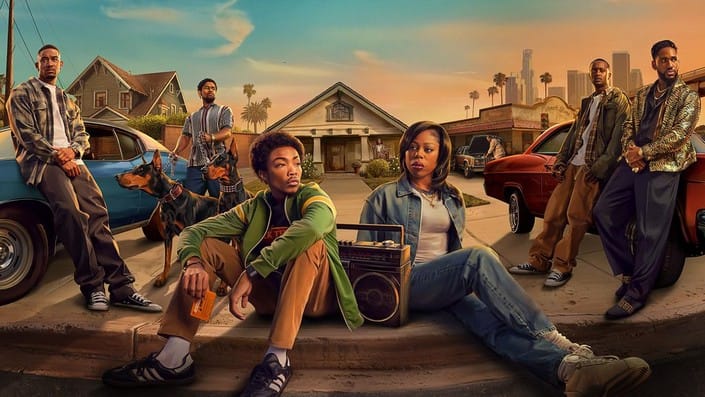
Well, no sense pretending this is a real quiz. The headline carries the point, and the human tableau below is the species of “key art” more often devoted to marketing deployment, but in this case neatly captures the sense of period and drama the show itself carries.
The heart of this piece is clearly the below chat with showrunner Malcolm Spellman, a Northern California-raised writer/producer with some strong credits that barely prepared us for this, his real arrival.
Herewith, for those who haven’t seen the show (or its predecessor “Snowfall”), is a list of the dramatis personae. Each has their own story; they're presented here, left to right (with enough spoilers coming to be worth posting a caution):
James Kinsey (Peyton Alex Smith): The quietly charismatic, if troubled, scion of the Kinsey family, with a history in the mean streets of South Central gang violence under the handle J-Loco. He’s glad his younger brother doesn’t bang—but when jeopardy arises, he’ll need to prove his rep is not a fiction. He’s also caught between the expectations of Big Daddy, who wants him to take over the family business, and his own instinct to protect Lamar from the street life he knows all too well.
Leon Simmons (Isaiah John): His story is brought along from the days of “Snowfall” to “The Drop”’s dawn-of-the-90s scenario, as he has moved from a role as feared gang enforcer to maintaining the for-the-people energy of his legal clinic. He’s haunted by what went down in the earlier decade, and he and Wanda Bell (see just below) will need to sort out their combative relationship history—and a possible future. His struggle is to preserve the community without returning to the violence that once defined his life.
Lamar Kinsey (Asante Blackk): Younger brother to James, a constant worry to his parents—and even more so to James—as he forsakes his church-going ways as a gospel-music accompanist. At 19, a musical prodigy struggling to find his stride as a rap producer, he’s almost clinically combative with the very people one should not mess with. He’s “Smokey Robinson-looking” to the rapper cadre, but his reflexive contrariness reminds one of a young Bob Dylan. His musical ambition is also an act of rebellion against a family that wants to protect him from the very world he wants to enter.
Wanda Bell (Gail Bean): Some will recall Bean’s edgily comic persona as a girl-powered love interest in the edgy, witty comedy show “Harlem,” but “Snowfall” viewers know her as the down-and-out addict whom her lover Leon despaired of rescuing then. As she pilots a choppy but fierce course through the embryonic days of L.A. rap at a label called Macroscope, she takes big swings. And as she does, she epitomizes the family’s sometimes brutal, sometimes exhilarating passage through music-business moments of alternating bullets and bluster. Her ambition is not simply to get into the music business; she believes West Coast rap can reshape American music culture.
Artillery (in real life, rap artist Simmie “Buddy” Sims III): A former banger whose mic skills lend credible street presence amid Wanda’s music crew, he finds a path to work with the brilliant neophyte Lamar, but his uncompromising street identity makes him a volatile presence. His anti-police underground hit “Officer Blackman” makes the local anti-gang cops go rogue. A brand of hip-hop philosopher, he carries the magnetism of Snoop but the threat of angrier N.W.A.-style outcries. His music is both his calling card and a direct provocation to the authorities.
Darryl “DG” Grant (Brandon Mychal Smith): Already rich from his hit-making impresario skills, he projects remorselessness but tends to make the wrong enemies. A former drug-game operator now trying to establish himself as a music-business power, DG sees hip-hop as another kind of hustle. He understands money and power, but is less comfortable with a new generation that prizes creativity and cultural credibility over fear.
Not seen above, but key to the story is Dara (Aleyse Shannon): A formidable presence in Wanda’s orbit, with her own attractiveness, allure, and power mode. She represents another kind of competition and possibility for Wanda, particularly as the music business becomes a battleground for ambition, loyalty, and personal relationships.
My conversation with Malcolm Spellman was arranged and completed despite the uncertainty as to whether FX would renew it for a second season (or more, given the track record of “Snowfall,” which extended itself to six seasons). Landgraf notably declared in 2024 that “Peak TV is over,” but has kept the beat going for the streamer as a whole and with willing promotional support for “The Drop.” On November 11 came the news that FX was dropping two Ryan Murphy horror-adjacent shows—a tough cancellation for a star producer but possibly indicative of making budget room for the much-admired Spellman series.
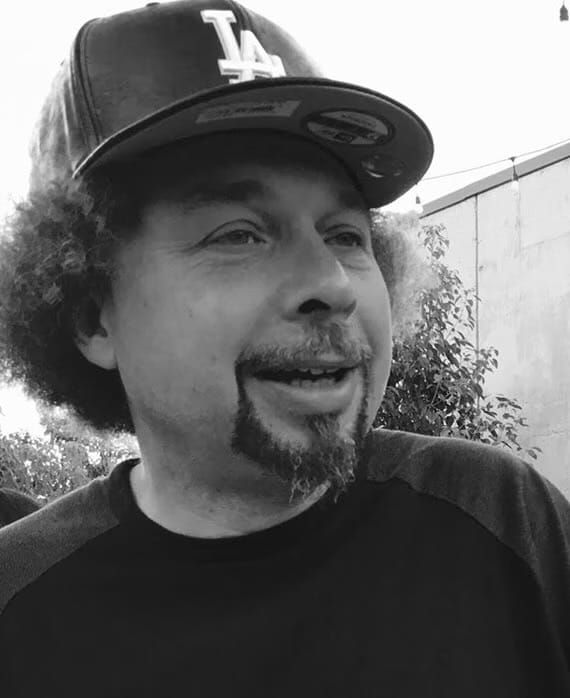
When we spoke by Zoom, Spellman was buoyant and engaging, but when the conversation turned more political, he showed an honest, not-so-buried societal critique that is part of the show’s potent DNA:
FS: When you first set to work on this series as a spin-off, were you confident as to keeping Leon and Wanda front and center? And if we can make the predictive jump, what is your through-line for any future relationship?
MS: Coming on, we knew it was Gail and Isaiah, and that to me is one of the things that should be an anchor of this series for every season. Let's say we go four or five, maybe six seasons, right? Will they or won't they [live out] this love story between two young Black people who have survived through all the shit of “Snowfall”? Now they're trying to make something else work in a healthy manner, and that story about whether their love can survive it is the primary guide rail throughout all the seasons—I hope—and it's something I experience in my own life. So I hope that the fierceness of this Black love and the volume of shit that will reasonably come between them will make it very satisfying when one day these two finally work their shit out and can be truly together.
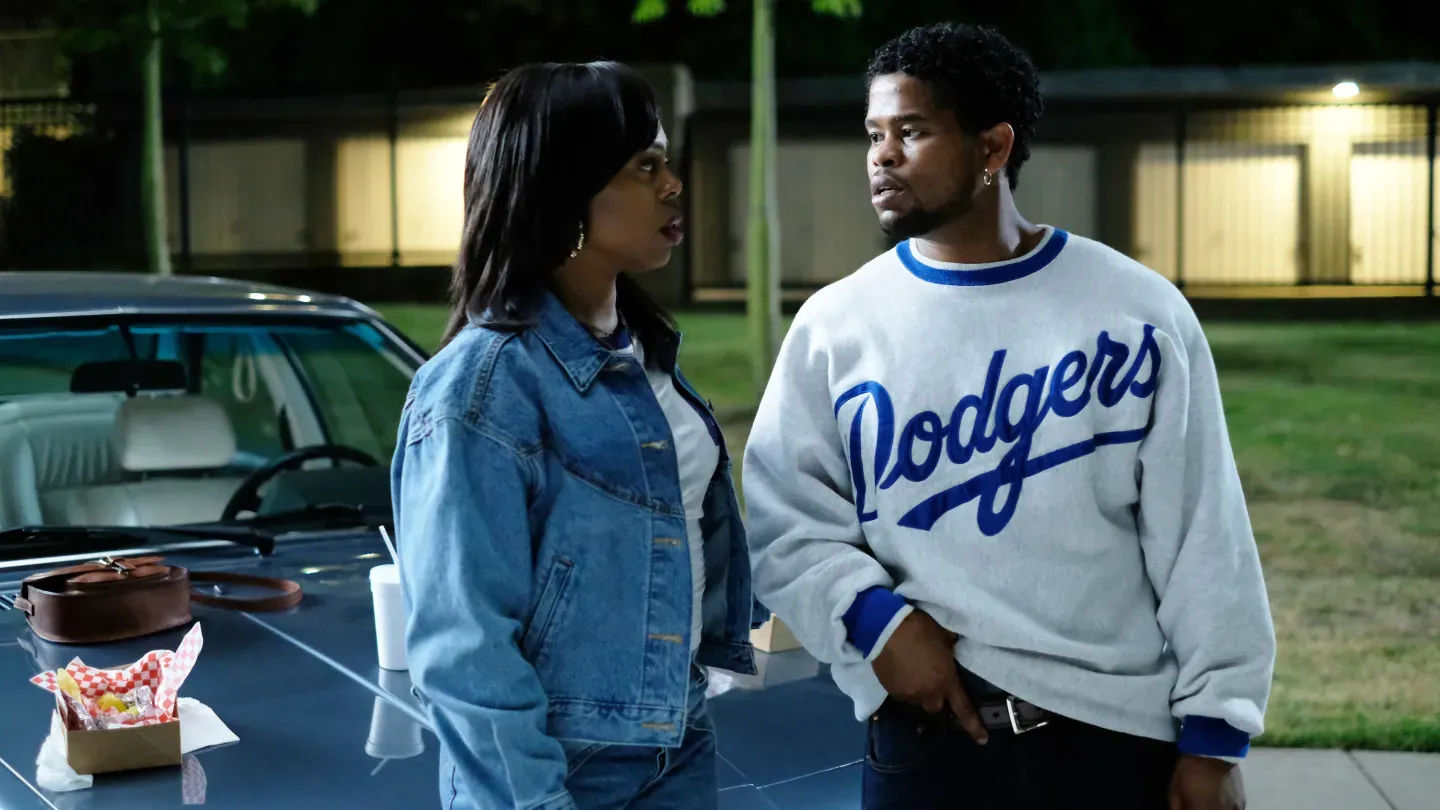
FS: For Wanda, I think that Dara, as a brittle, tough power herself, is pretty serious competition, given her allure and calculated mien. I love their conversation by the poolside—the moment when maybe they decide to get serious with each other and their shared ambitions?
MS: I think to make this work, what will organically happen is at some point in season two, there's going to be a new fella entering the picture, and then all of a sudden, now it's not only Wanda dealing with Dara; it's Leon dealing with this new guy, because you want him to be electrifying—so that you really want the audience to want Wanda to run away with this guy to make the stakes between the love affairs high.
FS: Family rules the interactions, whether internally for the Kinseys, or in the wider shared interests between Leon and James that go back to serious banging and revenge sorties in the streets. Their alignment betokens a more lethal and gangster-ridden time that's rushing towards the hood.
MS: If you are of an age like mine, you understand. I think a lot of people watching this show don't realize how primitive America was in 1991; it is a savage country at that time period. The murder rates are the highest they've ever been in this country's history. The police are crooked. The white people had, still, abandoned the cities at this time. They haven't started to rehab the cities, so there are no resources available to these people.
FS: The nationwide aspect comes across in Mykelti Williamson's performance of Big Daddy's revelations as he braces his sons, and also Leon, for the street warfare that is coming. He's been holding back, but now he tells a very meaningful story of the family's entire origin story and their flight from down South.
MS: And part of Big Daddy's speech there in Episode 108 [the season finale] is about making it okay for Leon to really be a man in these times. We are talking about a time period where two years, two or three years after this episode is taking place, the North Hollywood shootout happens. Yes, something you can't imagine happening today, but back then it was inevitable, right? L.A. was at this time period the bank robbery capital, high-speed chase capital, and gang-banging capital of the world, and it was normal for two Armenian dudes to put on full body armor, go rob banks and take on the cops in a shootout. That was just what the country was.
FS: We've learned much of the back story of Big Daddy and wife Gertie [Nicki Micheaux], who, given her own history, is trying to rein in anything—including Big Daddy's real-life parable about violence—that will drive the family unit toward disruption.
MS: Of course, morally, Gertie cannot sign off on this. But we will continue to show that this is a beautiful family living in a city that is under siege, a city which is going to actually go up in flames, literally later on that year. It is not a normal time. I urge anyone to look up Operation Hammer. That's what's going on at this time—the police are sending out thousands of units like an occupying force. We're gonna show in season two what a gang injunction is, because I don't think the audience really gets that was literal apartheid in Los Angeles. Like these, these, these neighborhoods were put under injunction, which meant everyone had to get permission to come and go.
FS: The streets were a little less crazy by the decade's end, when I was doing a chart for Los Angeles Magazine, with the assistance of certain activists and gang interventionists, depicting gang territories. Somewhat surprisingly, I was given a ride-along with the CRASH [Community Resources Against Street Hoodlums] unit, as they served a warrant. Before they rolled out they showed me the big wall chart—mug shots and lines of gang organization in great detail. But the early '90s were clearly the height of the heavy action.
MS: It is indescribable how fucked up LAPD was back then, and that it was by design. William Parker is the Grand Wizard of LAPD, and Daryl Gates was basically the Luke Skywalker of William Parker's vision for this corporate police force that views Black and Brown communities to be quarantined, right?
Those acronyms like CRASH were the genius of Daryl Gates. They didn't exist before that. He also created SWAT [Special Weapons and Tactics], and those acronyms are marketing a military corporate police that never existed before.
FS: So what got called the Blue Wave may not have the impact the seemingly empowered liberals are hoping for?
MS: It cannot be done. Like it's so foundational in America, and the fact that a generation of white people now have been groomed to believe there is no such thing as systemic racism, that critical race theory is not fact; it's a concept. Without education, mainstream liberal white people are never—and they are the power here—they're never gonna get it.
They are the power in this country. They have the numbers. They have the money. It is hopeless. I think you can only fight to make it less bad, which does work. I do think we improve. Like let me say this: I don't think at all America is as bad today as it was during Jim Crow, but a comprehensive awakening could only come if you looked at a $1 bill and understood that that man was a monster on that dollar bill, [he enslaved] human beings, and chased one of them for her entire life. Yeah, if you understand that, then there could be hope for this country. But no one knows that. No one opens up a $1 bill and realizes all the founding fathers were fucking brilliant, horrible monsters.
FS: There's a line the show walks between deploring the violence and asserting its reason for being. That could play into certain biases the unwitting audience has of this is how people in the hood interact, and maybe you don't want that.
MS: One of the things we do is that all of our lead characters are, in the minds of the writers, geniuses, and they're all remarkable—they all say and do profound shit, right? And so we will take an atypical approach to attacking those things. We know how to do it on this show without offending our community because our community is there with me while we're doing it.
We have the advisors we have on the show who are the literal people who were there, and they know how to give us the details in a way that has humanity, so that you're not just showing or exploiting violence, you're really digging into it. For instance, there's only two murders in season one, and they mean something. And you know what I'm saying? Like you see the fallout from these murders, and the police will be investigating these murders in season two, and we really make it much realer than a lot of the shit you see out there or even hear in these songs where it's like a gangster's fantasy.
FS: In the category of shit gets real, Skip Townsend, who is not attached to the show but has been among the most long-serving and esteemed among such interventionist figures, was recently arrested on the contested accusation of fomenting some violence himself.
MS: Yeah, I don’t think I have a comment right now about Skip, because it’s still open and pending.
FS: It's striking that after one of the incidents we're talking about, Leon is so ice-cold as we focus on his reactions. Looks like dude is betting on the wrong pony or something. There's kind of the question, where will he regain his humanity if he has got to keep, you know, banging like that?
MS: Well, I think the first thing we wanted to make sure of is in season one he's mourning the entire season. And so we are investing completely in Leon's humanity for the season, so that when he does this terrible deed at the end, we understand how substantial it is, and I think what we're gonna do is—in “Snowfall,” the original, Leon and Franklin are criminals. They're breaking the law. They're selling drugs.
And it is a more difficult tightrope to walk in a story like that, in a show like this, as Leon will be moving and encountering violence from a much more righteous standpoint. I just keep coming back to Big Daddy's speech. It is positing that for Leon to be a good man in this world, he has to accept that violence is going to be part of it because it is a violent world, and his job there is to protect his flock, even if that means using violence, which is way different than using violence to gain something.
FS: On rewatching Martin McDonagh’s In Bruges, with the much-lauded Colin Farrell performance of processing deep guilt, I was struck by the similar plight of Leon. He's got that darkness hiding in the back of his head, which he communicates without being overt somehow.
MS: He maintained that beautifully for the entire season, and Isaiah's performance makes that last scene where he picks up the gun so fucking meaningful because you really feel like this entire season he was hoping he wouldn't have to do that, and what he has learned is that he will have to in 1991. I just urge anyone to look up the murder rates then. He is going to have to do that. It's just about protecting his family—the weight of that, though, is very heavy with him.
It was [maternal figure] Cissy who had told him, ‘You got to make amends with the community,’ which is why he opened the legal clinic, and for it to get shut down is basically the world forcing him into a space he thought he'd never have to be in again, but this time it's not by choice. This time it's by the machinations of the world around him.
FS: The sole path to a livable future is in the music, and we leave the first season wondering if the hard-fought creation of commercial and artistic “product” can succeed—can you enlighten that aspect?
MS: The album will be very, very successful, and that's going to create gravitational pull to bring everybody back together. Even through all the dysfunction, this [music-centric] group is sort of a broader makeshift family that surrounds the core of the family, and they all fucked each other over and disappointed each other—and also stood up for each other in very real ways. And the success of the album is going to force them back together.
FS: I was rewatching the finale of “Snowfall,” and felt such a heavy sense of Franklin descending into hell. Did you want to restore some joy and vibrancy when you came at this?
MS: That was the mission, ultimately. To make this a show where you feel pressure for the characters every day, but it is a place you want to come to. These characters are dreamers, they're pursuing something that is their art, and we wanted to really emphasize the beauty and magic of our Black community—to really honor music, church, cuisine, Blackness in general—all really celebrated through the lens of a remarkable family.
Think about this family. Big Daddy is a musical genius. It got passed down to his daughter and both his grandkids. These are special people, and they embody a lot of what is the most exciting about this community, so yes, we wanted to lean into Black Joy and just beautiful Blackness this season.
Addendum: anyone wishing to read my piece for American Cinematographer, please check this space over the weekend for a sampling of insights from my several set visits, including deep interviews with cinematographers Tommy Maddux-Upshaw and Elliott Rocket. Of course subscribers to the ASC Mag can access the article from their site:
 ASC Staff
Comments ()