

Want TV Therapy for Living In Trump 2.0 ?: ”Star City” Is a Dreamlike Series About A Nightmare World
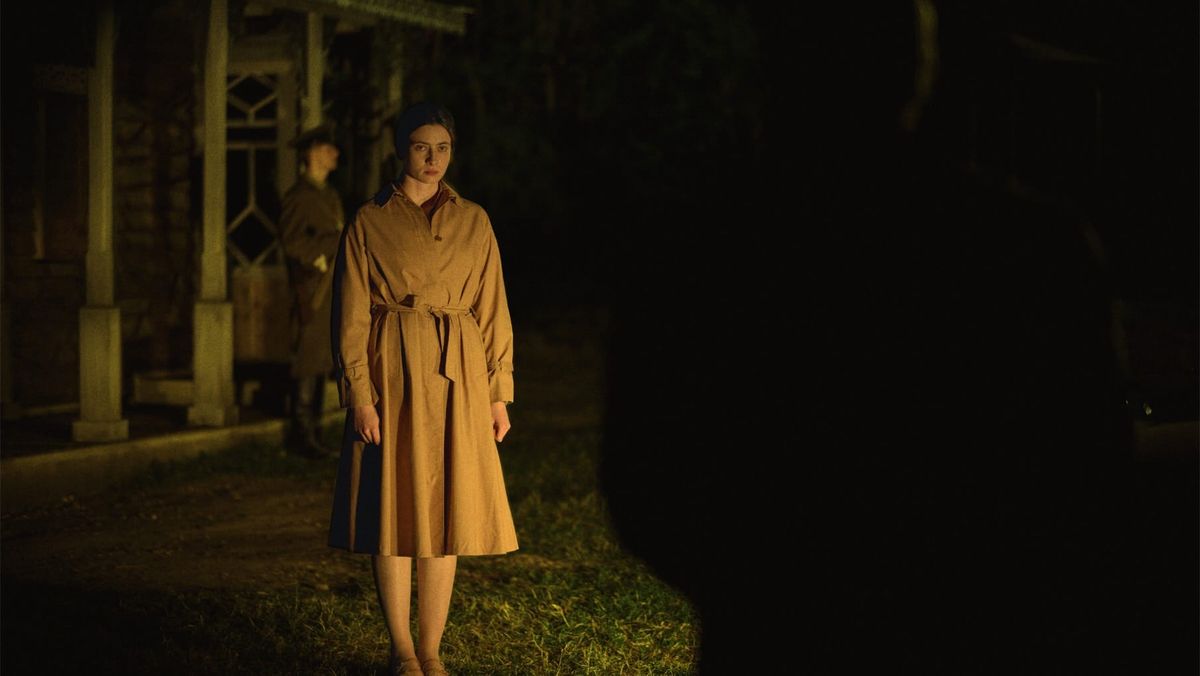
"I want to know what every person is doing before they do it. What every person is saying before they say it. What every person is thinking before they think it."
Comrade Colonel Lyudmilla Roskova, KGB colonel in “Star City”
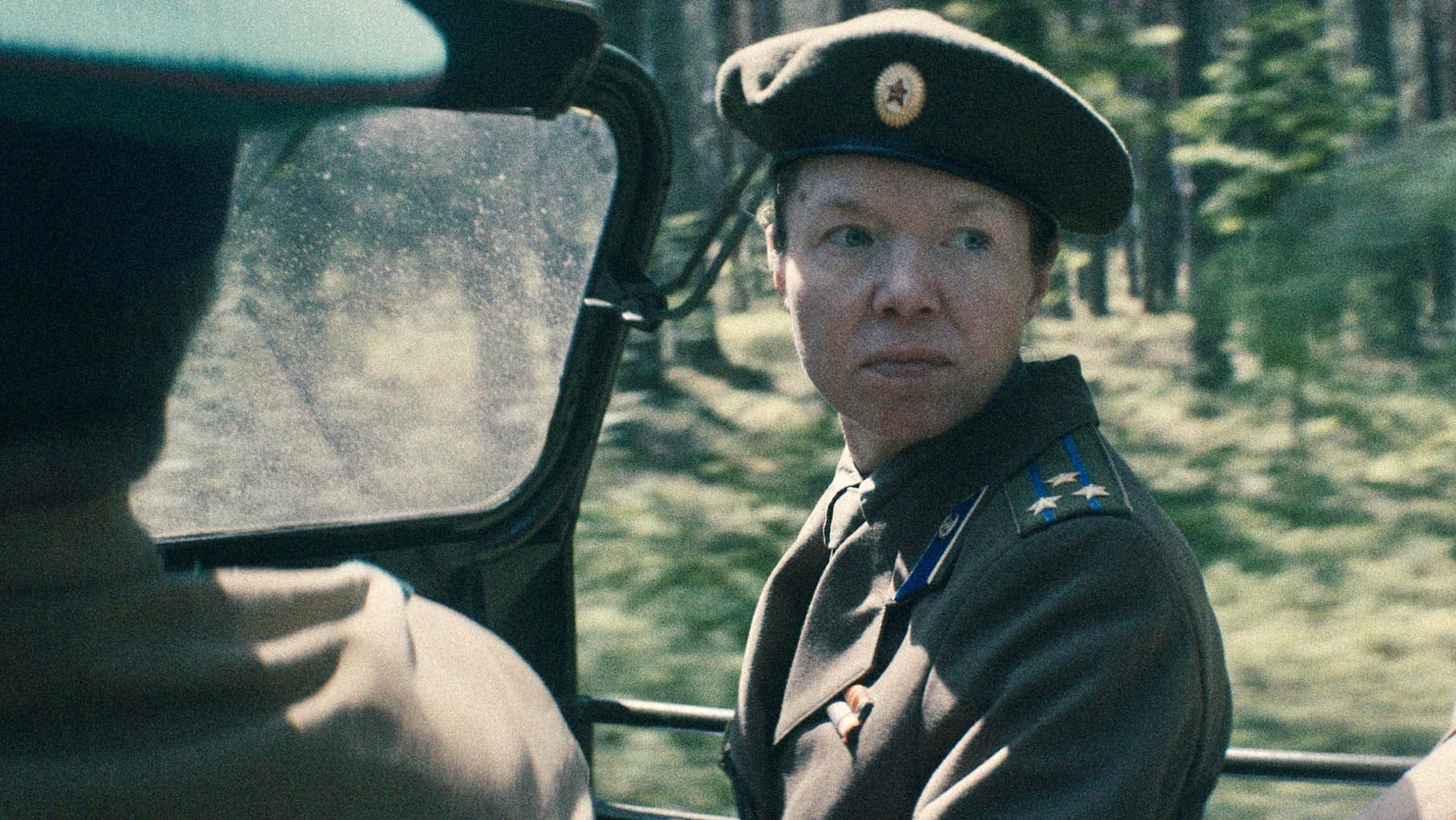
Be careful in your choice of mentors, would have been my best advice to “Star City”’s youthful counter-espionage apprentice Irina Morozova (Agnes O’Casey). Choose wrong and you may find yourself doing the bidding of a certain `Night Witch’ pictured just above; she's also speaker of the quote also seen above.
Not everything in our contemporary American lives must find refection in the entertainment industry’s cautionary tales, but watching excerpts of yesterday’s Senate hearings as democratic lawmakers' seething inquiries foundered on the simpleton obfuscations– some would say lies– offered by the DOJ’s Trump acolyte Todd Blanche and the hoople prospective head of national intelligence Jay Clayton.
All this before Trump’s promised speech on “election fraud” that may pop up any minute.
But, try as one might, in watching the interrogative attempts to evoke some truthiness from the lips of the two political hacks, it’s hard not to compare Trump’s oligarchial reign to that of the “Star City”’s ruling and historically accurate strong man figure, Leonid Brezhnev. It’s not even that much of stretch to compare Trump’s exhortation “we CANNOT give up!” (re ICE traffic stops) to an agit -prop poster from an earlier (1924-1953) Stalinist era.
Watching the greasily lupine Todd Blanche mutter his prevarications, hearing the fogbound Clayton do much the same, you have to ask--do they not define the role of what under Stalin were apparatchiks? As defined by dissident Russian chess master turned activist, the spawn of the Stephen Miller regency's MAGA waterboys whose main function for the ruling party is based on blind loyalty rather than any actual job skills.
One brief citation before we proceed to the good news about the quality of “Star City.” It was 2024 when Harold Meyerson in The American Prospect wrote a cogent essay titled, "Stop Equating Trump With Hitler! This Week, He's More Like Stalin.":
https://prospect.org/2024/11/14/2024-11-14-stop-equating-trump-hitler-more-like-stalin/
Citing comparisons to Stalin’s 1938 purges of the very generals who had created their nation’s top-drawer military capability, Meyerson saw the pattern even before Trump elevated Pete Hegseth to head the Department of…War. This came before Hegseth’s race and gendner-based purge of top brass had spooled up. (Just by the way--why does Pete always wear a stupefied expression, like the school bully someone finally smacked?)
Meyerson: “The sacking of multiple top military leaders for presumed lack of personal loyalty to the president (and reluctance to send the Army against American citizens) is without precedent in American history.
"It has ample precedent in Soviet history, however. As Stalin’s executions of most other Communist political leaders wound down in 1938, due largely to the shortage of remaining political leaders, he refocused his attention on the country’s Communist military leaders. "
(Of course Trump lately has found some sort of graying red meat in his Commie-baiting of hostile politicians; but the sackings are ongoing, perhaps most shamefully in the recent ouster of a top four-star general, sometime commander of Delta Force no less, General Chris Donahue.)
“Chris Donahue is one of the studs of the United States Army, said Republican ex-Ranger and Texas Congressional representative, Co, Keith Self: “He was [on earlier deployments] a Delta commander…very talented, capable, competent four-star general.”
The farewell walk:
/reel/1687122832513043
The general, who was the very epitome of a high testosterone count, did and does deserve better.
The thing about the Miller executive branch coup is that his monarchy keeps crumbling—witness the ouster of Putin fan Tulsi Gabbard. (She deserved a name check along with Stalin, Brezhnev and our KGB colonel Lyudmila, no?)
Then followed the face plant of temporary DNI candidate Bill Pulte, and the would-be ascension of the dimwitted Clayton.)
A side note: yes, I’ve seen and have been processing Christpher Nolan’s roaring (quite literally roaring, I promise you) and visually spectacular The Odyssey. And no, skeptics, the cast list was not actually derived from a misplaced guest list for say, the 2024 Met Ball. (Later this week will bring a consideration of the critics' reviews, most striving to give Nolan his due, despite carps.)
To top off the premise of today’s headline, let’s have a look at the show itself. I found it an addictive, if almost dreamlike, watch. Perhaps it was so absorbing because of the grinding impact of the nightmarish state surveillance weighing on the main characters.
A bit of context. Not to offend the many fan-people who have loyally followed “For All Mankind” through five seasons (with one more on tap) on Apple TV, nor to downgrade the unrelenting efforts of show creators Matt Wolpert and Ben Nevidi (along with separately billed Ronald D. Moore), we’ll here leave the estimable earler show to its own lunar orbit, the better to now delve into “Star City”.
While linked to the earlier show by certain events, and by a couple of shared characters cropping up as late e the nsot recent “For All…” finale, it is what the show runners promise– a credentialed standalone item.
Those worthies with their shiny, high-90s Rottem Tomatoes rating clearly feel rewarded for smoothly switching genres for the spin-off.
They’ve traded in the resolutely family-centric Houston homes and and flight control complex for the much more remote and claustrophobic hideaway of the Russian’s titular cosmonaut compound. It’s marked by triumphalist sculptures, deep secrecy, and pervasive fear.
In both series, the key alt-history flip is that that the Russkies in this re-set reached the moon first, in 1969. As opposed to the “For All Mankind” thesis, where U.S. colonization of space reaches beyond the moon to occupying Mars, in the newer show the Russian space program holds a lead and pushed on to Venus.
Because the race for military advantage and global prestige is ultimately performative, the main international value proposition is the bragging rights. Officially, the Kremlin cares little for the initiatives that Rhys Ifan’s character the Chief Designer is pushing. In a harried, believably perilous but determined quest, he schemes behind the scenes with his small and gifted cohort of engineers and flight crews (his `Eagles’).
Whether true to history or not, the same eager lust for planetary grabs exists for the American brain trust, as epitomized in the person of controversial reformed German missile genius Wernher von Braun. Even as competing tech and martial agendas have their say, the ethos in Houston remains patriotically, “Go, team,” no matter how ego-ridden the wonks and aviators may be.
In “Space City.” the stakes are much higher. In place of the US family drama spiked with scares, scares we get a psychological thriller playing out via mutterings in the corners of the drab Russian settings. The wisdom of the show runners is to show how dark and brutal are the consequences of a miscue can be.
In "For All Mankind," the truths are unveiled somewhere Out There. In “Star City,” the desperate answers may be locked in the broken heart of your mate, boss, or fellow cosmonaut.
While its essential DNA is readily felt—almost every one of these Yank astronauts and competing cosmonauts are simply mad-stoked to ride a tin can into space, whatever the risk. It’s true, both shows are about hearts and minds mixed with risk. Most of us live a lifetime without seeing such bravery and sacrifice up close.
If the earlier show found a way to win us over, with its chipper pastel aesthetic and lucidly portrayed wonkery, “Star City” is set to visual and tech lo-fi. The shabby chic of the cosmonauts’ suits and headgear, the drab greens of the ever-lurking sentinel soldiery, and the underlit hiding spaces serve to foreground the cast’s (generally worried) faces.
At first we think we’ve met our main heroine in the person of first human on the moon, Anastasia Belikova. In in the hands of Alice Englert, she conveys a child’s near-unquenchable sense of wonder alongside a farmgirl’s reluctance to be the face of the state program with its greed for attention. Such is her zeal to do the brave thing that she makes the flabbergasting chase scenes of the season finale into a girl’s own adventure
But we’re far from done in this female-forward dance among the whirlpools of surveillance. We meet Agnes O’Casey’s Irina as a mere clerk in a faceless pool of transcribers (it stretches about as far as the secretarial pool in Billy Wilder’s The Apartment), and the camera takes a good look. We see at once she’s a beauty, with a whiff of what was once life in the oligarch class, but her steely tranquility signals something’s up inside. Even in dead-end Building 12, a KGB covert recordings dump, she is deeply hungry for a life of impact. (It sems it.s not for nothing the actress is the actual granddaughter of the storied Irish playwright Sean O’Casey, with his tragicomic tales of Dublin.) Onstage and in earlier shows, she’s shown comic chops that are banked deeply away here.
Soon enough she lands in the company of fetching, emotive pianist Tanya (Ruby Ashbourne Serkis), who has loving marriage…with problems. Husband Valya Mironov (Adam Nagaitis ) is fretful and jumpy, though himself a celebrated cosmonaut. Is he simply ground down by the stresses of those gimcrack rockets and flight modules, and unnerved by the frantic, ad hoc fixes of chancy telemetry? In the nesting dolls of the plot's complications, we find out in the rush towards the finale.
But the story’s biggest blows for and against feminist empowerment are contained in Anna Maxwell Martin’s’ steely Night Witch. In a back story born out of real life legends bordering on the apocryphal, she earned her identity by killing Germans—a hundred, is the estimate—in the savage trenches of World War II. She’s got a sidearm holstered threateningly on her waist in her rather masculine army garb--we never doubt she’d use it extra-judicially.
The deadliest part of her skill set is her alchemical humanism; it’s an emotional skewer she keeps sheathed until just the right moments. “In my experience,” she tells protégé Irina, “it’s the small things that divide people and the big things that unite them.”
That's not from a page in a chapbook on empathy; when she deployed it as a wise-up tip to Irina I could barely train my eyes on, what with her slow-fissioning calculation. So steadily compelling is the performance that one was surprised to see Maxwell Martin make a jest—at least there’s a human in there, one thinks--in a podcast interview where she was asked to sum up Lyudmila as seen in the role. “Three words? She ponders. “Hmmm….Bad..Ass…Bitch!
Damn straight, and worth a watch.
Comments ()