

The Varlets and Vixens of "Industry"; the First Three Seasons Rocked--Now What?

Dear readers: As I prepare a post to land Tuesday, March 10, to be about the same length as this one and will delve still deeper into the series all the way through the recently concluded Season 4 (a 5th is promised), I've taken this opportunity to update the below post of fourteen months ago.
I've made some minor additions and tweaks to what you read below. As the series' unfolding becomes more widely, at times breathlessly discussed, may it serve a guide and possible inducement to either taste the "Industry" demi-monde for the first time or round out your viewing schedule now that all eight episodes are binge-able. Even as I post the below re-boot as a prelude, the storylines for Season 4's concluding passages, perhaps all too relevant to current oligarch misbehaviors, are causing a bit of an online ruckus.
In Tuesday's coming post, a consideration of whether the doings of a certain key character are still "enthralling", as one critic found even holding one nostril closed, or is said character what the cast's new set of amoral mandarins celebrate her as --"a hard fucking bird"?
To be continued...
From January 3, 2025: Let’s postulate for a moment that you or I might have overdone New Year’s Eve–may have just ridden out a two-day hangover leading into Dry January. Congrats and condolences. But if you follow the doings of the young traders on the bustling floor of the Pierpoint investment bank on HBO MAX’s “Industry,” you know that for them that kind of night is more or less…Tuesday?
Fair warning that the following will contain what some call “light” spoilers. But be
assured that at least the denser financial ploys that are the drama-inciting
incidents of the show will not be detailed here. Face it, it ’s all too complex for most of us, their jargon-laced torture kit of it of market and currency manipulation as practiced by investment bank traders and their analysts). Even when pricking up
your ears for many of their conversations, “You will not,” an admiring
correspondent for New York’s Vulture promises, “understand a single
word.”
That’s an exaggeration, of course—maybe you’re a current or sometime trader
yourself. Having briefly workshopped a memoir notion with a storied
hedgie, I know bits of argot. Thankfully the real sinew of the show isn’t the
exchanges of digital money, borne on angry threats and giddy prospects, but the
now interlocking, now ripped-to-shreds relationships of the (mostly) young
principal players. Even the Financial Times called the writers’ cagey elisions
of the techy chirping a mere “quibble —on the whole, the writing is delightfully snide, while political correctness is nowhere.”
“Industry” is not for family viewing, oh no. Generally attractive in the extreme, the
show’s performers are mostly newly discovered– though now sudden stars–-and
tend to have, if you’ll forgive the phrase, mad rizz. Amidst the psychic
tumult, the greed and fear, they act on animal– feral?--bodily attraction.
You maybe don’t want your kid to see this show--even if your kid is 32. (The revenge of the older characters is to dunk on the youthful; two of the best recurring
characters are played by Sarah Goldberg, as the remorseless and infinitely
chilly short-seller Petra, and Jay Duplass as the weathered, charismatically
conscience-free Jesse Bloom, a sweatpants-and sneakers kind of guy the young
aspirants can’t help but admire for his infamous, shifty trading
games during the pandemic.)
"They fuck you up, your mom and dad," wrote Philip Larkin at the turn of the 1970s when English poetry was getting more personal, and the series' key characters whnge plenty about that, but the true creative forbears of the show may be the "Angry You Men" of late-Fifties England. Though John Osborne, author of Look Back in Anger, was a Welshman who said, "Royalty is the gold filling in a mouthful of decay."
It seems that former Prince Andrew and Fergie have properly capped that, but the unresolved agonies of a British childhood seen to be encoded in the show's warring tribes of ineffectual neoliberals up against deracinated and casually bloodyminded nobles. (Russia no longer needs university lads spotted in the spy agencies; they go straight for the old school money guys now.)
Perhaps you’ve heard of a Musk-like character? Well, is Henry Muck the right kind of near-homophone as a name? Handed a character basket of jagged neuroses and the self- worship to ...almost power through them, “Game of Thrones”’ Kit Harington is anything but stunt casting as he wobbles between glugging ayahuasca and serving as skeleton key to a world of old-school privilege.
His sub-species of finance and publishing mandarins who are spawn of the upper-class university set are all too ready to spit on their hand and bugger the querulous public, reserving special sneers for the occasional striving plebians with their caste-traumatized psyches who burrow into the scrum with a handy dose of greed. Ken Leung as boss daddy Eric Tao and protégé’ Myha’la as Harper are the Yank duet high on the call sheet. Getting cagey is their blow.
But also, blow is their blow.
Did we only now mention the coke and sex? These frenemies with benefits
give the lie to the idea that snorting and snogging are somehow inimical. Just
about everything the swains and silk-shirted girls do in the off hours—but
really, are there any off hours in a zealously transactional cell phone
culture?—is decidedly Not Safe for Work. These people are certainly Not
Safe At Work, amidst the limo seats and loo stalls, scarfing drugs, mingling sex with humiliation shared by both parties.
Also unsafe is one’s job (and as shown in Season 1 as a stiff drink of real
consequences, one’s very life). The based-on-a-real-story fate of one frenziedly spiraling, freshly hatched trading desk recruit in seasonmone leads to a later recall it hurts to watch when compulsively bollocking numbers wizard Rishi (Sagar Radia) goes fully entropic in an episode devoted mostly to him. (Turn on subtitles to follow the japes as Rishi spouts away, often off camera, in many scenes).
There’s a reason that three of the talented Vulture reviewing crew put “Industry”’s
Season 3 on their 2024 year-end best lists; it’s easy to keep the episodes
skipping along, as one day’s king might be the next day’s knave. (These traders
don’t sleep much either; almost anybody on the job is seen doing enough
chop to have matching holes in their septum before long. It’s a kind of
pocket-lint symbolism—on this show, the doping is just another aspect of
anguished, reckless spending and getting. )
If I haven’t sold you that all this frenetic activity is almost farcically
entertaining, there’s plenty of time to catch up to the autumn 2024 season
three run, now that HBO signed the series up for a fourth season. So, it’s
recommended but as Bill Murray’s Jeff says to Dustin Hoffman’s
Michael in Tootsie: “I’m just afraid that you're going to burn in
Hell for all this.”
It's probably unwise to deeply inhale the more toxic fumes the show gives off; while we might find the key personalities to be compromised and feckless, they are
constantly swaying to the aspirational music that touches us all in some inner
room. The contention is not so much that greed is good, but that winning, sheerly
winning, is the best rebuke to a system built for the elites--and more granularly, built to serve the still-intact British class structure. Show runners Mickey Down and Konrad Kay are a story in their own right, as former Oxfordians (thus by definition, lads and ladies of privilege) who edited the school paper and entered the working world almost by chance with a rather fleeting stretch of working in finance.
Despite the ferociously high-tech setting that is the Pierpoint trading floor, the work vibe is loose (with psychotic features) but also fraught with terror of
costly mistakes. Insults are the lingua franca, aimed most resoundingly towards
the new traders whose number will be shaved down by the firm’s annual “reduction of force.” Resentments flare up, then die with little consequence. (Revenge works best when covert back-stabbings can be plotted.)
The soaring ceiling of the authentically if fictionally functional set (planted in a
cavernous room in Cardiff, Wales but meant to be in London’s City financial
district) can’t mask the claustrophobic elbow-to-energy- drink array of desks as occupied by varying wrangling specialists. In full cry the population resembles a large orchestra playing a rushing Shostakovich scherzo passage. (The show’s modernist theme music is derived from DJ/composer Nathan Micay and carries a certain urgency that is leavened frequently by music supervisor Ollie White’s hiply
ironic pop selections, notably Swan Lingo’s “Can’t See Your Face Anymore.”)
An achievement by the show runners (and their writers’ room that includes finance savants, but also once held Nia DaCosta) is to liberally hand out plot points and bravura scenes to the entire gaggle of cast mates.
Perhaps no dynamic is better exploited than that between Leung’s Eric--a veteran trader who has for some time avoided getting kicked upstairs to management—and his new protégé Harper, as played by Myha’la with an almost gymnastic series of persona vaults leading to the occasional un-stuck landing. “Isn’t it lucky that no one is ever satisfied?” Eric says of their scheming cohort, and if that’s the guiding
mantra of the show, the darker hues that lend it depth reside in his follow-up
to her: “Are we the marks?”
Having been bludgeoned by the many raves for the show, I started with Season 3, daring it to lose me. Well, in a week of stolen bingeing time immediately
following the Season 3 finale, I had churned through the rest, enjoying tone and two three all the more for the shaping of the storylines. Exemplary of that is the bitterly etched backstory of Marisa Abela’s Yasmin (some will have seen her doing her own singing in the Amy Winehouse biopic, Back to Black), which is finally vouchsafed in the lattermost episodes. If the writers’ room and the show’s cabal of directors (including at times the co-creators) have fallen in love with her attractiveness and thrown much screen time her way, it’s hard to blame them.
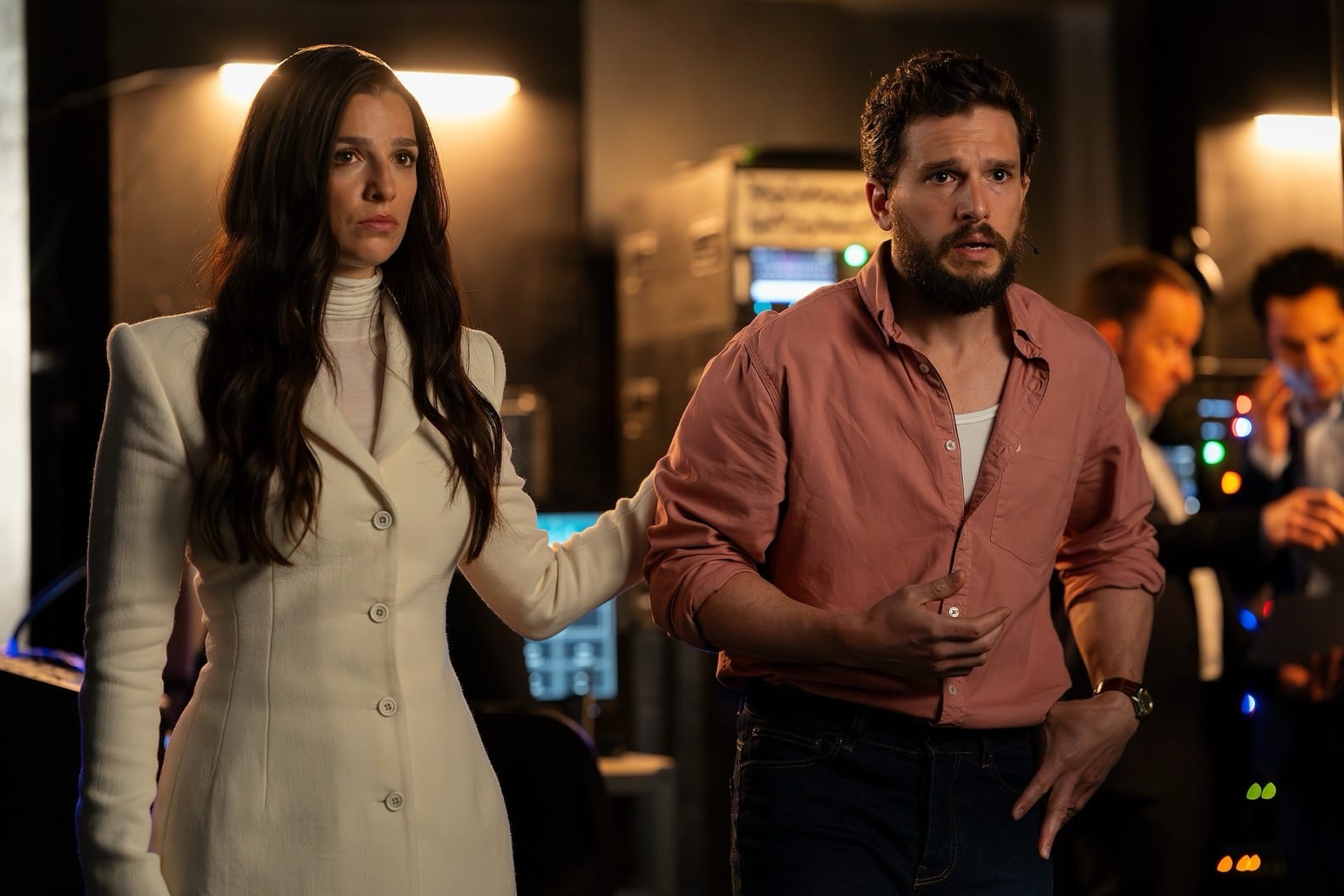
Yasmin’s self-awareness doesn’t’ really act as a drag on what she calls her “polyamorous” nature; in closing this rant of recommendation, perhaps it’s not indiscreet to quote a realization from Yasmin that definitely pays off around cliff-hanger time: “I’m good at making people feel like I love them.”
Haven’t we all known someone like that?
Comments ()