

"Project Hail Mary"--A Fable for This Moment?
“Malnourishment. Disruption. Famine. Every aspect of infrastructure going to food production and warfare. The entire fabric of society will fall apart. There will be plagues too , lots of them, all over the world because the medical care systems will be overwhelmed once easily contained outbreaks will go on unchecked.”
Andy Weir, Project Hail Mary
Sci-fi novelist Andy Weir’s Project Hail Mary shouldn’t have to hoist the burden of being a fable for our times. And yet there’s an urge to make it that.
It’s a somewhat surprising hit, passing $320 million worldwide partly due to a dearth of real box office competitors (see: ongoing enfeeblement of mainstream cinema). Its makers, including star, hands-on co-producer, and promo flywheel Ryan Gosling, don’t claim much for it beyond stature as a feel-good move at a time when one terrible man is making the whole world feel bad.
Rather than depicting the harms done by that one giddily stupid man it posits that planet Earth is under threat from a dying sun. And yet at times it does feel like an allegory about where life in America—and across the globe—seems to be going. As Weir’s prose puts it, the mess its heroes try to forestall sounds perilously close to where real life is barreling.
Haven’t many of us wished lately that some other solar system—you know, if we can’t get into Portugal—might be a fresh destination for mankind? We’ve wrecked our own place, abused it like a shitbox rental and left it issuing toxic smoke.
Personally I couldn’t handle the claustrophobia of going galactic distances in…astro-coach. Hamlet knew the entrapment: “I could be bounded by a nutshell and count myself king of infinite space, were it not that I have bad dreams.
Having missed the opening weekend showings that surged the release to north of $300 million box office worldwide, I caught up to the film early this week.
This same span of days, topically enough to thoughts of evacuating the planet, featured NASA’s venture of slinging the Orion space vehicle around the moon and back—at 250,000 miles, the furthest into the cosmos man has ever traveled. (Of course, Weir’s 2017 novel Artemis is set on a 2080s-future version of our moon. Somehow this roaring launch, made possible thanks to restoration by Congress of a goodly percent of the space agency’s budget that had been cut by the Trump/DOGE thuggery, felt healing to watch. Perhaps because the lift-off counted down even as the Supreme Court was rejecting his suit to cancel birthright citizenship.)
So, came the moment to see the film.
Mood: the two gents walking beside me on the way into the 1 p.m. weekday showing of Project Hail Mary were sharing a vape.
We shared a furtive grin.
This is how one rolls for a midday filmgoing in an overcast L.A.
The amiable duo strolling alongside me were both garbed in hoodies and shorts, and, as I often think when I survey the folks who play hooky from the sunlight at such hours, seemed feasibly to be crew members between movies in this moment where Hollywood film production is down by a third.
An experienced cinemagoer might have charted a course through his two-hour, forty-six minute offering with a gummy.
In any event, when the film kicked off with our hero Ryan Gosling stumbling about and mumbling incoherently (half-awake after a prolonged, induce, space-travel coma), they were the first to tee-hee at the appropriate points.
My hoodie gents were audibly stoked, present, ready, appreciative. In a larger crowd—the hundred -odd recliners were at best one-fifth filled—the laughs might have spread, persisted. But the multiplicity of laughter-seeking moments was eventually testing.
No need to dial up the site that points out suitable pee breaks; it felt like they tally into the low double figures.
Mind you, there is much to like in this goodhearted movie—its message of hope and connection in the face of the above-cited, current national and global mess.
Even reviewers dropping sporadically slighting reviews avoid outright negativity. Thus the headline cooked up from Bilge Ebiri’s intermittently warm review in Vulture was “Project Hail Mary Needs About 39 Per Cent Less Jokes”.
Or Justin Chang in the New Yorker, also giving full credence to the provenance of the film and the track record of its directorial duo of Phil Lord and Christopher Murray, found that “Project Hail Mary is the most exasperatingly insistent crowd-pleaser I’ve seen in a while. It serves up an elaborate science-fiction plot in easily digestible bites, often with a juicy one-liner or a side order of pratfall…but the audience’s good will is a precious, unstable resource, and the flippancy of Project Hail Mary expends it recklessly.”
It feels sour to itemize variouscritics dunking on whatever may be the film’s shortcomings without also noting the more-than-healthy audience response. Indeed, as the hoped-for lynchpin for Amazon MGM films to expand the heft and width of its theatrical release footprint, it leapt out of the box on the weekend of March 20 with $80 million in global ticket sales, stomping the (admittedly unimpressive) competition and giving the company bragging rights as owning the year’s first real hit. The source sci-fi novel from Weir, which had debuted in 2021 at No. 3 on the New York Times bestseller list, gained new life this season as a movie tie-in and jumped to first place on Amazon’s book rankings.
Some have even credited the success to the long tail of the pandemic finally being snuffed out, luring not just families but getting the incels to forsake their gamepads.
Gosling’s fan base knows he’s for real, he likes them back. His workmates point out that he’s a full-eye-contact, I-see-you guy. (Much as I found him in a brief chat after watching a screening of Lars and the Real Girl in 2007.)
He’s so unostentatiously confident in his appeal that his idea of a flex is playing unsettled by Harry Styles’s competing Q-factor in a “Saturday Night Live” cold open monologue. This is a guy who charmed the gruffness out of Harrison Ford while promoting Blade Runner 2049 in 2017, and snagged a Supporting Actor Oscar nom for playing Ken, yep, in 2023’s Barbie.
The Project Hail Mary story itself had been born partly out of Weir’s own long-lived personal loneliness. That isolation fueled his craft but ended when he met wife Ashley in a Los Angeles restaurant while in town pitching a TV series-- soon after publishing the parable of isolation The Martian in in 2011, which story thrived through the 2015 film adaptation and brought Matt Damon an Oscar.
Pundits have cited the wisdom of risking a public oversharing the cuteness factor with a crucial reveal in the trailer. They did so--and there will now commence mild spoilers in this post—by featuring the E.T.-reminiscent, buddy-comedy aspect of Gosling’s suddenly-an-astronaut character, Ryland Grace, bonding with the anthropomorphized Play-D’oh figure of Rocky the alien. We learn, a bit laboriously, that the developing friendship and urgent, worlds-saving science will be unveiled via complex processes both large and painstakingly small.
Each viewer will find their own enjoyment, or lack thereof, with the rocky one’s language tics. Each new crisis brings a new MacGyver scheme with accompanying theory dumps and duct-taped gimcrackery. And then those jokes. “There are certainly some real laughs as well as some groaners, but at times you want the film to just get on with it,” noted Ebiri.
By the time Gosling’s Grace finds his bearings in space, somewhere “Neptune-ish” multiple light years from home, the scientific jargon increasingly wedges its way into the story. Having seen Gosling early on as he quirkily charms some fairly deep knowledge into his classroom of eagerly middle schoolers, we as viewers who paid 25 bucks of course strive to be all in.
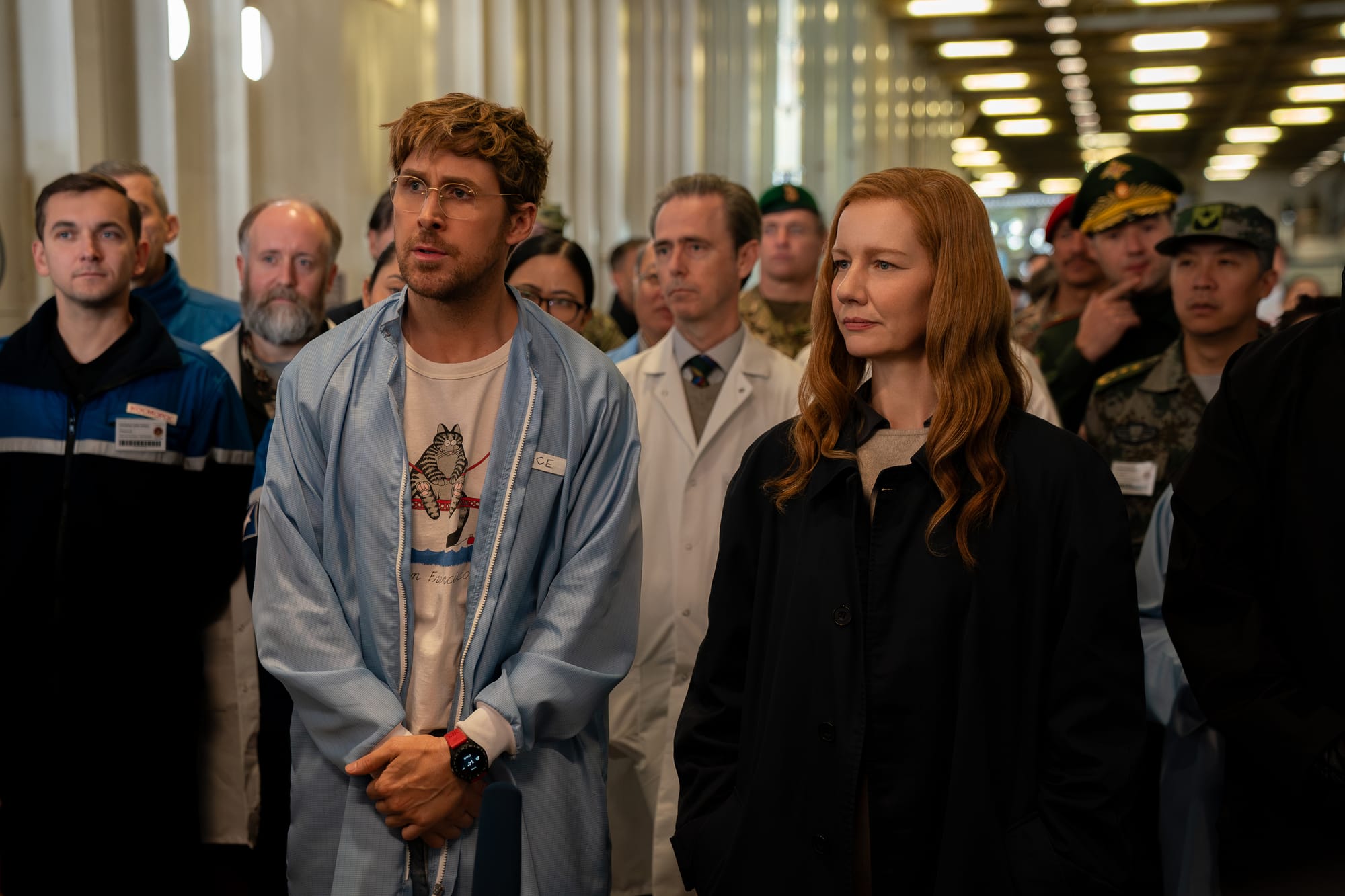
Granted that most of humankind simply enjoys looking at Gosling’s mug, the directors were clearly happy to oblige. The editors, no doubt busy sawing up and re-fitting the pieces of past/present time-shifting that’s mostly loyal to the novel’s arc, have betrayed him somewhat with leaving in Grace’s repeated fussing with his wonk-signifying wire-rim spectacles. This is perhaps meant to exhibit his Mr. Rogers (or is it Mr. Chips?) slide-rule-sensei likeability. But dude, you had us at `Canadian’. (Sorry about the tariffs, we wrecked our own economy too.)

It helps to know that the reason Grace is recruited somewhat forcibly from his classroom--to a forthrightly suicidal mission to save earth– is a paper he wrote years before, a brilliant yet controversial treatise studying the possibility of life on dry planets. Or, as Weir would have it in his reliably prolix way: “An Analysis of Water-Based Assumptions and Recalibration of Expectations for Evolutionary Models ”.
The casting of, Huller, who played such a well-crafted mixture of things both transparent and opaque as a privileged haute bourgeois wife to a Nazi death camp commandant’s in Jonathan Glazer’s’s The Zone of Interest, pays off nicely.
Huller’s character Eva Stratt being changed from the book’s Dutch scientist boss to a German (er, okay) martinet is smartly elided by the performance’s \obvious deep humanity. It’s in her trammeled smiles. Her much-lauded performance of Harry Styles’ landmark hit, “Sign of the Times” energizes the film by finally putting a dazzle in Grace’s eyes.
Perhaps the salient point as to the provenance of the movie is the combination of Weir’s dispatching the Project manuscript directly to Gosling at the very moment when the actor began to seek roles that his kids and spouse Eva Mendes. could enjoy with him. (Coming up—Shawn Levy’s Star Wars: Starfighter.) Gosling has willingly stumped for the Project Hail Mary release, obviously landing to good effect even as he’s steered well clear of Chalamet- scale promo swivets.
It would be churlish to cast Weir as the project’s Andy Supreme but with his own charm offensive he must be causing some envy from Science Guy Bill Nye (the very savant who, as part of the Planetary Society’s lobbying, helped churn up the current moon shot.)
When Weir’s source book was reviewed in the New York Times it was tagged “an engaging space odyssey” but also shaded a bit by comparison to the earlier film and the skills director Ridley Scott and star Matt Damon deployed with highly congruent elements (including screenwriter Drew Goddard): “The main character’s isolation, which was so crucial in The Martian, is a similarly convenient excuse for Weir to downplay messy human issues in favor of a cleverly organized series of challenges that Grace himself compares to “a video game.”
True enough, I read much of the book at a C-minus level of grasp. Doing so, I recalled the nice guy I copied my Chemistry homework from in high school. He was a lot easier to understand than say, this sort of passage: “Neutrinos are what’s called Manjora particles. It means the neutrino is its own antiparticle, Basically every time two neutrinos collide, it’s a matter-antimatter interaction . They annihilate and become two photons. Two photons actually were the the same wavelength and going opposite direcctions and since the wavelength of a photon is based on the energy in the photon.”
Jeez, I hope that’s not on the final.
All that said, it’s not only possible but probable this kvetching is merely the lamentation of an iun-science guy.
When Grace first meets Rocky, as he marvels at the clunky and improbable friend now in his universe, he wonders, “What would I tell my students at a time like this?” Roused from a kind placidity, he’s asked to “save billions from the apocalypse.” In that, he may serve as a vibrant example to the largely youthful audience this story is aimed at. While the book’s Dr. Stratt is fiercer than Huller’s carefully crafted version, they bring the same lessons to the fore:
“Do you think I don’t know you, Dr. Grace?” she yelled. “You’re a coward and you always have been. You abandoned a promising scientific career because people didn’t like an academic paper you wrote. .You retreated to the safety of children who worship you for being the cool teacher. You don’t have a romantic partner because that would mean you might suffer heartbreak. You avoid risk like the plague.”
Not so these filmmakers.
Comments ()