
Patti Smith, in L.A., Decrees "The People Rule"
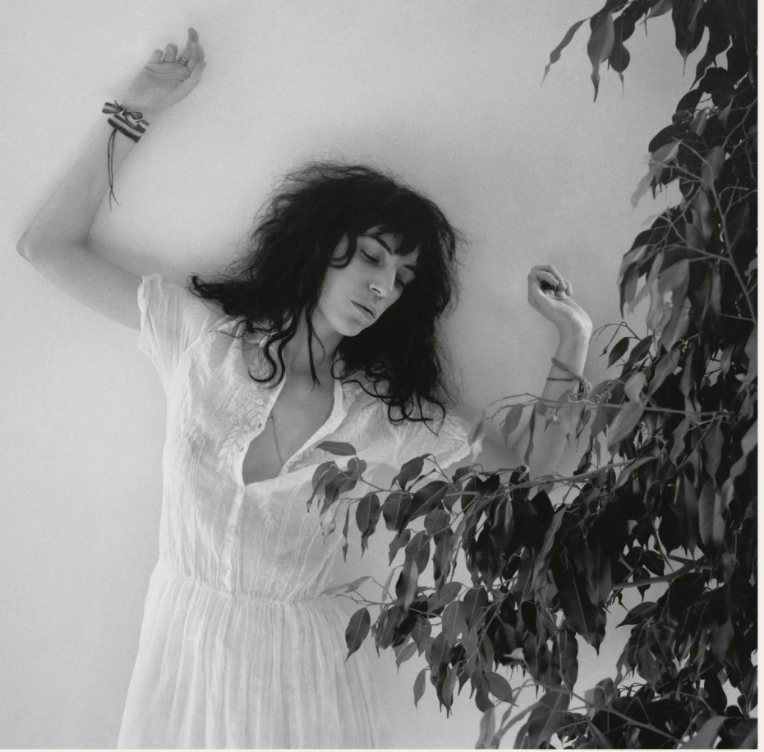
This is the girl for whom tears fall/This is a girl/Who was having a ball/Just a dark smear masking the eyes/Spirited away buried in sighs/ This is the girl who yearned to be heard/So much for cradling a smoldering bird/This is the girl/ This is the girl...
From Patti Smith's ode to Amy Winehouse, "This Is the Girl"
The first song Patti Smith would perform in her September 14 appearance at the 1200-seat Wilshire Ebell Theater in Los Angeles was the above tribute to the late Winehouse, who died, ever so sadly, for somebody's sins– but not Patti's. It was a generous nod to a soul sister of sorts.
It reminds us that at a time when Patti might have been sucked into the vortex of fame and its traps, she went private--for 17 years. The retreat was as covert as it was strategic. After a September, 1979 concert for 80,000 in Florence, Italy, Patti all but disappeared from public life, into a prolonged creative idyll with lover and husband-to-be Fred Sonic Smith, former guitarist in the MC5.
Her husband was 46 when he passed from heart failure in November of 1994, not long after his own birthday--also September 14. This evening's concert would journey from memorializing Winehouse into what was effectively a tribute to her late husband, with a sweet addition of an audience she had with Pope Leo, thankfully still with us after turning age 71 (as the first Augustinian pope) on...September 14.
Finding meaning in the coincidence may seem very much to be expected from the ever-mystical Patti, but she made the synchronicity, for all its underlying woe, somehow heartwarming,
Winehouse was found unresponsive from acute alcohol poisoning--a finding of five times the legal U.K. driving limit--at age 27 on July 23, 2011. Even as she joined the tragic pantheon of stars who passed at the same age, the song that reverberates is the all too autobiographical one: "They tried to make me go to rehab..."
Smith composed her tribute song as a spontaneous offering made in response to the sad news that reached her as she was on tour in Barcelona. She melded her own poesy with an aptly plaintive melody from her accompanist of what's now thirty years, Tony Shanahan, whose work this evening on piano, guitar and harmonies was deft and expert.
It says something about Smith's collaborative nature– more notably than ever in this warmly inclusive phase of her career – that two of the several songs she would offer this night were co-written, while two others were covers.
One could venture that the magic trick of Smith as an entertainer is her seeming casualness as she ad-libbed her transitions. Her text readings from her 2025 memoir Bread of Angels became intertwined with songs, abrupt skeins of memory, and even small miscues (e.g., she'd brought the wrong glasses onstage) without any mote of professional worriment. There was never a slack moment as she switched from instructive dip into creative process (the making of "Because the Night") to illustrative musical interludes to half-joshing anecdote (her whoa! moment beholding sunny Pope Leo right there in the Vatican) to the musical interludes that satisfied doubly as she dressed them up with chatty storytelling.
The sheer unpretentiousness she would display this night felt like an emblem of her ongoing approachable maturity. Her career has itself been a log improvisation, one that's come with trials and heartbreak but a constantly regressing search for inner selves, As she writes in the penultimate paragraph of Bread of Angels: What aspect of my being shall I present? One with a thundering step gathering imagined troops...or perhaps one who had a succession of loves, or who possesses a black velvet case containing the pearls from a beloved husband.
One thundering step demanding inclusion is, of course, "Because the Night," composed with Bruce Springsteen.
An avid audience of clearly long-loyal fans were still settling into the just-kids vibe when she and Shanahan delivered the 1976 hit. She detailed the making of the single (for it was by strict design codes made as a single, crafted as such by producer Jimmy Iovine.)
She told the tale with self-deprecating wit. And yet the account was lightly brush-strokedd with pathos, carried in part by an anecdote about the beloved late husband--his was the song's longed-for voice on the telephone. There was no denying, seeing her fist-pumping investment in the tune, that it was designated as the evening's banger; she put a bow on our fervent applause with, "Okay, so it's downhill from here."
Hardly, poetessa del Punk (as an Italian newspaper once called her). In fact, the evening, which would spool out flowingly through a total of just under ninety minutes, was the most winningly-paced recital of words and music I've ever witnessed. She made us aware early on that she would obey no strict chronology in spilling out her anecdotal soliloquies. The presentation was all the more of a marvel not despite but because of the hopscotching in time.
She's never lost touch with her heroes, from Renaissance painters to the Beat poets and rock shamans to abstract expressionists to spiritual leaders, but alway, hovering near the center of her cosmology is Bob Dylan.
She shared a treasure-chest aside from Bread of Angels-- choosing the Blakean "Dark Eyes" when Dylan asked her to duet with her onstage, and realizing, standing barefoot under "the intensity of his eyes" that, "for the moment I was just a widow and the raging young poet who once dominated my teenage senses, was just a man."
It was not without years of work and struggle that Smith made herself our key inheritor to the legacy of a whole landscape of still-reverberating creative geniuses. She's served in that position so long and so well that she's perhaps the only figure who could drop an array of names from th pantheon and evoke only fond admiration: "Alan [Ginsberg] escorted me to a dinner for William Burroughs at his bunker. Alan was very happy that I had recently visited with the Dalai Lama, and he asked me to help support the Tibetan people by performing at their annual benefit at Carnegie Hall. I was reluctant to start performing again, but he was determined that I return to the stage, and he appealed to Bob Dylan to extend his hand. Bob asked me to open for him on an East Coast swing of his Paradise Lost tour in December. Michael Stipe offered to travel with us by bus up and down the East Coast, and Allen Ginsberg and Gregory Corso often visited us on the road."
The evening, this week in Los Angeles, and your blogger's take on it, cannot help but veer towards the personal. It's only in sitting down to set the context that I realize Smith was the first rock star (well, proto-rock star) I ever met.
The potentially mockable part would include a certain what's -wrong-with this-picture? moment. I had been standing outside the eventually-to-be-immortal CBGB's with my hometown (that's right, New Jersey!) pal of longest duration, feeling all hipster and hitting the hash pipe as we stood in our Joe College khakis, incipiently long hair, and buttoned-down button-downs. Patti was in the trio stage--was it 1975?--and there was no loyal new mob yet. It was showtime. And yet, abruptly, Patti emerged alone, and we three were standing in the entry alcove of an adjacent flophouse. A pause. Tentative smiles. And the, it seemed the only gentlemanly thing to do: even as we stood coughing out blue clouds, I dared eye contact and used my just-scorched thumb to gesture an invitation to join.
Patti's smirk at our nerdish folly was generously subdued, and her reply mellow: "Gee man, I really like hash—but uh, it kinda numbs my throat, and ah--you know?"
That chance encounter would not come during the next connection– a mid-1976 interview we had conducted for Circus Magazine, staged as a phone call from my Manhattan apartment to her hotel room in Milwaukee. After a moment of distraction as fans flooded into her room, visitng fans, she moved our chat to Lenny Kaye's lodgings down the hall.
After it was vouchsafed that one or both parties on the call had sampled some herb during the process, she was all the more the loquacious interviewee she has always been. She noted that Elizabeth Taylor was on the TV, playing Cleopatra on the late movie: "She's got real interesting eyes, I see how Richard Burton fell in love with her. She's starin' into a fire now. She says... 'You will have a Top 40 single.'"
In that wryly celebratory moment (the single was headed for No.13 nationally) I had just enough restraint not to utter that old wheeze, "You know we met in person once. " It was three years before, downtown NYC, which given the current success seemed somehow long ago.
Clearly she had not connected her present interlocutor with the author of a certain take in the views section of Crawdaddy Magazine, where, in December, 1976, I had spoken scurrilously (as did many others) of the title cut of the previous year's Radio Ethiopia: There are not many pockets of Babylon, not even in the ink-dark corridor that is CBGB's, ready for this caterwauling enlightenment. It's a 12-minute feedback venture that starts with a Led Zeppish riff and plunges into a cacophonous, multitracked, elephant-chasing-a-baby-carriage frenzy. Staccato, Stonesy leadlines move across cymbal showers and the cries of nailed strings as a dazed Patti wanders in to exhort the "people of Ethiopia." A really healthy reed man could blow his way through, but her voice is only a sometime presence in the song.
So, bullet thankfully dodged, we discussed the nearly career-ending tumble she'd taken from a stage in Tampa, Florida: Patti won't call the months she was laid up afterwards a 'recovery.' "Call it a rediscovery," she says, "Our absence made space for a whole new assault by these new bands, like the Pistols and everybody, that was heard around the world. And I needed a rest, I was like a field that's been depleted by growing cotton. My brain needed a little topsoil, and I laid in bed and babbled to Andi Ostrowe (the woman who is Patti's road manager and all-around confidant) and created a whole new tapestry."One important element of that new tapestry is 'Because The Night': "Yeah, that song has really captured people's hearts. Bruce is a guy with a lot of energy, a guy who comes out fighting and I really like to improvise with him. We came together like a handshake."
Onstage at the Wilshire Ebell hall, she wound a long and droll account of the co-songwriting process around her performance, with Shanahan, of the tune. She described the insistence of Jimmy Iovine, producer of he 1976 Easter album, that the all-but-finished record needed a hit. From the stage at the Wilshire Ebell, she gave him a shoutout as he sat mid-audience with family. Teasing him with love and a decent impersonation, she declared, "I didn't care about hits at all. I didn't write them...it wasn't important to me. But Jimmy was highly competitive and really wanted us to have one. And so apparently Bruce Springsteen was working on some song, and he just couldn't finish the lyrics, and he had shelved it. So Jimmy asked Bruce if, you know, I could finish it, and Bruce was so nice to give it to Jimmy, and I was so un-nice not to listen to it– only because I wanted to write my own songs. I didn't want somebody else to write the songs... is this story going on too long?"
Here the audience as one all but bellowed "Nooooo!"
She continued: "So I put it on my cassette player, and it's like, what are you going to say? In my key, perfect arrangement, anthemic, sensual. And I just stood there, and I swear, out loud I just said, "It's one of those darn hits."
What she had said in our midnight Milwaukee phone call even as the song was kicking at the door of Top 40 stronghold was, "We're getting what we always asked for as a band — the privilege to be loved, to be trusted, to break certain barriers and reach a state of mutual ecstasy. When we come on now the atmosphere is so intense — it's like pullin' a knife through silk or something."
Never shy for an impactful metaphor, that girl. And those words from that hotel room where Elizabeth Taylor was so bewitching fifty years ago reverberated quite accurately on September 14 this year.
Lenny, speaking briefly when he picked up the phone, had put it this way: "Patti doesn't let 'em sit around."
It was a pretty sure bet that the evening would include a song that is just the ticket for that, and as the crowd recognized the slow-skipping beat, Patti addressed the microphone with her familiar sway keeping the time, that familiar vocal sob carrying the message:
I was dreaming/In my dreamin'/
Of an aspect bright and fair/And my sleeping, it was broken/But my dream, it lingered near...
It was John Cale, who produced Patti's monumental Horses debut album, who assayed that she came from the DNA of a Welsh preacher. And this night were all ready to say "amen," as she poured out the verse:
And my senses newly opened
I awakened to the cry
That the people have the power
To redeem the work of fools
Upon the meek the graces shower
It's decreed: the people rule...
With the same easy modulation she'd shown through this flawless time onstage, and without specifically detailing our current national spiral towards ruination, she looked us all in the eye with a closing, spoken reminder: "People have the power. People have the power. Don't forget it. Use your voice.
"Thank you, everybody. I had a great time.."
One more smile from her:
..City of Angels."
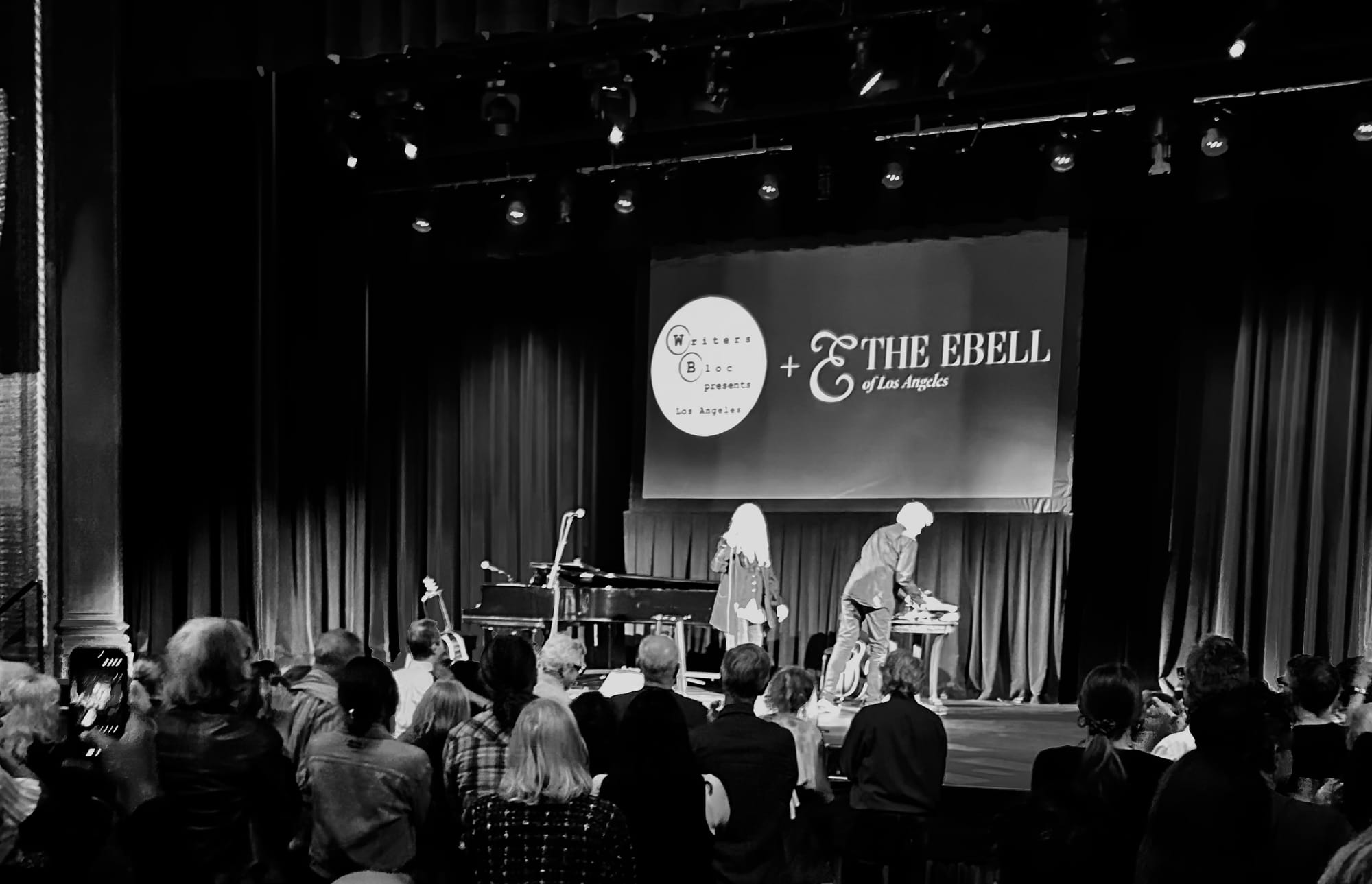
Patti and Tony take their leave...photo by Bob Wallace
Addendum: It speaks to my long time Patti-stan status that I would stalk her yet again that decade, as below:
The Patti Smith Group: The Palladium, New York NY
Fred Schruers, Rolling Stone, 13 July 1978
Patti comes home a hero
WATCHING THE crowd rise up out of its seats when Patti Smith walked onto the Palladium stage — her 'Because the Night' headed for the Top Ten — you had to clench your fists for her: Patti Smith is the Gunga Din of a certain kind of rock magic, trumpeting so hard and bravely that even the false notes become poignant and powerful.
She was holding Babel, her new book of poems. "I haven't fucked much with the past," she recited, switching her weight from foot to foot, "but I've fucked plenty with the future...."
...Lenny Kaye and Ivan Kral, the guitarists who have served as visual and musical foils since 1971 when Patti was a murmuring, chanting priestess, shuffled blank-eyed and played the clipped chords that turn 'Babelogue' into 'Rock 'n' Roll Nigger'. Throwing her book down, Smith then growled like a dirt bike: "Baby was a black sheep, baby was a whore...."
With her crooning, swooping vocal style as the focus, Patti and her band performed every song on their new album, Easter, as well as a stack of covers: 'The Kids Are Alright', 'You Gotta Run', 'Time Is on My Side', 'Be My Baby', 'Gloria' and 'My Generation'. And Smith's presence was riveting throughout. She kicked her way through a repertoire that had her acting as almost everything from a dizzy, skipping schoolgirl to a hip-stockinged stripper. But after contributing floppy backup vocals while Lenny and Ivan covered the Who and Lennon, she let the audience know, on '25th Floor', who really wears the tight pants in this band. It was the most compelling song in the set, with Kral and Kaye churning Patti's unleashed guitar leads back into the beat as she spit the words out.
The evening was wholly charged with Smith's will. She's imperiously proud of her hit single, of finally being on top at age thirty-one; she preceded 'Time Is on My Side' by shaking her fist during a babelogue that ended with "fuck the clock." And her first encore, a cover of 'You Light Up My Life', was at least half-serious — she stopped to repeat "you give me hope." The crowd was somehow relieved when she followed that with a gritty 'Redondo Beach' and an incensed 'My Generation', ripping the strings off her Fender and holding the wailing guitar up to quiver and glitter. For nearly two hours Patti Smith had busted her butt and almost no one sat down. That's as much of a resurrection as rock can ask.
#
Comments ()