

Nolan's "The Odyssey" Wins the Box Office and (Mostly) the Critics
Let’s face it, Christopher Nolan’s epic film version of The Odyssey is the inescapable, giant, chocolate-colored pony in the room for the pop-cultural conversation of this moment.
It surged this past week to a global $264 million in box office, a landmark for R-rated films, and is even selling a raft of translations of the original Homeric poem. (Not to mention herds of $70, 22" plastic-steed popcorn buckets at the snack bar.)

Even if you’ve been boning up on the source material in such translations, you probably still need to see it twice to follow the time shifts of the saga. (It’s long been understood that hair shirt confusion comes with the territory in writer-director Christopher Nolan’s films.)
Yes, just days before, the World Cup owned the focus across media for several weeks.
The Cup was setting the table for an invigorated national lean into soccer; the buzz was real enough. And yet that uptake had slowly leaked away and pretty well evaporated by the close-out, post-championship moment when a squaddie for the losing Argentinians started throwing hands (not allowed, duh!) in a pissy little midfield scrap with the victorious Spaniards. (Don’t hold your breath for a similar revitalization of Americans’ appointment-viewing stacks of games when the 2030 World Cup airs in a different time zone over in Spain, Portugal and Morocco).
Regrettable to say, for all the global amity and “Tubthumping” keg parties on saloon sidewalks, despite even the unfathomable skill of Lionel Messi bending it like Beckham, many of us still don’t understand such things as:
--how “stoppage time” and “extra time” might actually translate to dramatic viewing.
--why the over-punctilious, roving eyes of surveillance (via VAR, or Video Assist Review) has been enabled to expunge a selection of moments that, for a moment, bade to be exciting.
--why so many otherwise manly men would roll around performatively on the turf in a dramaturgical effort to escalate the barbarousness of an opponent’s glancing contact.
--the actual impact of judgments between a yellow-card and red-card penalties, especially when a simple phone call by President Donald J. Trump to Chief Smarmy Footie Weasel Gianni Infantino could efface the meaning of the latter.
--how the presence of Trump in the celebration ceremony could be so ill-managed that despite CSFWGI’s attempt to usher the heavily booed Trump out of the team photo could stand as the Tik Tok moment we recognize as “He Ruins everything.”
But enough handwringing about the footie.
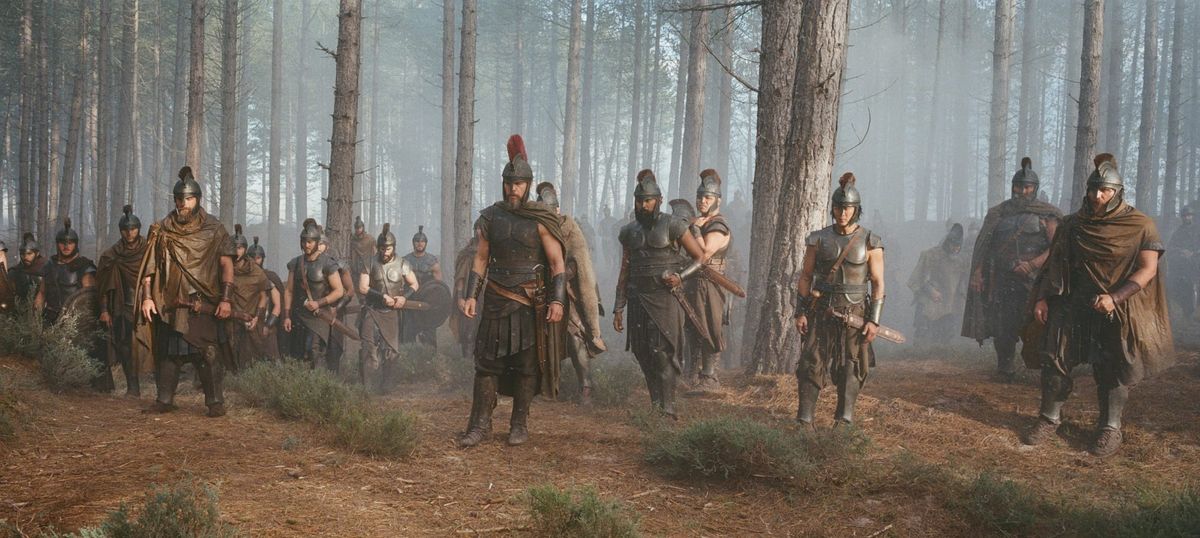
Beyond the time warps shared by futbol game clocks and film editing, we move into much different cultural terrain when casting an eye on the above still from The Odyssey, showing Matt Damon’s Odysseus framed in a coastal Scottish pine forest. (A moment that in Homer’s telling was located in Sicily, where the poem found the voyager facing cannibalistic giants, the Laestrygonians,.
If you’ve seen a trailer for the movie you can recognize the setting, making it no spoiler to realize that out of the misty tree line will burst a horde of giant metallic—or are they carbon fiber?—cladded-up warriors who are the creation of an imaginative directorial ethos. (Or, possibly they tramped into frame from a video-game shoot on a neighboring outdoor set?)
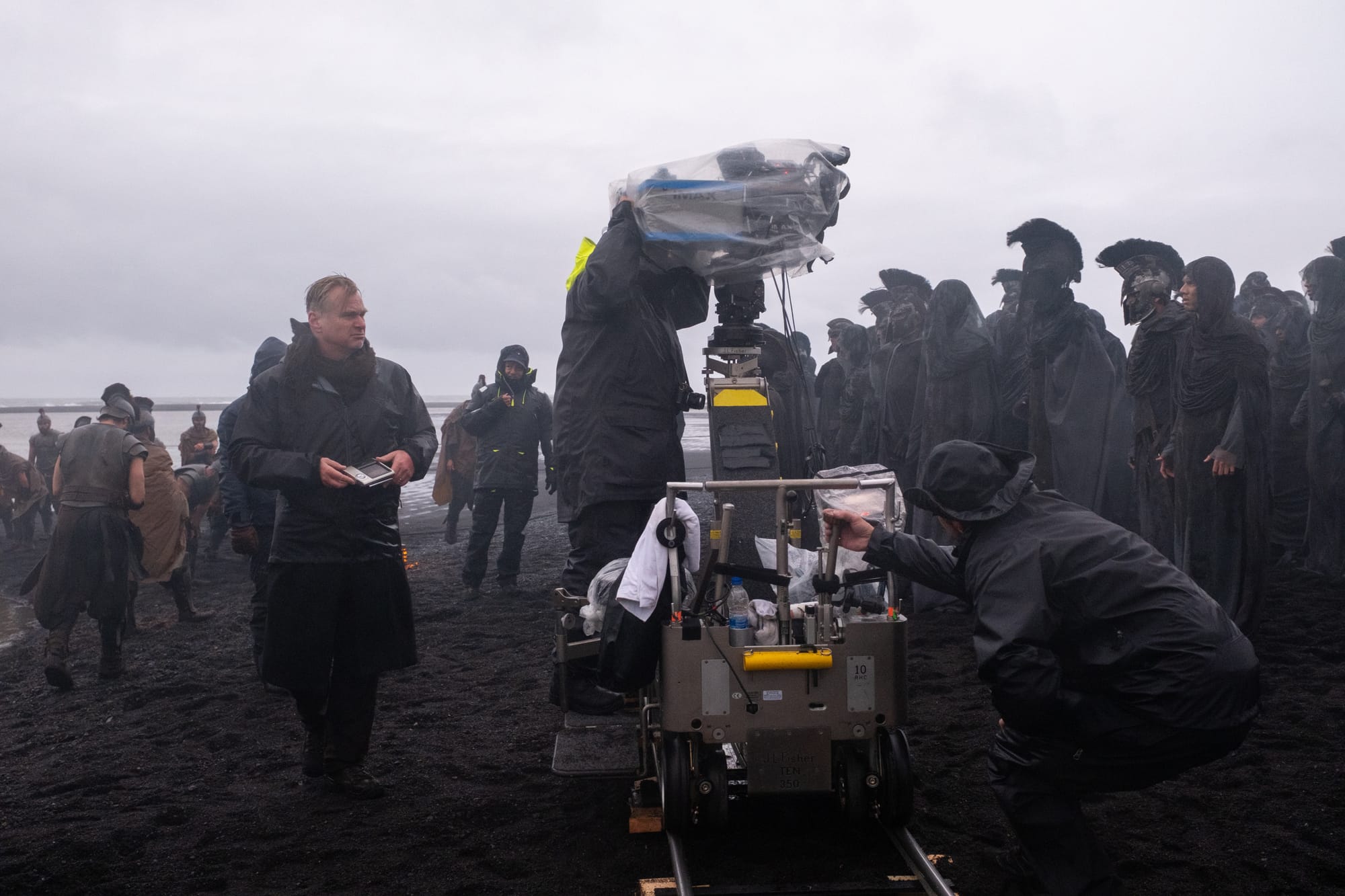
As seen through the lens of the pathbreaking technology that makes this the first feature to be shot entirely in IMAX, be assured the imagery will at times hoist you up in your seat, along with the most thunderous sound effects of any cinema experience I can recall.
Spectacle counts. That said, If you are using this sprawling two-hours-and-fifty-two-minutes journey through ancient Greece as your source for a junior high book report on the 2800-year-old poem, better do a re-think. Nolan’s distillation, for all its starry set-pieces, is not your fact-check go-to, unless you’re looking for a kind of Cliff -Notes-by-Del Toro version.
There’s a valid logic to most of the writer-director’s re-imagining. Much of that was detailed by Vulture’s Bilge Ebiri, whose in-depth conversation with Nolan bears the same ride-or-die admiration for Nolan as Ebiri’s neighboring review of the film. To wit: “One example of Nolan’s attempts to expand the visual palette comes in Odysseus’ encounter with the Laestrygonians...giant knights covered from head to toe in medieval armor. The scene comes right after Odysseus’ encounter with the Cyclops, another enormous man-eating creature, and Nolan wanted to avoid the repetition.”
Nolan sought, as the piece quotes, “a fantastical sense of otherness...the costumes are showing a completely different technology than what Odysseus has encountered. They are overwhelming in every sense.”
Seen. After some years of similar craft colloquies with master-level Hollywood directors, from Scorsese (a passionate advocate for deeper societal meanings in his work), to Spielberg (he talks straight to his admiring audience as you scribble it all down), Ridley Scott (with his scrappy zeal for melding imagery to character depths) and Fincher (bone-dry wit and a sharing of deep creative detail), I’ve found no one sells his own ambitions more nimbly than Nolan.
When I interviewed the director about 2006’s The Prestige for a Los Angeles Times profile of Christian Bale, he crystallized just how the actor’s gifts are deployed through a profound focus: “I think,” says Nolan, “that very often identity is reduced in films to simple, broad strokes. And so to get an actor to try and represent a more layered character, a more realistic psychology, you need an actor like Christian with acting layers. He can act on different levels at the same time.”
The pair had managed to re-boot D.C. Comics’ faltering Batman IP in 2004, and of course would team up to storied effect on 2008’s The Dark Knight and 2012’s The Dark Knight Rises, completing a trilogy. (With credit to Nolan’s brother Jonathan as a visiting co-writer; one scene I simply can’t shake shows us the menace of Heath Ledger’s Joker rambling up to Maggie Gyllenahaal, grooming his forelock with a gleaming ratchet and burring, “Well, hello, beautiful.”)
For all his success with the Caped Crusader, the steadily growing heft of Nolan’s career rests, for this fan, on the twin pillars of 2017’s Dunkirk and, it’s all but idle to say, July 2023’s Oppenheimer. (I cite the month because the enduring industry calculus is that chipper if message-bearing Barbie synergized with the profoundly somber nuclear era science to revivify, for a minute, fannies-in-seats moviegoing.)
It was no surprise that New York magazine’s recent, knowledgeable tally of the 100 Most Powerful directors handed Nolan the No. 1 spot before any deep deliberation. As cited: “He is in a class by himself,” says a producer. “There’s nobody like him. He’s never lost momentum, never struggled, never stumbled.” Nolan offers prestige and populism, intellectual oomph and global appeal — he wants his movies to be as big as possible.”
Certainly he’s hit some tricky marks once again, not just commercially but in terms of striking visuals, and dredged up blockbuster scale from that doorstop we grunted through in middle school. Yes, the Oscar nods could touch double figures, as the review metrics hover in mid-90s territory.
All this success coms not least because Nolan’s screenwriting and production skills (the latter needs co-executed by spouse Emma Thomas) have deepened over time. It’s not for nothing he was elected as president of the Director’s Guild, and he’s not just heedful of his fellow big shots. (In the recent spate of interviewing he showed care and concern for the less jumbo craftspeople, name-checking the success of Obsession and Backrooms, and even spared a thought for the currently eclipsed work force of the streaming cadre.
To root for Nolan is to root for cinema future, which is why repeating some of the below mutters asking for say, more complex character essences, somehow feels churlish.
Perhaps the surliest rebuke came from, of all places, The Economist as laid out by two (unsigned) pieces; a review of sorts (“A very silly adaptation of “The Odyssey”) and an essayistic upbraiding (“Why Sir Chrsitopher Nolan. Inspiures such devotion—and contempt”). The former piece, subtitled “An Epic Mistake,” assessed that in the film, “Startling liberties are taken with the plot to turn Odysseus, the archetypally flawed ancient hero, into a simple modern goody by flattening his flaws,” and further, “The casus belli of the Trojan war is given as a desire to improve trade routes, as if Agamemnon were merely a blameless advocate for free trade rather than one of antiquity’s greatest thugs.”
In contemplating a trip to the theater, what with the rigors of even finding a seat for a screening in the most desirable projection formats, you might simply dismiss the carping, along with the slapback that ended up atop the comments when The Economist Facebooked their coverage: “That's what adaptations *are* you soup forks.”
The financial journal's essay, which postulates that public opinion on Nolan’s directing is inevitably split between haters and fan wonks, reads like something overheard in a wood-paneled London gentlemen’s’ club. Relating that Nolan was born in 1970 to a British father and American mother (part of his racing was in Chicago) it laces in a quote from London Sunday Times film critic Tom Shone’s biographical study The Nolan Variations, summing up Nolan as “a very familiar type of Englishman…the kind of upper-middle class son of the home counties one could imagine with a career in the City who plays rugby with his fellow brokers on the weekend.”
The Economist, sometime advocate of Maggie Thatcher, further sniffs out a “streak of conservatism” in the film work, and drops asides on the canon, quoting Roger Ebert (re Memento) saying the protagonist. “Suffers from a condition brought on by a screenplay that finds it necessary, and it’s unkind of us to inquire too deeply” and probing a quirk: “Dead wives or girlfriends…further the plots of The Prestige, Inception, The Dark Knight and Interstellar."
And yet. Look at the brave stoicism of Emily Blunt (nominated for a Supporting Actress Oscar as Oppenheimer’s wife Katherine) or the (mostly) banked ferocity of Anne Hathaway as Penelope, and we see the fates of women are nor as clinical as some might imply. Certain of Nolan’s assertions on the current film show a leaning into family—“It’s a middle- aged marriage story,” he’s said, adding that her and Thomas finding themselves as “empty nesters” (albeit employing their four offspring in various production roles) impacted his conceptual thinking . (Even the touching arc of Odysseus’s dog Argos was influenced by crushing on the Nolan family dog Charlie.)
The kerfuffle over idiot Elon Musk kvetching about the casting of Lupita N’yong’o as Helen of Troy (the actress also plays her sister Clytemnestra, again fleetingly) guttered out quickly along with various numb-nuts complaints about Elliot Page playing a small if signal role.
Perhaps the entry point for the rumblings about the film’s approach, is in its mixed-messages as to the meaning, then and now, of war itself. Even without citing Trump and Hegseth’s moronic misplay in Iran and globally, it’s possible to complain that the film’s several gestures towards war-what-is-it-good-far are subsumed in the generally martial Homeric ethos of of Bronze Age warfare.
David Fear of Rolling Stone foresaw pushback in the audience from “Anyone who squirms at a movie bending over backward to present anti-war bona fides while simultaneously delivering a-hi-to-your-friends-in-hell retribution moment designed for bloodlust applause.”
From the more scholarly side of the reception came disappointment that wondered if the deceptive, not to say, con-man traits of the supposed hero are too much elided., and Odysseus too turgid. (No matter to them that he’s what Zeus, in the poem, calls “the most unhappy man alive."
The scholar and noted translator of the epic poem, Daniel Mendelsohn, was sad to see a filmic Odysseus with “no cleverness, no humor, no wily charm…one of the Western canon's formative tricksters has been transformed, into the kind of haunted protagonist featured in such previous Nolan movies as Oppenheimer and Memento….Nolan has merely remade Homer’s hero in his own image.”
Currently much-lauded (by Nolan, and also by David Denby in an astute New Yorker essay ) is Homer translator Emily Wilson . She's given the movie a generally gracious pat on the head, and why not—it has stoked a rush among book buyers, the 2017 release popping up as high as fifth in its category on Amazon books. In a chat at the 92nd Street YMHA with the Pulitzer Prize winning playwright, Sarah Ruhl, who modernized Eurydice for the stage, Wilson was full of humor and zest. In fact, when asked to recite a passage in the original Greek, she shucked her top layer sweater to reveal major, erm, classical ink, then stood and declaimed the lines to rich applause. (She cordially advised would-be filmgoers to at least dip into Wikipedia to assess how Homeric the film might actually be.)
In lamenting how incomplete an understanding of women in archaic Greek society has come down to us, she granted how the film could hardly have bought into the original gorier finishing off of the suitors and household folk. (Especially given what vengeful Telemachus character, does to the hapless female house slaves in the poem.) We are not called upon to “weep for them,” Wilson noted with equanimity, despite their fate at the hands of a certain bloodyminded father and son team. “It’s a film that has interest in shame,” she said, “But it doesn’t have any interest in glory.”
In all candor– or is it an attempt to show out in book group next week?--your correspondent was sooner swept up in the evocative muscularity and pace of Wilson’s usefully plainspoken translation (which Nolan has himself praised and adored) than in the film’s editing-suite origami.
Putting aside the central story beat of the Trojan horse, which is hinted at immediately but deployed much later, Damon as a bearded trouper is steadily more pained than purposeful. Even a seemingly perilous hinge point when the hero is presented with a potential mutiny– his men seem to know the way stations of his odyssey could leave them all dead—the memorandum of understanding that’s reached plays out not unlike a trust exercise at the company retreat. “There’s no moment in this film in which Odysseus does a clever trick,” chided Wilson onstage at the Y, “There’s much more laughs in Homer.”
Just to be tedious, let's admit a long-running complaint regarding Nolan’s work is a certain no-sex-please-we’re-British climate. (By contrast, consider the bedsweat-and-candlelight business in the tents of the 2004 Brad Pitt-starring Troy, which Nolan was briefly attached to direct before Wolfgang Peterson came on. )
Such wall-to-wall lack of concupiescence compared too the poem dismayed the Times's Maureen Dowd ("Nolan's Zero-Eros `Odyssey'") and even New York (Is No One Horny...?) In fact, Nolan may have set Damon no greater acting challenge than to depict Odysseus stoned on lotus flower, looking blankly into the adoring gaze of goddess Calypso’s camera-ready Charlize Theron. The man is so lonely for home and wife Penelope that the promise of eternal youth with benefits, leaves him all nah, I’m good, I just need a ride home.
Samantha Morton can do otherworldly as few can (e.g., Minority Report), and seems an Oscar nom shoo-in as a Circe who would leave theorginal tale-tellers baffled. If the poem gives us a temptress--check out Andrei Konchalovsly's bit-of-s-hoot 1997 NBC two-parter for Bernadette Peters' portrayal--Morton is a mutable witch.
Contrary to the poem but in line with the Nolan proscriptions, her onscreen chapter is free of eros but serves up a gnarly banquet that nearly summons emesis. For better or worse, it's already been tabbed as the awards season ole card.
Not in for the okey-doke is Times critic Maya Phillips, who despairs that Nolan "shifts from seafaring epic to body horror" and Phillips the leading man's deceit that saves the day: "aparticularly disheartening disservice to one of the earliest examples of a powerful, sexually autonomous woman."
Plus another goddess who finds he's just not that into her.
To be fair, low-T is very much the voyager's state of mind in Homer, as we see him , via Wilson, “not wanting her, though she still wanted him. By day he sat on the rocky beach, in tears and grief, staring in heartbreak at the fruitless sea.”
Finally, re the plot, even Wilson and he classicist cohort will tell you “Scholars since antiquity have been puzzled by the ending of The Odyssey.” She does assert that even restored to his previous stature, Odysseus would have some disaffected Ithacans who survived what went down. Nolan ties it up in picturesque fashion.
So take the below tallying at face value—it’s simply here to show the ambivalence found in reviews of Nolan’s master work—for that it is—even as it shows some critical feet in various buckets.
The Los Angeles Times’s Amy Nicholson had the seeming temerity to write her review, even after the initial mostly ecstatic tastemakers weighed in her welcoming, breezy style. Even with certain asides of some dubiety—“As ever, it’s light on sex, heavy on wine-dark angst”—she pulls a deft U-turn into positivity: “Once you endure its opening stretch — an expositional barrage with the pace of an obnoxious cop show —The Odyssey ascends as a monument to movie craft."
Along with a fair percentage of Nolan-neutral film buffs (we’re not talking here of the school of the arts people who can explain Memento or Inception in a sentenc), Nicholson finds the time shifts of the narrative onerous: “The Greeks never tried t confuse the audience in the pursuit of suspense. They delivered their plots arrow-straight to make the dread sting.”
The Odyssey has already inspired so much chitter-chatter that its actual release was poised to be a letdown in comparison. But just wait till you actually see this eye-glazing dud of a movie.
Rolling Stone’s Fear similarly felt a degree of awe mitigated by reserve: “Nolan and his behind-the-camera collaborators want to wow you. If they can’t do that, then they will at least overwhelm you. Yes, it’s a human story at its core. But you couldn’t separate the intimacy from the maximalist presentation even if you wanted to.”
No sense attributing the quick recouping of production and marketing costs to the cineaste out there; the picture just might touch a billion in box office take during a likely six-month theatrical run--but the fan base seemed not to include Time's Stephanie Zachaarek: "The Odyssey has already inspired so much chitter-chatter that its actual release was poised to be a letdown in comparison. But just wait till you actually see this eye-glazing dud of a movie."
IndieWire’s David Ehrlich found it to be “too clunky to be S-tier Nolan, but the last act rewards the hourney.”
The New Yorker’s Richard Brody declared that it solved a basic problem by providing “a readily digestible modernity—ancient Greeks, they’re just like us!—but does so at the expense of the richness of detail and the societal complexity that makes reading Homer such a vital and immediate experience… Nolan, energized by the self-restraining power of modern morality, turns an epic poem prosaic.”
Brody’s New Yorker colleague Justin Chang lodged a generally friendly take, but still noted, “There are times when you can sense Nolan’s frustration—not with Homer so much as his own inability to reshape the material into something more than mere spectacle.” It’s hard to parse just how much ambivalence can be found in his kicker: “Nolan is by now as close to a Zeus figure as exists in Hollywood cinema, and The Odyssey is his latest lightning bolt, hurled from an Olympian perch of critical and commercial supremacy. It’s also proof that he should violate his own laws more often.”
Wilson seems to have earned the last word, and there we may all agree: “I hope you have a wonderful time at the movies.”
Comments ()