

Modes of Manhood, 2026: Jinx, Coop and Pete
This is not going to be a rant about that current media fixation, The Manosphere.
Well okay, there is one named subject above whose Venn diagram shows the locus where Cosplay Warfighter meets both Piss Artist and Attempted-Manliness Douche.
You already have guessed which name that is.

More generally though, a certified pop culture icon takes his (or her, or their) place in the showbiz ranks—or as the star fictional performer on a show--when their nickname becomes a familiar `call sign'. (As aviators call their monikers).
The monosyllable can be simply short for a surname, as with Jon Hamm’s Andrew Cooper in “Your Friends and Neighbors” (of which Season Two airs the sixth of eight episodes on Friday 5/8 on Apple TV+). He's known to his wealthy suburban cohort, especially his pack of slightly subordinate (if also wealthy) bro's, as Coop.
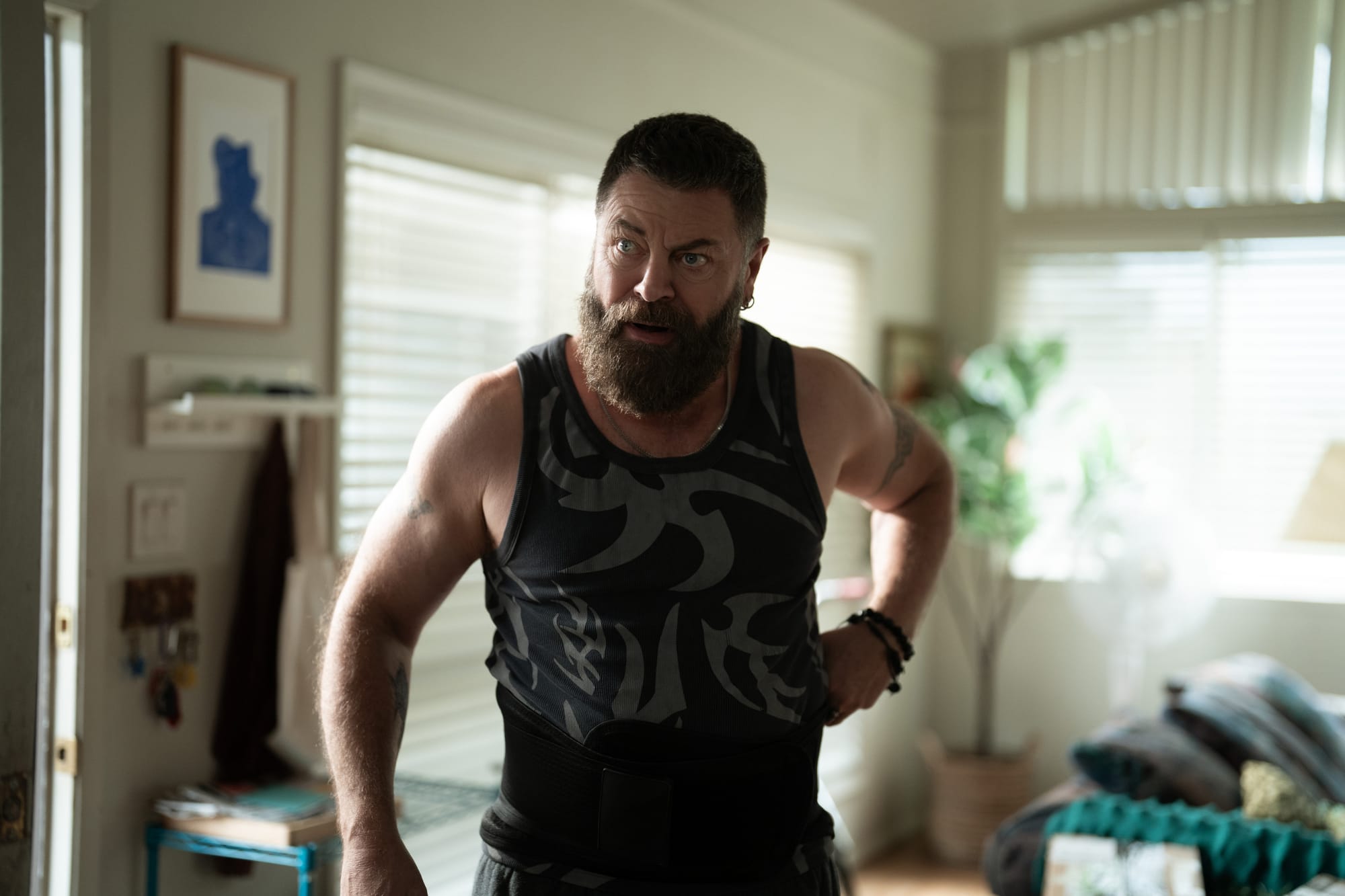
Another, in the person of Nick Offerman’s struggling father/grandfather figure in “Margo Has Money Troubles”—also on Apple, with the sixth of eight episodes airing 5/6–has a moniker linked to his pro-wrestler days: Jinx. (Offerman has attributed the name to his pro wrestling character 's way of “casting his glamor” to disable opponents.)
The third has been anointed by his first name ever since the President made him the cabinet’s key Warrior Boy, while spouting off about who might be the prime mover towards the hapless war they started with strikes on Iran, “Pete, I think you were the first one to speak up.” This was it:
https://www.instagram.com/reels/DWRNfZqChru/
So, let’s let Mr. Hegseth exit in the clown car and we shall delve into the other two.
As played in “Your Friends and Neighbors” by Hamm, we first see Coop as a recently ousted hedge fund overachiever manque'. He garnered wealth, and the lifestyle that goes with it, during his once-happy years as the coolest dude in a New York suburban enclave that’s New Rochelle in all but name. His moniker is used by one and save his sister Ali, who calls him Andy. If that infantilizes him—and also her—it also calls up an innocence that we soon realize is forever lost. This we learned—and here commence light spoilers for both seasons-- with a dead body as receipt in the opening minutes of Season 1, Episode 1.
As he navigates uneasily through the scheduled 19 episodes of the still-unspooling span of two seasons, Coop is indeed cooped up, so to speak; first by a criminal investigation, and subsequently, as the chapters roll out, by the compounding threat that a whole growing array of his nefarious doings will come to light.
Also, Coop’s head is a mess, and his lower back is challenged by even a simple thing like helping lug a fatally damaged body.
No, not that first body as cited above. Nominally a comedy, “Your Friends” often tracks as rather ominous dramedy. It isn’t bloodless, though the storytelling has roots in the suburban novels of Cheever and Updike. In addition to making for a casual critique of materialism among the elites, there’s deep midlife-crisis tension driving the menfolk. Those who were once capitalist princes are now, to quote one of the richest of them who thereby supplies an episode title) "Halfway to Invisible."
Along with Coop’s saga, the dread undergirding the show’s unfolding character conflicts is very much about aging. One could write a longer take than this to give full measure to the also intriguing pangs, neuroses and household tragedies of the series’ strong female contingent another time for that, perhaps.
Each of show runner Jonathan Tropper’s six novels have been adapted or acquired by various studios, and just as Faulkner had his own storybook county in Mississippi, Tropper has Westchester: His stories "were about families and men in this world screwing up their lives.”
There’s an unmistakable congruence to the writer’s longtime residency in New Rochelle in his 2003 novel “This Is Where I Leave You.” It was adapted for a 2014 film by Shawn Levy, with Jason Bateman as central character Judd. (Opposite Tina Fey playing Judd’s sister.) It's one of the earlier explorations of Bateman’s angst-whisperer blue period that includes “Ozark” and raked up the heights—or perhaps we should say depths—of suburban anomie with this year’s “DTF St. Louis”.)
This blog mined the show's first season for some insight into suburban life as it felt just under a year ago in a post of "Your Friends and Neighbors" that asked, with Hamm's character, that debut season's key question:
 Fred Schruers
As Tropper has described the course of his authorial fixations into the present series, limning this world of screw-ups fulfilled a plan: "I had always intended to come back to this for a TV treatment.”
There are some who find Coop to be the redux version of “Mad Men’s Don Draper, who spoke in parables rather the sardomic pushback Coop favors. The late innings of the show’s criminal arc require certain clean-ups, albeit in a stately mansion, that echo the Scoresesan exigencies of not just mad men but made men.
The Jon Hamm who portrayed Don Draper had his own dark history from combat in Korea, as we discovered in stages, but perhaps his signature use of his own inner life came when he shared, with a group of dour Hershey candy marketing execs, his memory of what a Snickers bar meant to the Pennsylvania orphan he was.
Not unlike the new uses Billy Wilder found for the until-then journeyman, often-comic lead actor Fred MacMurray in the Fifties with Double Indemnity and The Apartment, Hamm has found further depths to explore in the likes of “Fargo” (the nipple-ringed crackpot sheriff/politico of 2023’s Season 5.)
Even the skeptics who lump his Coop character in with certain “sad dad” and/or “rich people suck” streaming tropes find Hamm’s casting spot on. (Indeed, the show wasn’t mounted until Hamm chose to join as first on the call sheet and as also a key contributor to shaping it.)
Even in a mostly slighting review by Inkoo Kang in the New Yorker are cued to the leading man’s essence: “Hamm, who had trouble finding a new groove after “Mad Men,” is perfectly cast as Coop, who, like Don Draper, constantly looks both imperious and ill at ease. His performance is the show’s main asset.”

To address Coop’s nuanced take as a simultaneously sad dad and sucky rich person requires a look at the key interacting cast mates, male or female both. Amanda Peet as Coop’s once-delighted (and still sporadically delightful) ex is the she's-got-has-anger-issues focal point, as we viewers shake our heads at the willfulness that accompanies her excruciatingly documented, menopausal mid-life crisis.
Even if you believe that licensed therapists themselves have a deep saturnine streak you wonder at her behavioral slip-up’s. (Let’s just say that for all the breezy and at times adulterous fornication, the show never goes wife-swap skeevy. Tropper has cited landmark deeper fare such film fare as American Beauty and The Ice Storm as models—but Coop and Mel stage their respective dalliances with exactly the wrong frenemies’ spouses.)
Coop’s business manager, from his earlier wealth-growing days on through what becomes a plunge into high-end burglary victimizing his peer group (see series title) is the fifty-ish Barney Choi, played to a grouchy but wry fare-thee-well by Hoon Lee.
If Hamm voices the downbeat sarcasm that animates various dialog scenes akin to Tropper’s several comic novels, Barney brings a ruder quippery that summons laughs. You may recall him as the smarty-pants, louche but marginally dangerous character Job in the HBO slugfest “Banshee”. In that four-season run from 2103-2016, the comedic if dangerous Job cyber-hoodwinked the bad guys alongside the protagonist crook-turned-Robin Hood country sheriff figure Lucas.
Yes, Lucas is played by the same Antony Starr you may love as the Trumpian, satanic Homelander in “The Boys”. In “Banshee”, Starr got beat up so hard and regularly that when I glimpsed him in a Venice grocery I had to bite my tongue lest I fan-boy into “Love your show, but dude, how many aspirin do you take every day?" (Job put it another way: ""The inside of your head must look like a Jackson Pollock.")
In that series Lee 's Job went about his tasks with a haughty elan that made you wonder just where the locus of the cross-dressing character’s sex-positivity might lie; curt and oh-honey cheeky, he would make such strategic observations as noting that even if there’s casual Friday, “There’s no `Sweatpants Monday'”.
Fine performances abound in Coop's "Your Friends" orbit as well. Corbin Bernsen as his sometimes boss and prickly hedge fund king is set up in the plot like an easy doll to knock down at the county fair, but he rolls with his own species of cranky, fatalist wisdom.
Especially worth noting is sometime Broadway go-to Lena Hall (she won a Tony for her role “Hedwig and the Angry Inch”) as Cooper’s sister Ali. She convincingly walks a line of dark wittiness masking deep worriment as she’s challenged by living with her bi-polar diagnosis and accompanying history. But what she does with her throwaway lines barely prepares you for her musical moments. Choice needle drops in each episode tuck us into various moods, but we are still barely prepared for the depth she serves up in Warren Zevon’s stirring, last-days farewell, “Keep Me in Your Heart”.
The show's theme is at once sorrowful and tiny-bubbles effervescent, at once a lullaby and a taunt:
Opening credits and theme of "Your Friends and Neighbors"
Reviewers snowed under with the rampant anomie of what be peak streaming TV often seek to alert us to what they consider tropes. Because Hamm as a damaged Master of the Universe has so long inhabited the glassy towers of Mad Ave or Wall Street he’s been slagged as potentially typecast at times —but he makes so much of his work devilishly entertaining. (At one stage of his immersion in hard-partying with his moneyed bros he comes home stinking of booze and coke-fueled sweatiness, and son Hunter advises him he needs to bathe. “Good note,” the dapper one says with fond acceptance.)
Peet’s Mel, for her part, struggles to notch parenting victories as regards alienated daughter Tori, and we vainly try to relate to the supposed tragedy of turning down acceptance at Princeton, but for scene after scene privilege is a thankless arc. Even Mel’s attempted sexual liaisons seem doomed, and you don’t have to root for Coop’s half-stumbling conquests to find him more puppy-ish than lecherous even as his ex-wife suffers her loneliness.
It may seem societally short-sighted to applaud Hamm’s characterization for its charm and swagger even as we forgive his hyper-peccadilloes; but of the three brohams cited above, perhaps he’s the one who most accurately depicts the mid-life state of play in a world where suburbia is rife with malfeasance, even as the actual madness lies just down the road in Washington, D.C.
The slickness and top tax brackets of coop contrasts with a different take on manhood in “Margo’s Got Money Troubles,” Nick Offerman’s Jinx tis fresh out of rehab as the tries to redeem the life he torched with pain-killing drugs and smack. Having hit the ditch as estranged dad to Elle Fanning’s Margo and Michelle Pfeiffer’s Shayanne, he unexpectedly walks back in to their lives. Jinx hopes, even as he gives us cause to doubt it, that he can become the charm for both of them of them, and for Margo’s baby son Bodhi.
What he does possess is a certain eloquent self-awareness, and a humanity he instinctively drills down to when someone needs a hug. Or, and we find ourselves wishes for this, an extraordinarily firm handshake.
Said L.A. Times reviewer Robert Lloyd of the show, “It’s as sweet as can be. The show is positive about just about everything: motherhood, daughterhood, professional wrestling, second chances, sex work, cosplaying and the way art shows up in strange places.”
The world of entertainment has been considerably enriched, it has to be said, by the many works of David E, Kelley on (mostly) small screens and occasionally larger ones. A notch in the latter case was 1996’s To Gillian On Her 37th Birthday, which he adapted and co-produced as starring wife Michelle Pfeiffer. Here they collaborate for the first time since. If “Margo” is on a much different wavelength than say, Pfeiffer’s ever-so watchable pointillist performance as complex grande dame in 2021’s indie French Exit, and if in the early stages of postulating the excesses of Shayanne, she snacks on the set dressing a little bit, she pulls us into a variety of now-acerbic, now-touching scenes with Fanning.
It’s hard to hand the win for this lightly intoxicating box of ornaments to anyone but Fanning, boldly thirst-trapping hordes of incels with the very physique that she maternally gives over to breast-feeding Bodhi. "Margo's" novelist Rufi Thorpe has a natural way of teeing up troubled but wisecracking folks living through real-people crises. When we see that Margo lives up a discouragingly steep staircase in a discouragingly typical low-rent Orange County apartment, we feel glad to be well away from the those sucky rich people and standing beside the struggling middle class. As Nick Hornby stated in his June 2024 New York Times review of Thorpe’s much-celebrated source novel, “Thorpe is very good on delivering the suffocating beat-by-beat impossibility of Margo’s situation: the panic, the squalor, the despair, the puke.”
Further, Hornby notes, “Jinx turns out to be a loving, competent grandfather …” As Kelley observed to the Los Angeles Times, “This family had a very dysfunctional way of loving, but they loved just the same, in a very ferocious way.”
As we know from Offerman’s comic zenith as the ever-disgruntled boss man Ron Swanson in “Parks and Recreation,” or as we admired as he dove deep into empathetic instincts when paired with another male survivor in “The Last of Us,” Offerman is a resourceful scene partner, and can draw us in on his solo brooding as well. As Thorpe said after viewing the show, “He just has that ability to be hypermasculine and believably bounce a baby and cook a lasagna from scratch.”
In summation: if the makers of “Your Friends and Neighbors” are to be celebrated for capturing our sense of how wrong it can go for the one percenters, and Sneaky Pete Hegseth is to be reviled for his part if the ruination of America by the executive branch, perhaps the class sensitivity of “Margo Has Money Troubles” is best acknowledged by Hornby’s review of the novel: "One of the things that interest the author is class: Well-meaning moneyed people (the least sympathetic people in the book, incidentally) keep making helpful suggestions for Margo’s betterment — college! viticulture! But when you are 20 and you have a baby and no money, how many options are available to you? “
Comments ()