

"Marty Supreme" Is A Ripping (and Touching) Yarn

If there's an organizing or governing principle that connects Josh’s taste and my taste, it's a desire to try to write something that feels like it's being written while it's unspooling in the projector, right? And to try to always have that sense of immediacy, so that a viewer can't get ahead of the work. "
Ron Bronstein on co-writing “Marty Supreme” with Josh Safdie, in their shared panel chat at the Writer’s Guild Theater, December 6, 2025
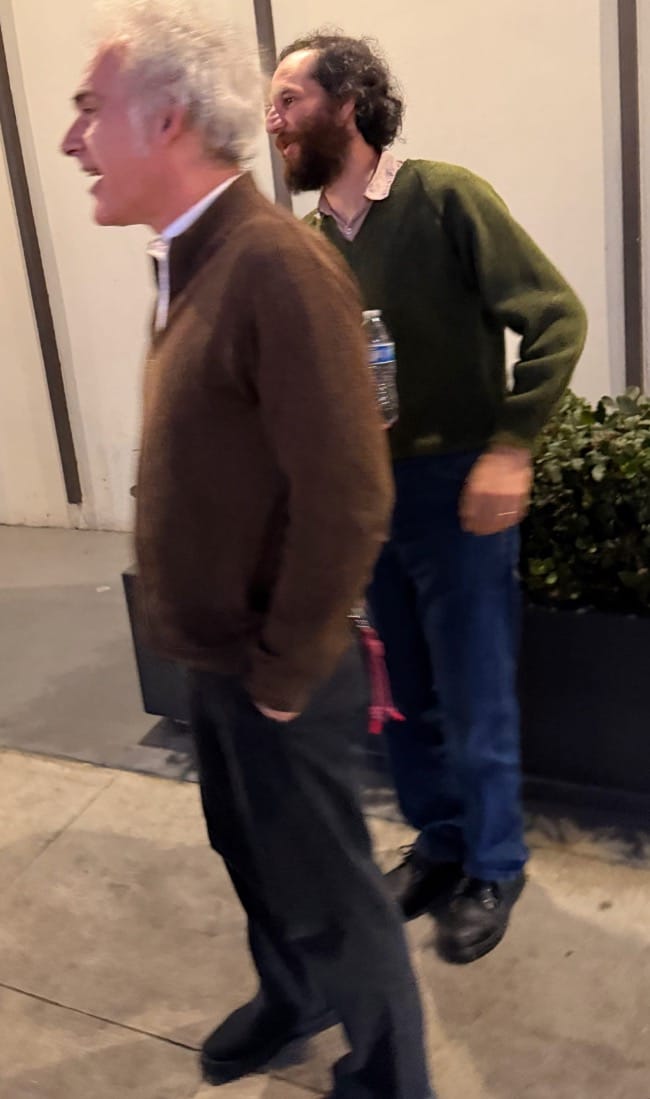
Multi-hyphenate filmmaker Josh Safdie has recalled being winningly struck by Ron Bronstein’s visage the first time he saw his future work-partner on a New York street. And it’s true that even from a slight distance the sometime actor’s leonine head begs to see him cast as a Roman emperor, with his enviable wreath of graying blonde hair forming a contrast to Safdie’s aquiline-nosed, often-smiling face under a slightly unruly bird’s nest of a darker hue. What makes Safdie equally magnetic as a study is his sheer zeal for his craft. That enthusiasm was exactly the right gear to engage for the duo’s recounting of their work process on “Marty Supreme,” which opens from A24 on Christmas. It’s the next ascending step, one that stands to move him from upstart hitmaker (2019’s “Uncut Gems," made with brother Benny Safdie, brought $50 million against a budget of $19 million), and helped tee up Adam Sandler for the Master Thespian stage of his career.
The warm reception for the film and its makers was thanks to the generally transporting effect of the film’s mostly-breakneck two hours and forty minutes. The pace and general freneticism of the cascading emotional turns, mingled with purposeful chaos edgeing into violence, left the full house in the hall sated, but eager and curious for the chat that followed via thoughtful queries by moderator (and Rotten Tomatoes Awards Editor) Jacqueline Coley.
“Marty Supreme” opens on Christmas Day but has been widely seen by tastemaker audiences –e.g. at a special screening for the foremost table tennis club in Los Angeles—and a raft of critics who’ve posted some near-ecstatic reviews. Such takes have ranged from “a rare film that will become a watershed moment in cinematic history, in the same way that Taxi Driver and Pulp Fiction did,” to “a riveting study of a man who fully believes it when he says, `I have a purpose. You don’t. And if you think that’s some kind of blessing, it’s not.’"
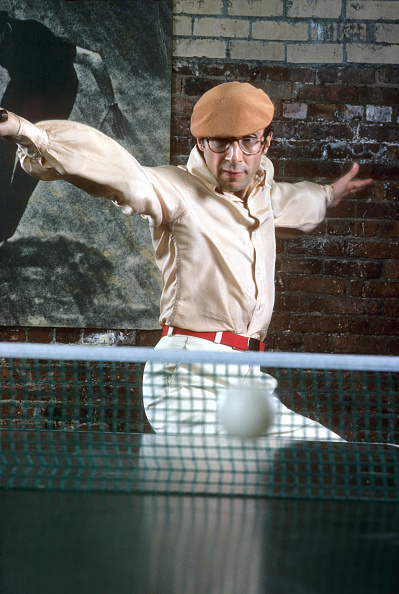
If “narcissist” has become a perhaps-shopworn tag for people who don’t know how important we are, Timmy’s Marty is that personality cubed, and the alchemy of the performance is that while derived from the actual Marty Reisman--who used his inborn hustle and athletic chops to seek international fame--the film’s Marty Mauser thinks globally but hustles you locally.
Deeply sourced and gobsmack-ingly authentic as Chalamet’s performance is, Timmy as an Oscars tout has a tough heat with Leo DiCaprio’s “One Battle After Another” dude, Michael B. Jordan’s dual role in “Sinners”, and—indulge me in a fave-film, dark-horse pick here—Paul Mescal as Willie the Shake opposite deserving actress front-runner Jessie Buckley in the achingly humane “Hamnet.”
We meet Marty in the kind of city shoe store that only designer Jack Fisk could make so wholly credible, where our hero (or varlet?) canoodles and more with unhappily married neighbor Rachel (a revelatory Odessa A’zion). He also and defies his uncle/boss as played by none other than Larry Ratso Sloman, who, in a just world, surely took time on set to treat now completely known Dylan-re-incarnator Chalamet with tales of riding in the back of the bus with the Rolling Thunder Revue squad. (Said surprise was exceeded in stunt-casting reach only by Shark Tank’s Kevin O’Leary as the justifiably jealous spouse of—and we’re still talking about masterful casting pranks here—Gwyneth Paltrow’s wholly satisfying portrayal of faded movie star Kay Stone.)
The needle drops of songs from Peter Gabriel to Public Image Ltd. to (urgh) Tears for Fears further display that these filmmakers have no problem telling their 50s story using jittery 70s camerawork (“Seven”’s Darius Khondji) with an 80s soundtrack.
It appears that Josh, 31, has set his course to operate going forward with what the industry’s art-house droogs call “third brother” Bronstein, leaving younger sibling Benny, 29, to make his own pop-auteur way with the recent, only lightly embraced, “The Smashing Machine.”
Both men onstage studded their accounts of shared work by spouting confessions, or perhaps they veered towards humblebrags, and about the tempestuousness of their work relations. Each made it clear they are working through their own challenges and neuroses in the process. Bronstein: “Since the subject matter is always so personal, and all the dialog, all the. hostile, humiliating exchanges that we put in our work, is coming from personal experience.
“It's an intimate, invasive process, and then the other person will just take an idea and just beat the shit out of it, just tie it to a chair and force it to confess its weaknesses. It’s incredible our friendship survives.”
One of Safdie’s strengths is deep research, which he credited onstage to his wife’s position heading that work up for the production. (Bronstein, too, has a spouse in the business—actress Mary Bronstein is currently enjoying considerable acclaim for writing (and directing a much-lauded Rose Byrne) in “If I Had Legs I’d Kick You."
Safdie is clearly the “show, don’t tell” part of the equation, Bronstein states: Whatever my contributions are, they are going to be fleshed out and placed in an entirely three dimensional setting with an incredible attention to detail.” For a man who pored over a ten-book history of ping pong, Safdie’s concise take -on the theme of writerly combat: “My dog is not allowed to sit in the writing room anymore. Because it stopped being nice to him.”
Safdie, having incorporated Sandler’s portrait of barreling desperation in “Uncut Gems,” cites Chalamet’s stuffed-away charm as enabling the Marty character’s different self-spawned emergencies embody a passion we cling to. Bronstein: “The issue of like, likability never really comes up between us, because we're looking to love these people all the time, not because of like, not in spite of their flaws, but because of them, in a way.”
Of the immersion by of the still youthful Chalamet, who turns 30 December 27, Safdie adds, “With Timmy, I was interested in a person that I hadn't seen him do yet [onscreen], but I was interested in this person I gotten to know over these seven years. So a lot of it was him taking the words that we put on page and using them to talk about his own life and use it, use the text as a tool to understand yourself. And he was very generous with that.”
Safdie’s summation is best understood once one’s seen the film, but it’s useful insight as to the title character’s journey: “With this film, we had a somewhat overarching structure. We knew an ending at least, and we knew we wanted to explore what change could be--a deep rooted change.
“Dreams are for the lonely. Here Marty’s [realizing] what is a dream? I believe that the there's a sympathy there, and I believe that there's a yearning for connection, And that the movie is about belief.”
Also: for a lively take on the real Marty back in the day, read David Hirshey's New York Daily News story :

Finally, enjoy M. Chalamet's sardonic but amusingly lifelike rendition of a self-important star seizing the reins of a marketing strategy Zoom meeting, or "pitch package": Timothee_Chalamet_internal_brand_marketing_meeting_MartySupreme_11.08.2025.mp4
Comments ()