

In 2026, "Pluribus" Speaks To A World Stuck in Neutral
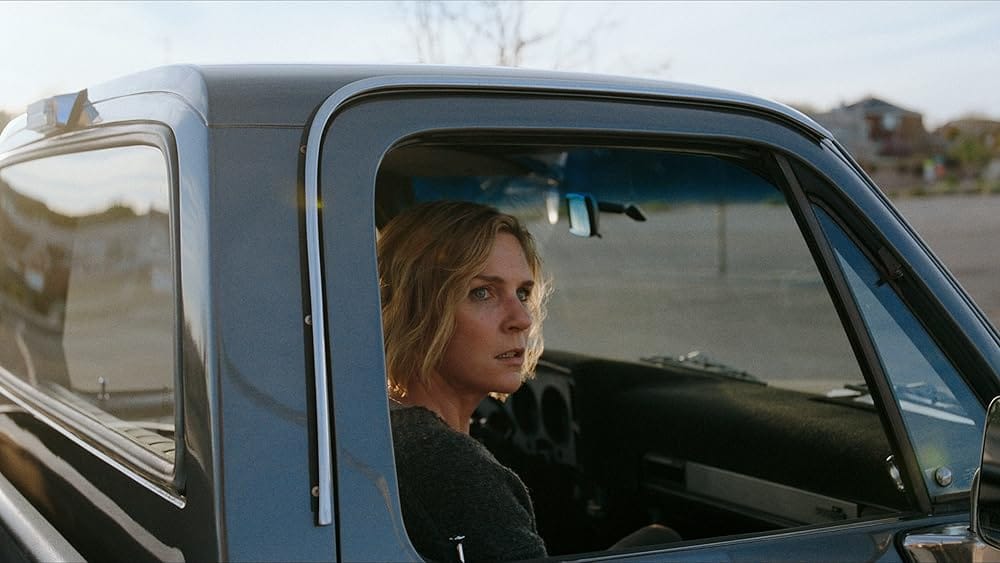
You or I might believe we comprehend the actual science underlying the viral event that, in Vince Gillian’s Apple TV series “Pluribus,” eliminated a goodly portion of the earth’s population and effectively enslaved all but 13 of the rest as a hive mind. But that sci-fi mumbo-jumbo, cleverly postulated as it may be, is not the secret sauce of what makes the show so itchily addictive.
An equally enticing mental pursuit is to wonder just what our metaphysical takeaway is meant to be—minor topics, like what is the nature of existence?
I know, we may need to put a pin in that question until Trump leaves office, can’t we just do that? There’s the stuck-in-neutral part; are we really living in a world where Vanilla Ice is playing the New Year’s ball at Mar-A-Logo, with Stephen Miller and Kristi Noem cosplaying humans grooving, while some guy, in real time, paints a garage-door-sized portrait of Jesus?
No, Jesus wasn’t there. Or if he was, he left early. (Or did ICE snatch him?)
So yes, the real world is baffling enough before getting all… ontological. You know, chewing on the essence of “being” itself.
Gilligan has spoken sparingly as to what the deep-rooted inspiration for the series may be. As he put it to the A.V. Club in a nimble promotional interview: “The tagline that I used when I pitched to Apple was something like,` The most miserable person on Earth tries to save the world from happiness.’”
But before we all think he’s put us into the dark future out of sheer whimsy, Gilligan offered another clue as to what’s going on with the Rhea Seehorn character Carol Sturka, who’s onscreen or in our thoughts almost every minute of the nine episodes: “Those are the kind of stories I like, where the audience can say, “You know, I don’t know if she’s even doing the right thing. I know her heart’s in the right place, but is she even doing the right thing?”
Having watched episodes one through nine hasn’t done all that much to fully inform us as to the ultimate aims and nature of the “joining”. Gilligan et al have made the show’s slow burn quirkily entertaining. It owns an often picturesque and complex surface from the first moments, where an array of radio telescopes try to read the cosmos, while elsewhere, doomed lab rats (along with us, it seems) meet their fate. It has its own strange music, perhaps embodied by a searching, solo French horn and sometimes a full orchestra (Dave Porter does the enticing score) . I can’t read sheet music, but I can hum a few bars of the eclectic needle drops . Some familiar, as Sheryl Crow singing “My Favorite Mistake” as the background vibe in the magically recreated diner that was Carol’s go-to in the Before Times. This attempt to assuage Carol's anguish (that just brought her a Best Actress win at the Critics 'Circle award) is almost as disturbing as the lonely anomie she's been suffering.
The transformed world that we see in the often-riveting initial episode has already been spottily incinerated as the unknown virus overtook the global population and left them almost ghoulishly comfortable with their straitened, hyper-educated but near-mindless lifestyle. "There's no drama in happiness," Gilligan said on the first of the chipper, official "Pluribus "podcast, but he's just the man to find the bitter humor in an unhappiness that stirs Carol to demand, in Episode 1, "What the hell is wrong with you people?" Gilligan, like Carol, is a writer who found early ,ostensible success and yet saw a beloved one-from-the-heart project shelved. (Hers is the novel, Bitter Chrysalis, his the would-be series "A.M.P.E.D." , which became the film Hancock.) We watch Carol go, in just minutes, from pulp-novel queen to simply getting the damn TV to come alive. ("God Bless America!" she exults when it does. )
Gradually the darkening sci-fi elements (that suspicious milk!) of which the podcasts unveil but little, show her isolation as we clutch for some hope in the person of antagonistic anti-joining Paraguayan zealot Manousos (Carlos Manuel Vesga). So avid are the de-individualized, happy campers to recruit Carol that, in their “joining,” they create a throwback, old-school moment in the eatery, right down to actual chow that the not-quite-humans buy with actual money. This fresh hell we might compare to our own wish to eliminate the pat celebrity-bio screeds that crowd into our social media and pose dumb-ass machine-learning queries under our every post.
Gilligan does make clear that the entire enterprise he meticulously depicts is inspired in part as a homage made up in almost childlike innocence: “I love all the old tropes. I love the wonderful, classic sci-fi stuff like Invasion Of The Body Snatchers and “The Twilight Zone” and all their twists.”
When we post-millennial folks first began to reach out online seeking shared wisdom—the “hive mind” we called it then—is now not so quaintly, one all-knowing concatenation of all human knowledge and skill sets. (Thus, people who might have been waiting tables at some trougn-1n-brew outlet can placidly pilot, say, a repurposed Air Force One. The quietly heartbreaking darkness of Gilligan’s “Breaking Bad” creation Walter White roaring “I am the danger!” at his long-suffering wife, the still more heartbreaking emotional jailbreak of Rhea Seehorn’s Kim sharing a forlorn ciggie with Bob Odenkirk’s title character in “Better Call Saul” are hardly more disturbing than the meh of the docile, shuffling mobs. The show runner’s slightly good `ol boy wittiness in the seams of the dialog on earlier shows was never quitter as chortle-producing as the cranky outbursts from Carol as the too-canny happiness missionaries school her with passive-aggressive lessons.
So, before we dive too deep into the phenomena of ordering up an atom bomb from a mild-mannered DHL delivery man, or of an obliviously sinister oaf becoming president because he was in the right place and time wearing a suit (okay, that can happen in real life), please, er join me in remembering what kind of filmed magic Gilligan and his team have made over the years.
These brief accounts are perforce somewhat first-personalized, but perhaps you’ll indulge me.
Over time, since he emerged from honing his chops via the second season of “The X-Files” to present our “Sopranos-schooled pop culture with January 2008’s debut of “Breaking Bad,” I’ve had the chance to speak with Gilligan sporadically. First up was while doing a blog titled The Hollywood Deal for the sadly short-lived Wall Street Journal offshoot Portfolio.com. Here’s how that moment struck me then:
The high desert. A pair of khakis floats into frame, billowing in the wind as they descend and are flattened by a rocketing camper van, which crashes. A man in white briefs and a gas mask, clearly in extremis, jumps out, pulls a shirt from a coat hangar on the rear-view, camcorders a message t0 his wife and son, and stands in the middle of a dirt road, holding a gun he's retrieved from an indistinctly bloody and body-strewn scene in the van.This is the opening of the abruptly popular (its first two episodes were among the most downloaded shows on iTunes this week) AMC series, < The man is Walter White (played with expert and endless flop sweat by Bryan Cranston, of “Malcolm In the Middle,” and his creator is Vince Gilligan.
“A guy in his underwear in a gas mask,” Gilligan told me in his folksy Virginia accent the other day, “that kind of stuff came to me pretty early on-- and then I had to go back and figure out why he was in his underpants out in the middle of nowhere, I kinda came up with the image first and had to reverse engineer it to figure out why.”
Without spoiling the fun—if that’s the word for a show that often dips out of comedy into pathos and violence and then back again—Walter White is a high school chemistry teacher with a moonlighting job at a car wash (getting respect at neither, and just hitting age 50,) with a drolly determined wife and a son afflicted with cerebral palsy. When he stumbles into the disintegration of a meth-cooking ring (riding along with his brother-in-law, a DEA agent), he takes up the trade in the company of a smart-ass, screw-up kid who once studied with him…
[The remaining 1100 words of commentary and quotes from past and present are available below for members]
As Gilligan puts it, “The irony is that at the verge of death he really comes to life for the first time; this idea of coming to life in the face of death is an important one for the show."
Given the warm reception thus far, has he had second thoughts about diagnosing his male lead as having just two years to live? And is there a way to fix that?
“You can really piss off your audience, really alienate them if you pull a quote, unquote `Dallas’, like that season that turned out to be a dream. If you let your character off the hook too easily audience will bite ya in the ass for it and rightly so. That would be a major shark jump at that point and so I might have written myself into a corner. But I’m just taking it day by day at --this point I just really hope for the show to reach an audience and be well received.”
Finally, the show’s one-sheet, of a half-clad Cranston standing stricken in the desert clutching a gun—did Gilligan recognize that as the key image the moment he saw it?
“Nope, I didn’t. I should have seen that coming because the whole time I was there on that location out there in those boondocks west of Albuquerque shooting that stuff, I was thinking `What’s the poster gonna be? It never dawned on me it was it was standing in front of me sipping on an iced tea.”
By July of 2012, I was doing a story previewing the final season for The Wrap’s magazine section: ‘Breaking Bad’ Getting ‘Darker and Uglier,’ Bryan Cranston and Vince Gilligan Promise”
To the delight of the photographer, star and showrunner willingly enacted a sketch where Cranston volubly and with fierce gesticulations, purported to reject the latest Gilligan script: Floating sheets of script settle slowly to the floor as Gilligan, aiming for a deadpan expression rather than trying to match acting chops with his much-honored leading man, ends up looking credibly agog.
When it’s suggested to Gilligan that a hugely dominant and irreplaceable lead actor can occasionally create almost as many problems as opportunities, the daring, inventive storyteller grins. "Yes, sometimes it really goes south," Gilligan says in his soft-toned Virginia accent, thankful that’s not his problem. "The quality that made our show work was Bryan, and I’d say that whether he was standing here or not.
"Our main character is a guy who decides to become a criminal, a bad guy. And as you would expect, during that process, he becomes less and less likable. If you had someone in the role who at base was less than sympathetic, less than likeable, you’d be off on very poor footing from the git-go…”
Cranston: “The thing that is difficult for me to accept is his whole ego. His hubris, greed, and avaricious nature are foreign to me. I have to allow myself to go there and have him become the peacock that he is."
You might think that after playing the character for three years, Cranston would have some ideas about where the show should go from here. But he insists that’s not the case, that in Vince he trusts. “This is his baby,” he says. “I’m the surrogate father, but he is the sperm donor, and he fathered this. He is the master and commander, and there is no discussion of where it’s going. I don’t even ask him,"
By the time Gilligan and creative colleague Peter Gould had spun up and againsucceeded wildly with another dose of Albuquerquean woe and criminality with the offshoot “Better Call Saul,” they were quick to realize that much in the fashion of Aaron Paul arriving at stardom as Jesses Pinkman, the initially underused Seehorn was a full-on discovery with the chops and magnetism to carry the series alongside Bob Odenkirk. In a piece for the Los Angeles Times, “A Couple That Schemes Together, Dreams Together”, in August 202, I spoke with Gould about writing and directing the show’s final episode:
https://www.latimes.com/entertainment-arts/awards/story/2022-08-16/criminal-couples-saul-ozark-succession
Seehorn’s work had earned its own way to her late-season tour de force showing:
Gould: When we started the show, we really didn't have a clear idea of where we were going with the Kim character. In fact, if you've watched the very beginning of the show, the pilot, I think she has maybe three lines of dialogue. And then the second episode, she's only a visual presence. We were feeling our way through it. And then as we worked with Rhea, and as we got to know, our main character, Jimmy better, we started understanding how central she was going to be to his journey. As the series went on, of course, it turns out that Kim has a wild side.”
(From here commence some spoilers as to “Better Call Saul’”s concluding passages.)
Gould added that Kim’s treatment of the grieving widow of the Howard character (played by Patrick Fabian, who has a delicious cameo in “Pluribus), “Is convincingly unforgivable, maybe the worst thing that she's ever done in her life, which is that she gaslights her with lies, lies to her about what she's seen, and to reinforce the legend that [Kim and Jimmy] built.
"Part of the brilliance of Rhea Seehorn’s performance is that there's a paradox at the heart of it… she has the best poker face, maybe of any character I've ever seen--an ability to hide her thoughts and intentions from the other characters. But somehow, and this is the contradiction in the miracle. The camera sees everything. It's a magical thing we've learned to write over the years.”
Perhaps even more memorable as indicator of her skills is her farewell to Jimy, as we know Odenkirk’s titular character: “What Rhea brings that line—"I didn't want to end because I was having too much fun.” The way she says the word fun, has so much depth to it, so many levels. But clearly she hates herself for what she's done.
"That's the wonderful, terrible, painful thing about that scene: she's doing the right thing for herself. She's doing the right thing for Jimmy and for the world. But she still loves him, and he loves her.
“But the one thing she's determined is that…she's been, she's going to carve a new path for herself. And whether we get to see that path, or what that path might be, is a question for the future.”
The rest is indeed part of Kim’s story best discovered, or rediscovered, on one’s own. But the thought that occurs is that Seehorn, if we look at her future, is becoming something of a legend herself.
Comments ()