

Hockney's "Hand Eye Heart": latter-day discoveries in his "journey to light"
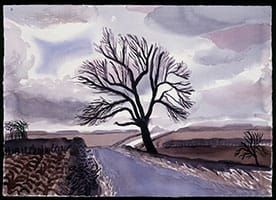
Far from white-hot L.A., David Hockney embraces the cool vistas of his youth.
By Fred Schruers
Los Angeles Times January 30, 2005
SPECIAL TO THE TIMES
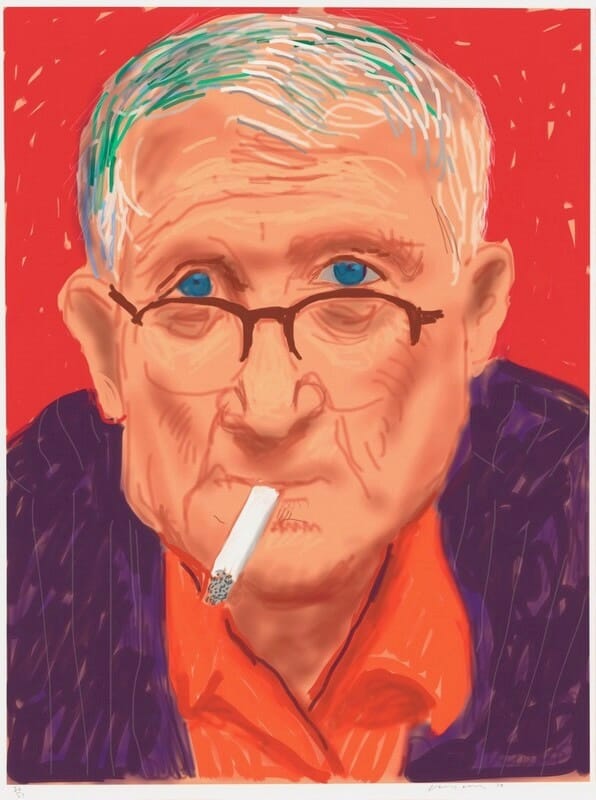
Bridlington, England — DAVID HOCKNEY stands in the filtered gray daylight of the train station platform, a stork-like figure whose cane and upthrust chin set him apart as he’s scanning the arriving passengers. He’s wearing a stylish fedora, dark greatcoat and a suit that will prove to be cashmere, a sensible outfit for a December drive in the English countryside with the window halfway down. Hockney, who at 67 has let his once-peroxided hair go comfortably pewter, smiles at the visitor and extends his hand with an intriguing mixture of warmth and reserve.
“Not many people go to Bridlington,” he almost immediately says with a conspiratorial savor. “If you tell someone in London you’ve been to Bridlington, they won’t know where it is.”
York is only a two-hour train journey from London, and Bridlington is an hour’s drive beyond that, but it’s a drive into a seemingly unchanged world. Bridlington is still in part a fishing village, in part the seaside resort Hockney’s family visited in the ‘40s and ‘50s, where he bought and furnished a comfortable home overlooking the North Sea for his mother (who died in 1999 at age 99) and his sister, Margaret Hockney, who lives there still. “It was built by a Bridlington trawler owner for his ugly daughter,” says Hockney, who made a point of not removing the number plates that once guided patrons during the house’s latter days as a bed and breakfast.
Hockney, strolling toward his car in a way that shows the cane to be more accessory than necessity, wants to know how the journey from London was. As a seasoned trencherman, he seems pleased that his visitor enjoyed a full English breakfast en route. Our mission today is to drive via back roads through East Yorkshire – not to be confused with the Yorkshire Dales, the more famously picturesque terrain to the west where Turner painted landscapes – and look at some of the locales that inspired the 55 watercolors in Hockney’s upcoming (Feb. 26 through April 2) show at LA Louver gallery in Venice, Calif. It’s titled “Hand Eye Heart,” after the Chinese formulation describing what painting draws upon. The show’s mostly roadside vistas share a rough-hewn beauty that’s rich in mossy greens, lavender-gray skies and stark, winter-stripped trees and hedgerows. One grouping is of 36 smaller paintings, hung four scenes high by nine scenes long, composing a pastorale in lush green and rich yellow hues.
For all its pleasures, it’s a show that could induce in Los Angeles art lovers a feeling of suspense and even poignancy, for these works were inspired by and executed in Hockney’s native country and mark the culmination of three years largely spent away from his L.A. home and studio off Mulholland Drive. Although he won’t state outright that he’s away from America indefinitely -- he’ll casually say things such as, “I’m a claustrophobe, that’s why I live in L.A.” -- he also gives no timetable for his return.
Blame a great deal of his urge to roam on his newly discovered medium of watercolors. What began as a few portraits in the late ‘90s flowered into a group of works done in Spain, then bravura Norwegian and Icelandic landscapes. Hockney learned the craft quickly and came to love loading up his brush for the kind of strokes that require real commitment.
“A painting is an artist’s account of looking at the world,” he says on this day, a credo he’s stated before. The world he’s seen recently is revealed (though sometimes barely, as with one fog-shrouded row of trees in the new show’s untitled signature work), largely under northern light. His studio in the Bridlington home’s converted attic lets in the same faint glow, and the L.A. show’s “Bridlington. Garden and Rooftops III” invites you to make what you will of the sedate view north from it.
Hockney’s friend, writer and cultural critic Lawrence Weschler, has written an essay for LA Louver’s catalog, and he finds “a return to origins” in Hockney’s autumn- and winterscapes: “the sense of returning in winter, perhaps, to one’s own springtime.”
CONTINUITY, NOT CHANGE
Hockney leads the way to his tan Lexus, which he chose as the quietest ride this side of a Bentley. He immediately rolls down his window and lights a smoke,...