

Finding the heart of "Hamnet": "This great act of magic"
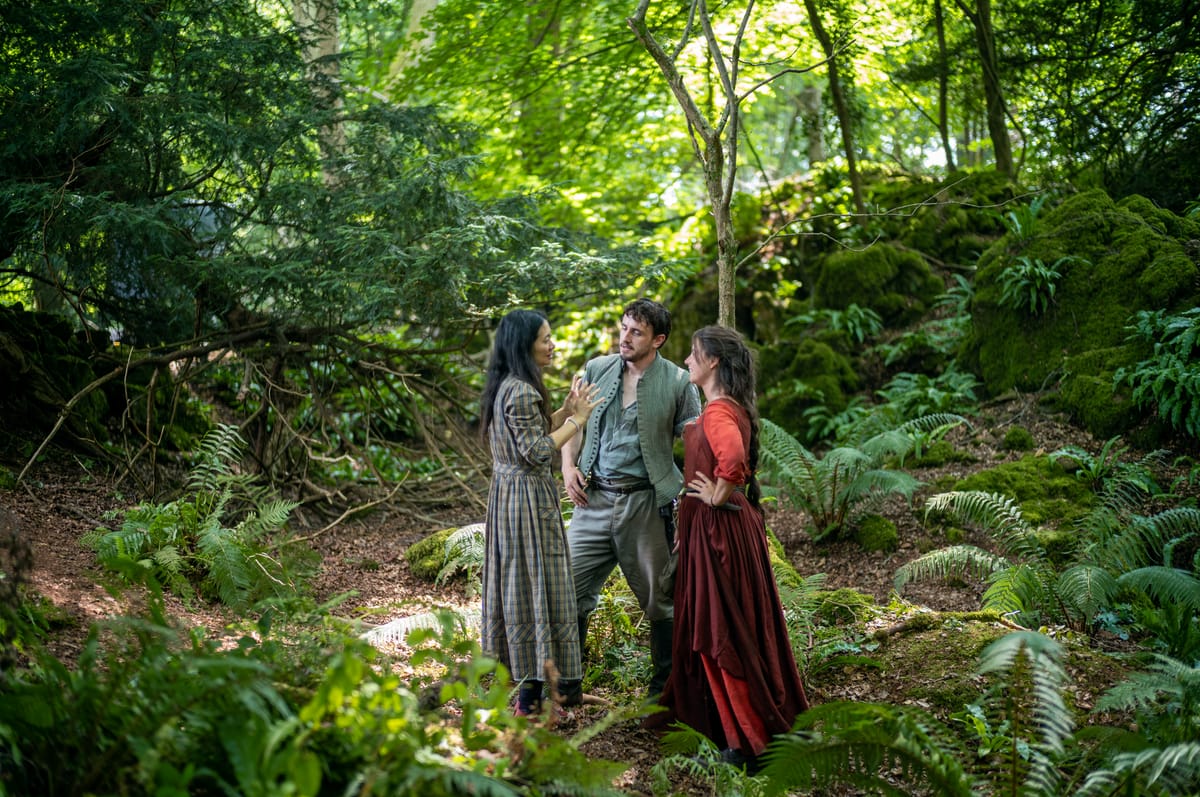
The mission of this post is uncomplicated; the hope is to invite cinemagoers to one of the year’s most worthwhile film events--the heartbreak machine (and immediate awards contender) “Hamnet”. For those who may feel challenged by the many warnings of its deeply sorrowful moments (as well as carps from various high-tier critics that those depths are manipulative), I’d still encourage attending. You don’t have to buy into the annual Oscars politicking (though Best Picture, Director and notably, Actress nods all seem within reach) to appreciate the intense yet steadily naturalistic work by the cast.
No one is surprised by the revelatory turns from female lead Jessie Buckley as Agnes, and from Paul Mescal as her screen husband --okay, a/k/a Will Shakespeare. But other performances beckon you in—notably the couple’s son, the title character, as played by young Jacobi Jupe. (He's now 12, almost two years after the shoot wrapped).
At the screening I attended at the Director’s Guild Theater in Hollywood, where the sound system is cleanly powerful and immersive– a proper enhancement for the resourceful sound design–Jupe won standing-ovation audience applause second only to Buckley. (Mescal was elsewhere, presumably in rehearsals to play Paul McCartney for Sam Mendes in a Beatles four-film event, slated for April 2028.).
Though she can deliver a cogent soundbite on her creativity, the raised-in-Killarney Buckley keeps her actor’s armamentarium slightly veiled. Before even digging into the film’s source material (the 2020 award-winning novel by co-screenwriter Maggie O’Farrell), she began considering the role while shooting a film in New York, while in her spare hours often texting with Zhao.
A personal rapport had formed on their phone screens, but then came a somewhat impetuous, abrupt meet-up in Buckley’s lodging, one that sparked up as both were up late-messaging: “It was 1 a.m., “ the actress related in the post-screening panel interview, "And she texted back and said, `I'm not [sleeping].' And I said, “Well, come over.” And so I opened the door, and the two of us kind of fell into each other's arms, sat on the couch all night, chatting, sharing the deepest parts of ourselves with each other.”
Zhao had been through a break-up not long before, plus family broodings and loss, which became the planking for discussing the book-into-film performances paths: “It was just, `I’ll show you my heart, you show me yours, and all of this will feed into the story.’ This woman is fucking amazing. She is an incredible leader, because it's not born out of ego, it's born out of community.
“She's constantly on an exploration and excavation of herself—it’s very rare that you get a leader like that who's consciously leading from the feminine point of view, exploring the language of cinema through that, and trying to tenderize the edges that have become hard in our industry and in our culture with her heart. And I think she is a master.”
The commitment to such shared investment grew as Buckley began to find the emotional center of Agnes. The work at the beginning “Was very scary”—here she cast a look at Zhao—“I was lost when we started shooting, because I got on this massive journey”-and here she gestured fondly to young Jupe beside her—"with this little man, and with Paul and with Chloe and with all the crew.”
(For those avoiding major plot points, and not cognizant of Shakespeare’s at-points-contestable history, here commence certain spoilers.)
“You hope,” Buckley continued, “to bring this story to the next place and hand it over. And being honest, at that time I was really wanting to become a mother myself”—as she would—"and it was intense, because [the story] was about losing a child. This whole journey was almost too much. The first few days, I was so lost, and then I realized, of course, I’m meant to be lost, because that's exactly what Agnes is like. It's too much to try to contain this grief and find the thing that is lost.”
With her unfussy and somehow innocent brand of beauty—the intimation of an overbite, the self-sufficient but open gaze, the rock climber’s physique--she’s generally believable from first glance, a marvel that works splendidly with the character’s forest nymph, woodlands-witch presentation. The novel dares, as does Zhao, to let the primary couple’s attraction gallop to the fore almost at once, and given that the big-featured Mescal is quite the Gaelic football hunk himself, it feels like it’s we the audience, rather than the director, who wills them to a first kiss.
If the historical setting in the late 16th century has long baffled scholars as to Shakespeare’s precise life details, it plays into Zhao’s own free dive into the eternal verities of family life and loss. Though the playwright penned a couple of lesser works after the plot-triggering death in the family, there’s little dispute that “Hamlet” (a name interchangeable at the time with the film’s title) is the Bard’s chef d’oeuvre. You could call it a tragedy, as indeed it's one of revenge with swordplay and poisonings, but the scholar Frank Kermode posits that what the playwright created (and what we see in Zhao’s film) is what the play’s character Polonius would call a “poem unlimited”.
Somehow Buckley finds a way to spit out Early Modern English colloquialisms that don’t feel anachronistic but do reveal the character's free-spiritedness, and Mescal is a smart enough scene partner to hold fast to Will’s own interiority and reservedness. We do get why he pounds on the table when he’s stuck in his writing—as with our eavesdropping on his growling rehearsal of the young actor who will step up in the play’s final act at (of its first performance) at the rough-hewn Globe Theater, Zhao is preparing the stage, quite literally, for the transformative events that cannot help but batter, then win, your own emotions at the story’s end.
Panel guest Joe Alwyn, who plays Agnes Hathaway’s brother Bartholomew, remembered the atmosphere of the story's concluding events under gray English skies: “In the moment, over those days watching this performance on stage, it was like collective therapy…I've never experienced something like that en masse before, and it felt incredibly focused and cathartic, unique and really moving to see everyone be so vulnerable in front of each other, whether you were being seen on camera or not. You could just feel it around you, with 400 people.”
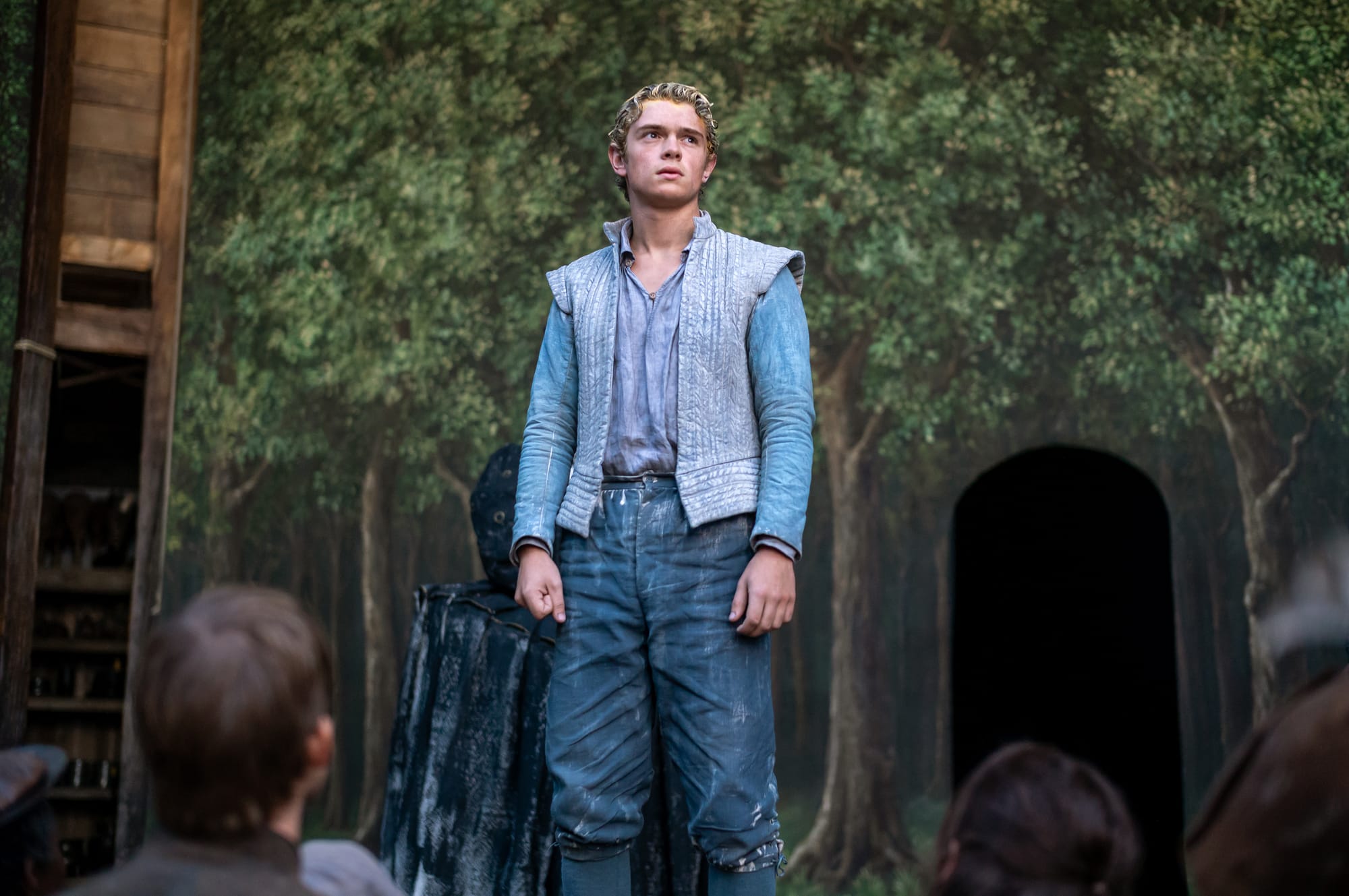
Perhaps the most charged moments of the work's entire emotional arc are provided by Jacobi Jupe’s older brother Noah. As a filmgoer you could be forgiven for doubting his prospects to bring the scene off. “Good luck playing this,” you might mutter as the story reaches its zenith. You wonder just what could come of the near-solo minutes onstage wherein the increasingly fierce engagement of the Globe audience (and we’re right there with them) meets the words Shakespeare crafted centuries ago. After some byplay with younger brother Jacobi (who was cast first and japed fraternally in the panel, “I got you the job,” ) Noah admitted his unease: “Coming into it, reading the script and seeing the character [whom he would portray onstage] of Hamlet, and all these monologues feel really lonely– you're doing them to a faceless audience, having to perform on your own out there. And I was really nervous about it.
“But then came this experience that Chloe created, with these people, this environment where everyone was connected. And I remember first day, walking out doing the dress rehearsal, and Jessie was there--just her, because none of the background actors were there—and suddenly I had someone to act to, to share the scene with, and it wasn't lonely anymore…I just felt this sense of support for Jacobi and for our family.” Even more arresting–and this thought is best appreciated once you’ve seen the film--is how the elder Jupe all but reincarnates the lost namesake and stitches toether the fragile, woeful yet somehow joyous meeting of wounded hearts. He, and we, and Mescal in ghostly face paint, and Buckley indelibly, live the moment together, feeling the younger character’s unseen, figurative but palpable presence in the theatrical space. Noah: “Jacobi had to be part of that last scene. He had to sort of come and end the film with all of us.”
Critics and colleagues, not to mention the filmmaker herself, have propounded a theory that the film's creative ignition for the auteurist leader Zhao truly emerged from her own heartfelt, kindred immersion in the story she co-wrote, directed and co-edited. She is at some level Shakespeare struggling with his own grief, crafting a template for finding a way through. As Buckley explains those final onstage moments–the characters, for the muddy-footed groundlings at the Globe, and for we filmgoers, are all caught up in the redemptive power of art over unspeakable sorrow. It became a moment when Agnes and the woman playing her fused: “I was looking at Will—and Paul--recognizing what he'd done– this great act of magic. He'd taken something that I initially was so angry about—“How dare you take my grief and give it to people I don't know?", and then I realized what he did was create a portal to transcend that grief through creating this play. And in that transcendence, it gave me access to the thing that I lost, which is my son.”
Comments ()