

"Disclosure Day": Steven Spielberg Wants A Better World...Now Would Be Good
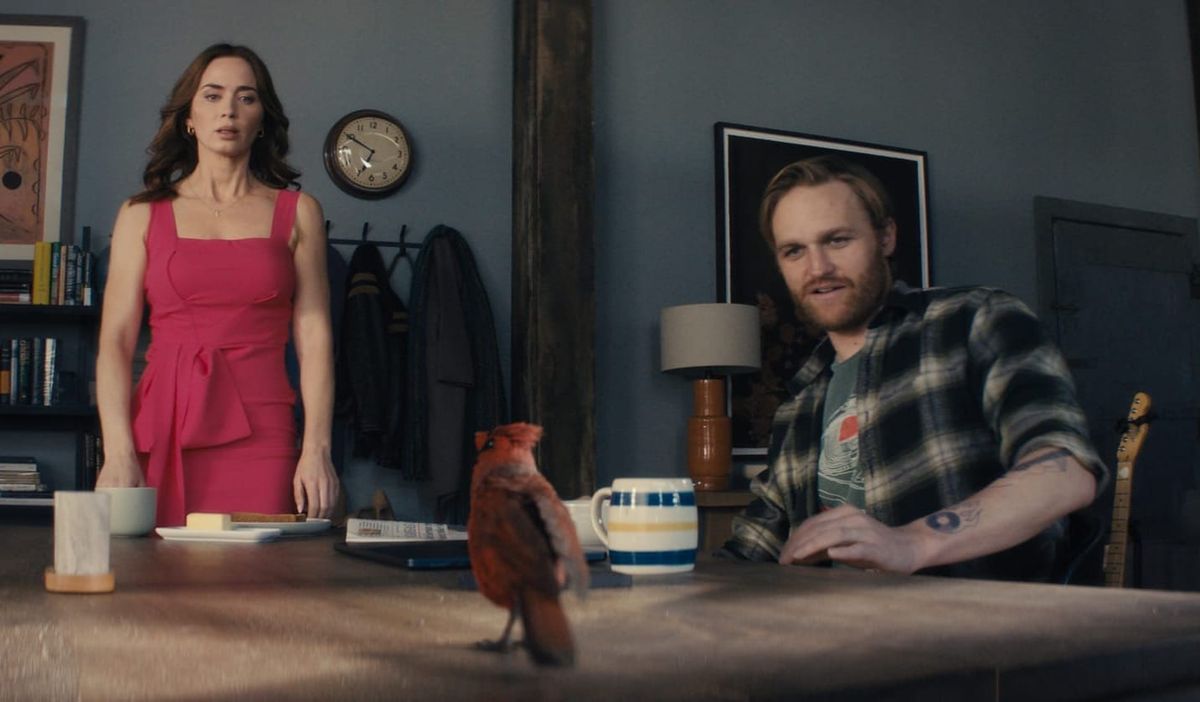
The cardinal, also known as the Northern Cardinal, is the official state bird of six American states. New Jersey, where the American Goldfinch owns that title, is not one.
Still, when Steven Spielberg spent his early years in what’s known as The Garden State, examples of the species were, as now, throughout the Jersey suburbs--from the Spielberg family’s southerly enclave of Haddon Township to my hometown of Mountain Lakes ninety-six miles north.
Up there, in summer picnics, on a slate patio under big oak trees, we enjoyed the head--bobbing presence of the twittering specimen we named Norton after the Art Carney character who also would seldom shut up throughout the domestic perturbations of “The Honeymooners.”
When a stray cardinal pops through the open window of the loftspace weather woman Margaret Fairchild (Emily Blunt) shares with her boyfriend, they’re querulous as the moment changes the film’s early reels from menacing to…chirpy. And Margaret is soon piping up in fluent Russian to her boyfriend Jackson (Wyatt Russell).
It’s the most blithely entertaining passage of the film– hich film, to its credit has much weightier things it’s striving to get at. This viewer did wonder if , and how, the bird —red-hued as males are– was perhaps CG-spawned, or maybe an animatronic rig. (Some critics have griped that certain creatures seen later, in their role as incarnating aliens, display a taxidermical look.) In due course the bir d mage will be seen again; as with so much of Spielberg, childhood still has things to say.
We watch that first fly-by greedily because Blunt’s got that kind of magnetism onscreen; it’s as if she earned her reported $15 million payday quote simply by showing up. She's more than an empathetic; she's a mid reader. When se sees you, man, you've been seen.
You know, was the story unfolds, Spielberg wants that for us all.
So powerful is her presence that when the born-clueless Jackson exhibits his bafflement at her magic trick, we want him to stay near, to share the frame. rather than give way to a parallel chase scenario following phlegmatic math wonk Daniel, whom we just we met in the movie’s opening moments. He’s been hiding in the crowd at a pro-wrestling match (no one could have predicted that another outbreak of fake violence for idiots would be coming to the White House this same week).
The momentary capture of Daniel and girlfriend Jane (Eve Hewson, adding another high mark on her resume’ even in her snack-size role ) comes off almost like a meet-cute between that couple and shadowy investigator Colin Firth. (And yet, as Vulture reviewer Bilge Ebiri notes, “Nobody seems to want to actually hurt anybody.”) The ever-accomplished British actor is a villain who somehow means well, sort of. Some viewers may have a reaction of “you again?” as his stalker tendencies play out. Any real loathing we have for him and his covert agency WRDEX can mostly be diverted toward seething henchman Boyd (Henry Lloyd-Hughes), who possibly wandered into the film from the `You , Too, Can Channel Lord Voldemort’ workshop.
The script, churned up from Spielberg’s original inspirations as typed out on an iPad Notes app, was undertaken across 42 drafts by his trusted colleague (“Jurassic Park”) David Koepp, and increasingly hinges on a hopeful spirituality that, is pieced together through, as the New York Times’ Manohla Dargis writes, “sober interludes that touch on belief, reason, trauma, self-governance, the common good and higher powers…”
Points were not docked for aiming high as Spielberg, she writes, “has something to say about the world and our place in it, and while you might dismiss his ideas and sincerity, there’s no dismissing his filmmaking.”
Even the sometimes sourpuss reviewers are telling folks to see it, to which I do agree. Sometimes crusty Guardian fixture Peter Bradshaw pasted up four stars the very enjoyable and entirely ridiculous space-alien conspiracy adventure…only Spielberg could get away with taking two of the world’s best-known hoaxes – Roswell and crop circles – and treating them with judicious deadpan respect,”
The Times was also all in with a piece by the always-cogent, multiple-Pulitzer winner Wesley Morris: “He has made a propulsive, lean-mean conspiracy machine that’s funny, intriguing and suspenseful — but it also concerns our alienation from something Spielberg is certain we desperately need more than ever: collective catharsis, the sort you come by at the movies.”
Morris captures an aspect Ebiri (whose oral history of the whole Spielberg canon is a must for fan-persons), the reviewer finding it to ultimately be a “who are we movie” that “can be messy, but much of its beauty lies in that messiness. It’s an astoundingly personal film.”
As this is being written, Universal is hoping that the critic’s reaction (a just slightly snippy 84 on Rotten Tomatoes) is advancing from Thursday’s $12 million to a number more galactic—perhaps the 300 or so million that Variety prognosticates could meet up with the tab of an estimated $115m shoot and eighty more million in promotion. (Update as of Sunday June 14: a robust $44 million weekend in North America is Spielberg's best new-to-the screen summer opening in 24 years.)
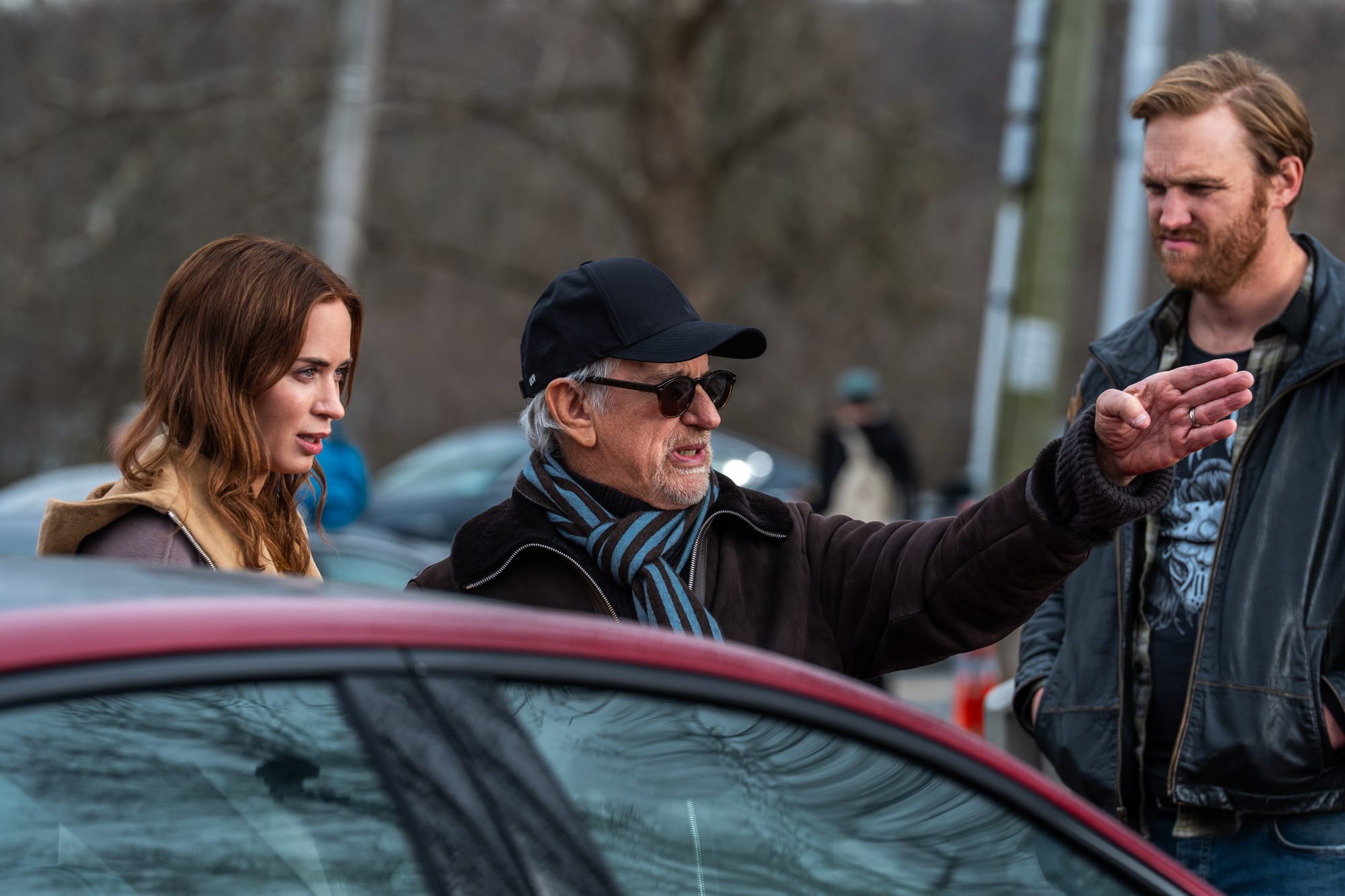
If some pundits have detected Spielberg’s zealous promotional availability as a seasoned hitmaker’s charm offensive, it must be said that, I’ve been lucky enough to fleetingly discover, he is a most companionable man. Morris speaks of “getting to know one of the great humanists as a human. And it’s an exceedingly regular man who made all of this enormous and enormously affecting art.”
My chance to meet him came around the time he was pulling off a perhaps unprecedented directorial coup, as Morris notes –the ability to essay both a heaving blockbuster (“Jurassic Park” would be the first movie to cross the $900 million mark) and one of the more impactful treatments of the legacy of the Holocaust. Morris: “More than once, he inhabited both modes within one calendar year: “Jurassic Park” in the summer of 1993, for instance, then “Schindler’s List” at the end of Hanukkah, perhaps the most triumphant single-year change-up any Hollywood director has had.”
I was witness to those accomplishments in the making, to some extent, having visited the set of 1991’s “Hook” (much more on that below) and then a few days’ worth of eavesdropping on “Jurassic Park” as it shot on a vast Universal soundstage. As Nedry skids on the mud to face a thorny-faced “spitter”—a/k/a/ The Dilophosaurus—Spielberg mischievously leaves the poor soul fumfering before it, wheedling.
As Paul Schrader once said to me about Ed Begley, Jr. whistling “What’s new, Pussycat?” while leaning a little too close to the black panther in, “Cat People” “You know he’s a goner, I guess.” Once the grisly deed was done, the shoot paused for lunch and Spielberg ever so graciously brough me over to the Amblin compound just steps away, and made us very tasty matzo brei.
The follow-up chat took place long distance over a satellite phone as Spielberg was shooting “Schindler’s List”. We didn’t go deep on the latter film-in-progress—but his zeal was evident. “This one,” he said, “Has got me by my passion.”
“Spielberg has always known,” says Morris speaking more generally of the directpor’s body of work, “that his movies are attempts to understand his boyhood….to illuminate parts of himself.”
The recent spate of interviews—in fact, the entire present concatenation of the director’s filmic work and interviews taken as a whole—back up something Ebiri saw in a crucial moment of “Disclosure Day” as the third act re-creates a past—cardinals included: “I was reminded of one of my favorite scenes from the director’s filmography, the Freudian revisit to the abandoned treehouse in Hook that brings back a grown-up Peter Pan’s memories.”
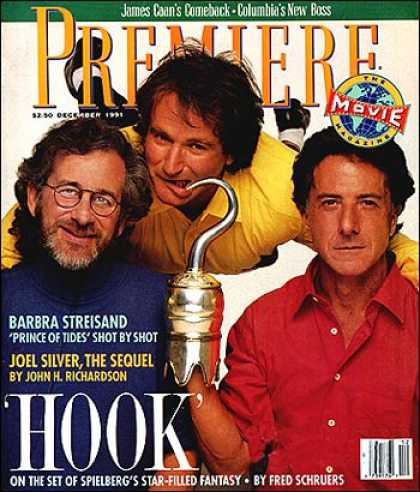
It was in the late autumn of 1991 that I’d found myself on the set of “Hook,” on Stage 27 on the Sony Pictures lot. The piece that would run in Premiere magazine would run double the typical length of a set visit story; though this was our first acquaintanceship, Spielberg—along with top-drawer producer Kathleen Kennedy—had shown a genuine, welcoming trust.
This transparency was despite an arduous shoot that had seen the budget skying from $40 million towards nearly double that, with the story’s passel of the Lost Boys acting almost giddily uncooperative. His joking message to them one day was a wish that they should all become directors one day, and that they would… have to work with kids.
Further, Julia Roberts’ Tinkerbelle had steadily tested everyone’s nerves as she demonstratively rode out personal problems.
Perhaps without the comic relief of Robin Williams as Peter Pan winding up. Dustin Hoffman (the title character, or course), the project would have ground to a halt.
Here’s how Ken Turan’s eventual review in the Los Angles Times saw
it: “Though this is his 11th feature as a director, “Hook” is clearly a project Spielberg has been pointed toward for his entire career. Though nominally a sequel to J. M. Barrie’s “Peter Pan,” “Hook” is really a modern reworking of that 1904 play, whose subtitle, “The Boy Who Wouldn’t Grow Up,” has often been applied to the director himself. “I’ve always been Peter Pan,” Spielberg told Premiere magazine. “That’s why I wanted to do this movie.”
Spielberg had continued to me, “In a way, it's typecasting for me to do this, because I've always felt a great affinity for that character.”
Spielberg seemed to accept or even welcome the tag of cinematic bard of childhood. “It doesn't go away, and even movies I make about grown-ups, it will always be in those films. I don't know how to be anybody else, you know. I'm stuck with who I am, and the movies I make have to pass through me before they get to the screen. If I make a movie about a retirement home, would probably be very childlike
“I think all children experience filmmaking when their parents buy them a birthday present of little characters, soldiers. When I was a lad, it was cowboys, and the kid lies down on the shag rug on his stomach, holds a little figure right up to his eyes, so it's very realistic, and gets an angle on that shoulder, puts the other soldier at arm's length in the other hand, and goes bang, bang, bang, bang.
“That's the beginning of filmmaking, and we all go through it, girls with their dolls in doll houses, boys with their trains and racing cars and toy soldiers, we all started out as filmmakers, and I guess I never grew out of it.”
Had that ethos fed into certain harsher critical takes?
“I've never taken that kind of stuff seriously, but I guess I have to live with that, because it's what I cut out for myself at the beginning of my filmmaking. I made these movies that were perceived to be big. I thought “Close Encounters” was very personal, the smallest, most personal movie I’d ever made, was perceived to be big only because how much money it raked in. Had it made no money, if it hadn't been a blockbuster, I might have been permitted to delve into “Color Purple” and “Empire of the Sun” with a little more respect.”
Came the moment when the call sheet advised it was another good day to fight on the Pirate Town set. Pen and Hook will clink and clatter up the steps of a decaying tavern, fighting busily, even as their sword play takes Pan towards a triple candelabra, and someone suggested an errantd stroke should flick the candle out. ‘No, I've seen that, says Spielberg, ‘when Danny Kaye is dueling Basil Rathbone in “The Court Jester.” Then he pauses thoughtfully. “What I haven't seen is a sword flicking the candles on.”
And thus it was arranged, surprisingly quickly, by the director’s top-line pro’s. Spielberg has a moment to commune with the Lost Boys as to his eagerness for what’s up next, the adaptation of Michael Crichton's novel “Jurassic Park.”
“The dinosaurs run riot in a theme park, he shares. “They extract edthe blood from the thorax of a mosquito,” He tells a credulous, if slightly abstracted young actor, “and get the DNA from a dinosaur that lived 120 million years ago.“
Perhaps a little guilty to have transported himself into a future shoot, he swings back to Peter Pan, and in the most Spielbergian of ways, finds the essence he still carries with him: “You're going to find in his adventure that he rescued his past, he rescued the memory of himself as a child, and carried that best friend with him the rest of his life.
“It will never leave him again.”
Comments ()