

David Byrne's "Who Is the Sky" Tour Was Heavenly at the Hollywood Bowl
Everyone is trying
To get to the bar
The name of the bar
The bar is called Heaven
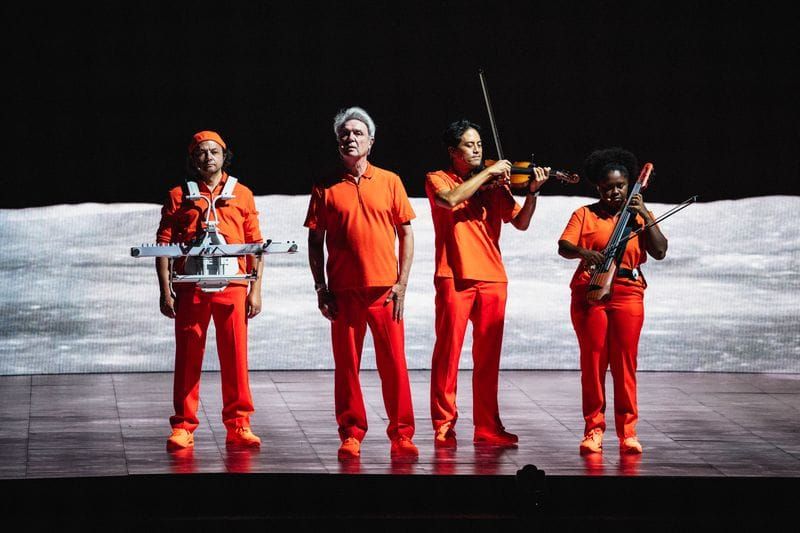
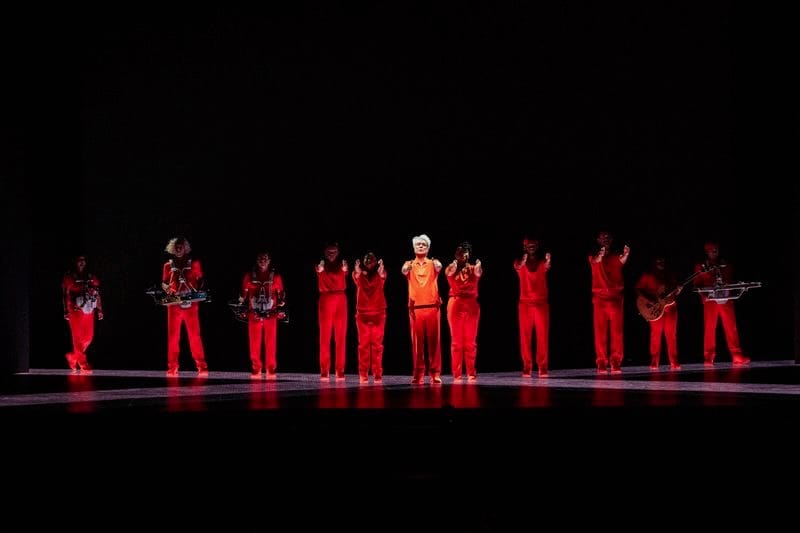
When David Byrne opened his Saturday, August 29 concert poised front and center under the soaring arch of the Hollywood Bowl bandshell, his ensemble’s matching wardrobe on a bare stage was hardly a cosmic reveal. He’d been in town for two warmly-received nights just last November, part of the still-running tour flogging his respectably-greeted 2025 album, Who Is The Sky?
And the setlist, players and “Dave's our guy” vibe was present then. (The company's slate-blue outfits, a kind of fashion-backwards take on medical scrubs and a switch from the previous night's bright orange, hinted at the leader's comfortable dad bod beneath.)
But where the 3500-seat Dolby offers grandiosity (and as a nation, gold trim now makes us barf), the Bowl offers grandeur, and a particular sense of moment as we sit surrounded by nature. On Saturday, the hillside breezes ruffled through the picnicking--and wine quaffing—crowd, as we perched on canvas chairs under a just-past full moon.
But oh, the painful battering of stupidity since that November! There was an atmosphere of "Let’s just put aside the emotional wear and tear of a new Trump yawp of ignorance coming daily"– as the man onstage largely would. (There are still a sampling of dates in Mexico, and just two back East, as a marathon tour concludes.)
One might look back and see what Byrne had to say about the Iraq war in March of 2003 when Musicians United to Win Without War ran an ad he co-signed with many others. The ad ran in the New York Times and Rolling Stone under the banner, ”War on Iraq is wrong and we know it.” His thoughts in his 2002 book, How Music Works , have aged only too well, suiting present circumstance: “Huge amounts of money were expended in what seemed to be obviously futile and counterproductive efforts that many felt would not only bring death to many innocent people but would end up making us as a nation, less admired and certainly less safe, both physically and economically, for the foreseeable future.”
This is about as doctrinaire as Byrne has ever been, before and since. Byrne’s musical and showman's gifts, visionary though they may be, stand conspicuously against a Kid Rock world of flames and putrid MAGA mud, but his approach has generally been gently voiced.
Also from his book, in discussing how he set off on his ongoing refurbishment of the Heads line-up to tour with 1980’s Remain in Light: “I knew the music we’d record was less angsty than the stuff we’d done previously. It was about surrender, ecstasy and transcendence, and the live performances tended to bring these qualities to the forefront…it wasn’t just an intellectual conceit. I could feel lifted and transported onstage. I think audiences felt this too.”
Amidst an unmistakable frisson of privilege made visible (and hurrah to the LA Philharmonic for initiating a new run of bargain ticket sales to a less pecunious cohort), the moment took its sweet time arriving. For all the dulcet vibrations of this evening’s setting, prior to the opening notes there had been about an hour of spool-up, first from the virtuously didactic “stepping" ” troupe Joe Brown’s Stroll Groove ,and then the U.S.C. marching band. (The latter played a perhaps too generous selection of tuba-centric covers, none more loudly cheered than Ms. Dolly Parton’s “Nine to Five,” aAnd none more baffling than a cover of Cream’s “White Room.”)
Enhancing the buzz for the industry-heavy crowd was the earlier announcement that Brady Corbet, the director of The Brutalist, had already trained his 70mm cameras on dates from Byrne’s long-running tour, stocking up footage for a feature. (Byrne's 2018 American Utopia album yielded a kindred tour, plus a Broadway stint, and Spike Lee film version.)
But abiding in the hillside retreat where we 17,000 had gathered was a sense of what Byrne was celebrating in his book, as he opened up his staging to an expanded and richly choreographed presentation: “The band became a more abstract entity…the more everyone gave up some individuality, and surrendered to the music, …it was a living, breathing model of an ephemeral utopia…’
For this attendee, surrender arrived promptly, as Byrne’s oeuvre signified with the second verse:
The band in heaven
They play my favorite song
Play it once again
Play it all night long
Oh, the easeful humanity of those simple phrases heard in this setting .
Several decades prior I had chosen the song as a fanboy's front-runner on the 1979 Fear of Music album (though “Life During Wartime,” which we’d inevitably hear this night, also made a strong case). But from the moment I heard it as done on the 1984 Jonathan Demme film, with Byrne harmonizing with then-bandmate Lynn Mabry, it owned the favorite tag.
To read my review of the film in Rolling Stone, please see a recent post commemorating the film's re-release:
https://www.dogtown.press/stop-making-sense-life-during-wartime/
The song continues:
Heaven
Heaven is a place
A place where nothing
Nothing ever happens
Novelist and occasional rock critic Jonathan Lethem’s April 2012, 144-page book on Fear of Music, done for the esteemed 33 1/3 book series, is quite the tasty marvel, one to make many a writer groan with envy.
The slim volume perches on the immersion, by Lethem’s 15-year-old self in Brooklyn in 1979, into the titular album. It was the third long-playing release from the band, and more of a David Byrne solo effort that the fandom—or even perhaps the band as a whole—realized at first. With it sporadic titles –“Drugs,” “Mind,, “Air,” Paper,” etc.—it didn’t present as high art. It even contained a thinking punter’s banger, the destined-for-immortality “Life During Wartime”, which clairvoyantly encapsulates the world of Paul Thomas Anderson’s 2025 One Battle After Another. Lethem again, in 2012: “Ordinary human beings who once had time for dancing and lovey-dovey have now stripped down the chassis of their existence to function as roving outlaw-survivalist-terrorist-hackers.”
Nestled fifth on the album, at the end of side one, if you’ll indulge the antiquated sequence reference, it left your ears ringing a bit until mine sought out “Heaven” as the second cut on the second side’s six tracks.
Lethem folds in the song’s lightly legendary provenance—it began its adoption process when Eno overheard Byrne humming a freshet of the melody while… washing the dishes (more songs about buildings, food and—scrubbing?).
Lethem addresses the track’s routine tempo, on paper at least, recognizing that even as a ballad of sorts it hews to a 4/4 rock spine, but with a different feel. I would never strive to approach Lethem’s (often deliciously wry) eloquence in describing it: “It drowns in its gorgeous reservations. Or maybe it’s only you who drowns, in “Heaven”’s unsarcastic sarcasm, its thrilling boredom, its overwrought dispassion, as you plunge through the gummy stasis of its surface, on which floating petals conceal a murky whirlpool of reverb and echo and guitars."
The wised-up Lethem goes deep in confronting the slack-jawed adolescent he was: “Just be grateful the song hates its own beauty a little, a kind of inoculation against feelings of unworthiness, and a hatred that’s likely its most beautiful feature.”
It’s certainly not for nothing that the track was midwifed by Eno, the very producer who would make Music for Airports and other exploratory, often ambient works.
Gould, for his part, shares an insight that may be a clue to a certain diminishing of deep impact, as both he and Lethem find in the latter-day Talking Heads output as well, one can only surmise, that of Byrne in his post-Heads collaborations: “In addition to relying on Brian Eno’s methodology of building up tracks in layers from a minimal rhythmic base, David Byrne experimented with an approach to lyric writing based more on the way words felt and sounded than on what they actually meant, consciously resisting the impulse, as he would later put it, to “make sense.”
“Heaven,” then. With its hints of teleportation, it’s otherworldly enough to take you where—or just as feasibly, nowhere. Lethem has theorized that much of the Talking Heads canon is thematically about what he terms Fear of Nowhere. He further scotched any notion the song was rooted in the giddily artsy mythos of early punk and new wave, with a characteristic jape: “Is Heaven a hip nickname for VIP room at Max’s Kansas City, say?”
The road to what just might be a beautiful nowhere continues:
There is a party
Everyone is there
Everyone will leave
At exactly the same time
…and the follow-on refrain:
It's hard to imagine
That nothing at all
Could be so exciting
Could be so much fun
That verse's vocal turn is to me, some of Byrne’s best singing anywhere. As he cavorts through his vocal range, one wonders, is that agony or exultation in the high notes? (Jerry Harrison added major piano chords throughout that won him a rare co-writing credit.) As the song heads for a wind-down, it stakes out still more territory for its half-buried tenet that not everything in life is a quest for meaning, not for novelty. There’s something still amiable despite an opaqueness, carried forth in the mid-range vocal’s instructive, etched-consonants:
When this kiss is over
It will start again
It will not be any different
It will be exactly the same
It must be taken on board that “Heaven” was likely not picked as the Who Is the Sky tour’s lead-off item solely for its true believers like me. It’s perhaps platitudinous to note that Los Angeles seemed to embrace open-heartedly anything Byrne might essay this evening, that the feeling in the air was that, in embracing demanding a good dose of “nothing”, we might go for allow almost anything.
(If I haven’t said it yet, this show is a most watchable evening– theatrical, a fully positive valence where streams of visuals and texted homilies, met dance, and elite fretwork, and simple joyousness to shower we happy patrons with a big-top rock show with brains.
Inevitably, several new songs delivered with the same zeal as the must-haves. Byrne now being anything but free of ego—with just a sliver of self-righteousness glinting a bit—followed “Heaven” with “Everybody Laughs,” a cut from the album the current tour ostensibly seeks to promote. But he’s demonstrated that the right band and a committed approach can make his sets feel in sum, like a flywheel of nothing but hits.
By showing of the almost circus-ring polymorphic activity of dance, socko horn riffs, shredding, wild harmony, the whole kit-bag of smart pop music, Whatever “And She Was” did in. terms of sales and airplay, it’s one of those talking Heads earworms that always feels necessary., on a drive or at the Bowl.
Some years ago, I joined a group of friends-since-childhood in a comfortably rustic and weathered multi-bedroom ski-vacay retreat one family owned. There was a standard lo-fi boombox that had nada on hand to use it with, but when I opened my rucksack and pulled out a Heads two-CD (remember) collection and those four sides got played on repeat pretty much without pause. The vault from a trio at CBGB’s to OK Boomer playlist seems the most natural thing in the world.
That said, the next dozen or so songs at the Bowl mostly weren’t all bucket-list fare—maybe too recent (the single “T Shirt”), too retro-avant (Strange Overtones,” the Byrne-Eno cut), or, in my case, too fresh out of the shrink-wrap of the 2025 album.
Yes, reliables like “Nothing But) Flowers” and “This Must Be the Place (Naïve Melody)” showed forth their vistures in a strutting mid-concert panoply. And Dave’s illustrative Mr. Rogers-like chatter as to song origins (come for the familiar quirkiness of “My Apartment Is My friend”, stay for a case of voyeuristic dwelling envy that will damage your self-respect) was right in the pocket of yes, we like hearing more parables as to exactly who is this guy writing the songs?”. But we knew the big finale blow-out was just around the corner.
There was a time when “Psycho Killer” owned pride of place atop the setlist, letting audiences know they were about to turn their evening over to a master and his band. “Heaven” is the antithesis of “Psycho Killer” in Talking Heads’ repertoire,” Gould’s bio noted. And although I was slightly aghast when the open bass notes sounded forth and wife turned to me with an highly audible and not so accurate) “Your favorite song!”, I was happy to hear it, as always.
Gould has also pointed out the song has been heard in virtually every gig the Heads ever played, from the ancient garage-band days as the Artistic to their Rock & Roll Hall of Fame induction set. (Famously, such moments reveal the canine teeth of shredded friendships, but one wonders if any inducted band ever was more dismissive in their body language than the Heads a) standing through Tina Weymouth’s resentful, root-canal caliber stemwinder and b) while doing the song. (Envision The Artistics doing “Psycho Killer,” the first self-penned song Byrne dared to perform. Oh for a bootleg of an early set when choices included the lovelorn “I Wish You Wouldn’t Say That,” and the much-cited-as-influential “96 Tears” by
? and the Mysterians.
At this stage the audience was as thoroughly in the grip of Byrne and his fiercely engaged players as we had planned to be, and “Life during Wartime” coaxed from their seats many of the crowd who had at last folded up their picnic gear to dance. “The song makes Fear of Music twice as big, at least.”, as Lethem calmly avers, And as he wrote in the 2022 book, it’s “The exact center of the Heads’ accomplishment…[they] simply and abruptly assume the fullness of their capabilities.”
How fitting, then, that the song would evoke the thoroughly palpable, part-angry and yet part soothing roar, when Byrne’s video selects showed footage of ICE raids bon the large LED screens behind him. . The song suddenly connects the sunny Who Is the Sky’s it the devout bicyclist Byrne to current events, in a snippet featuring a lone protestor rocketing through their ranks, then safely escaping the staggering herd of porcine immigration agents? To the fandom who may still have their foot in the bucket on the tendered (and tender) joys of the newest album, it’s a connection that’s both timely and brings a charged sense of belonging.
Standing out vividly in Byrne’s quirky brief tales of inspiration was this: “Not too long ago I read an interview with the actor and director, John Cameron Mitchell, and he said that love and kindness are the most punk things you can do right now.”
So, then. Just maybe m heaven really is a place where nothing ever happens,. But with David Byrne delivering his particular brand of goods, to drink it all in and then walk forth in the balmy night some 3,000 miles from where Byrne’s adventure in music started, was to like quite a lot had happened.
Comments ()