

"Crime 101" Brings Its Own Kind of Heat
Perfect is the enemy of good.
It’s a common enough cliché, right? A phrase that has over time excused plenty of mediocre work, but also brought a welcome productivity to various ventures.
Notably in cinema, where even the legends among directors often judge their days by how many pages of script they shot.
Specifically, I heard Olver Stone say it on a set…where was it? Might have been in 1991 in the barrel-vaulted marble halls of the New Orleans criminal courts building, while prepping a scene from J.F.K. with the perfectionist Kevin Costner? Or perhaps on motor launch ride boat ride around Los Angeles Harbor (fictionally, the Potomac River) on Nixon in 1995. The latter may have posed a continuity challenge, as the scene unveiled the 37th president’s close cabal dining on undercooked steaks.
(Historical footnote: that film’s predictive version of Stephen Miller is James Woods as chief enabler H.R. Haldeman—who knew then that the emerging MAGA necromancer Woods probably considered that the hero role? Still, it's Paul Sorvino’s Kissinger who gets the line that helped lead to a screenplay Oscar nom: “Can you imagine what a this man might have been had he ever been loved?”)
And further, who might have guessed that a power-greedy, porcine, aging brat would come along to make us muse that Nixon was hardly as bad as it could get? J.T. Walsh as Ehrlichman speaks the line which perhaps helped bring an Oscar nom for Stone and two others’ as Best Original Screenplay, and most closely locks onto what’s most Trumpian in Stone’s biopic: “You got people dying because he didn't make the varsity football team.”
Yes, Trump steadily proves a corollary cliché: Terrible is the enemy of good.
Okay, then. One takes up today’s main topic aiming to lasso the above epigraph into an accounting of the “good”-ness of Crime 101,.
The film—lengthy at two hours and twenty minutes, albeit at a winning pace--entered the box office race on February 13 and two weeks later stood just north of $26 million-plus domestically, against a budget north of 90 million.
The economics of streaming services are sufficiently murky even to trade press experts that whatever profit shortfall exists when the last oily popcorn has been vacuumed off the movie house floors, the number may be mostly for pride’s sake. Lead releasing company Amazon MGM may feel a pang, but the end result can’t materially affect parent Amazon. (As a point of comparison, the $250 million Jeff Bezos spent to acquire The Washington Post—and more recently, turf it into the gutter with his major editorial cutbacks—represented couch change against his estimated $25 billion worth.)
Having recently profiled the prolific and dauntingly talented crime novelist Don Winslow (link to the Rolling Stone article at bottom), I had the chance to part the production veil a bit through talks with co-producer Shane Salerno and writer-director of the film, Bart Layton.
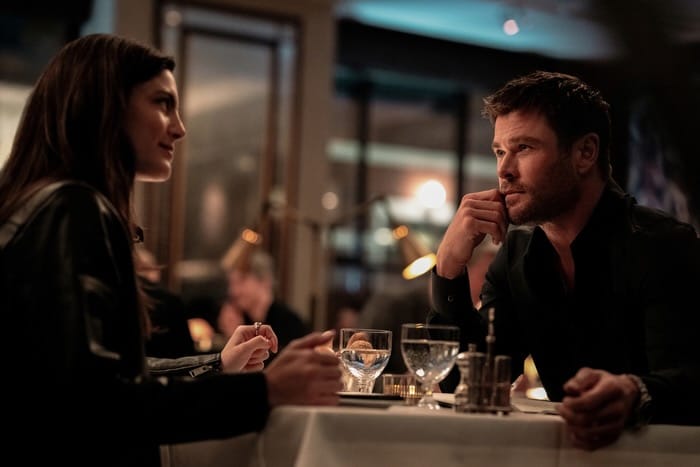
The latter’s canny work was met with the inevitable reviewer grumblings that the film leaned (quite consciously) into certain genre tropes. At a glance, then: we watch the marginally discredited veteran detective Lou (an always-winning Mark Ruffalo) suffer under a go-along-to-get-along system even as he doggedly hunts the smooth criminal (Chris Hemsworth, in a revelatory new mode) as he dares one last career-capping jewel theft. But the story as expanded from Winslow's creation features Halle Berry as painfully aging-out high-end insurance specialist, plus a reliably dyspeptic Nick Nolte as an unblinking betrayer, and Irish acting marvel Barry Keoghan as a grotesquely violent crook who shows us the jagged vulnerability of a lifelong misfit.
Did I mention Monica Barbaro yet? She’s here, in all her girl- next- door-cubed glory, once again bringing the just slightly saw-toothed edge she showed as Joan Baez in A Complete Unknown . Opposite Timothee Chalamet's Dylan figure, she scored with a line like “Sometimes you’re really an asshole, Bob.” As one of the film’s cadre of authentically drawn females, she brings Hemsworth’s Mike Davis up short—in more ways than one, as we shall see below.
The film has brought a somewhat sheepish display of positivity among elite reviewers. The New Yorker’s Justin Chang, who found the Maya/Mike arc provided "some of the film’s more pleasurable curves,” added, “You believe Hemsworth, Ruffalo, and Berry, even if you never quite lose sig ht of the world-weary archetypes they represent,” and concludes that the “imperfect [italics mine] but enveloping L.A. noir offers an escape from what Hollywood typically considers escapism. The actors, no less than the characters they play, can take pride in a job well done.”
Perhaps the dean of British reviewers is The Guardian 's Peter Bradshaw, who was already all in with Layton’s American Animals: “bizarrely gripping...[with] enormous flair. I was utterly absorbed in this teeth-clenchingly exciting story".
In a reference that incorporates the two well-motivated, slam-bang chase scenes, Bradshaw adjudged Crime 101 as “a highly watchable spectacle, leaving a sizzling streak of rubber on the tarmac.”
John Powers of NPR’s Fresh Air skipped the hand-wringing: “If there's anything I miss in pop culture, it's the presence of ordinary movies. As a “pleasingly rare example of what used to be commonplace,” he found that “one of the movie's pleasures is that it isn't clogged with action sequences. It's got an old-fashioned interest in character, especially compromised characters, and gestures at darkness rather than diving into it. It glistens with the silver-lined optimism you find in Elmore Leonard.”
Powers nods to a realization the writer-director has emphasized when we spoke, that he sought to probe "The currency in L.A.--youth and beauty and wealth and status. And when that starts to expire, what have you got?" As Powers notes: "Layton lets us see how the whole plot is driven by the abysss separating the entitlement of L.A.'s haves from the struggle of its countless have-not's.".
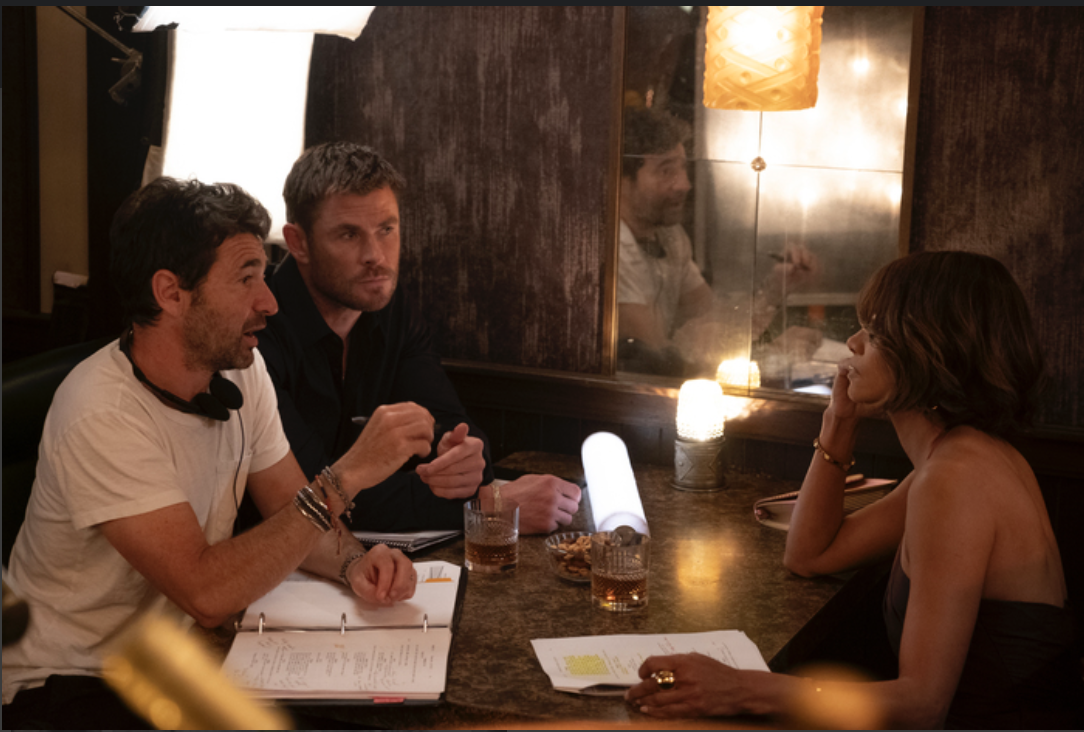
“You’re always trying to smuggle something into what obviously has to be a broadly entertaining,” says Layton of layering in a barely whispered childhood saga Mike Davis lived through (then as foster child James): “What I wanted was someone who felt real to us, who had real stuff that they were covering up, and yet felt. I think Davis in the novella, the is probably a little more slick, and Don was writing a kind of homage to Elmore Leonard, in a way. (Indeed, Winslow would tell me that an hour conversation with Leonard—who is name checked alongside a chapter heading in his current collection—was a lifelong highlight.
“I see Don as part of that lineage,” says Layton, who voyaged in Winslow’s vintage Mustang up and down the 101, surfboard-shopping, “whether you go all the way back t Damon Runyon, Raymond Chandler, Elmore Leonard, Don now carrying the torch, in a way.
“But once I started adapting it, because I come from documentary, my natural thing is, I Immediately went off to try to find individuals who were the closest in the real world to the character that Don was creating. And Don also does a ton of research. And as you know, most of his stuff is so beautifully kind of rooted in reality.”
It was mainly the top-tier reviewers who were not caught napping on a picture that fulfills much of what Layton promised with his 2018 American Animals, a meta-rich docudrama formulation that also starred Keoghan. On the Roger Ebert site, Seitz found that Layton had wrought “the rare big-budget Hollywood movie that has a very clear idea of what it wants to say, faithfully replicating genre clichés while putting a nifty spin on them.
"This is a special movie.," he adds, "It has a life force unlike any other crime thriller I’ve seen. It’s about characters who suffer a personal failure by the end emerge transformed. It’s a violent movie, but not a cruel one, and unexpectedly moving by the end. "
Rolling Stone's David Fear most aptly gave a shout-out to the top drawer, if under-recognized, casting director Avy Kaufman, who also built the call sheets of players for Sentimental Value and Train Dreams, and found stage and screen performers who excel up and down the call sheet.
Indeed, the procession of compact but telling performances from character actors has been much noted. That said, the production was off to a head start, as Ruffalo—who in fact was brought on Pedro Pascal was summoned away to make Fantastic Four: First Steps—had, well before the film mounted, reached out to Layton after admiring American Animals. (A second fortunate happenstance was that Layton and Keoghan were already art friends after the latter’s turn in said film.)
Both Winslow and producing partner Shane Salerno had a hand in kibitzing on the writing phase, with Layton necessarily supplying the. Ove to buzzier urban locales ls (Los Angles as opposed to Winslow’s familiar shore towns) and wedging in plot points, some rather daring as filmgoers will see, as he built out elements that augmented the original spareness engendered by the curtailed length of a novella. The project found an early adherent when Eric Fellner if Working Title Films, now 130 films into a quality catalog and perhaps known best for Coen Brothers gems and some veddy British romantic comedies, asked to take a crack with Layton taking on dual duties. Eric said, `Look, we really love this story. Could we take a flyer on it? We can't pay you what you would get paid, you know, by a studio at this stage, but we'll make you whole if we make it.”
The source novella was all but strangled in its commercial crib by the onset of Covid, and as a planned national promo breakout was canceled. Salerno told me the book had been all but assassinated. By that staggering start. (It had been part of a six-story collection then called Broken that essentially had its publishing run as a hardbound book sandbagged, along with its film, Tv, ab streaming chances.
The development of Crime 101 as a film tied into a repackaging of the collection bearing its title proved advantageous. As luck would have it, craft and casting and the slow eruption of fierce competition between the streaming giants would pay off Working Title’s earnest claim. “So they were true to their word, and we didn't hear from them for a year, and then suddenly—"Hey, we’ve got this script for you to read.’ . We gave some notes, and the next thing I know is, I get a call at 10 o'clock at night. saying we think this is going to--we’re in $100 million bidding war. And, you know, and so the movie that you see tonight survived about three assassination attempts before it got to the theater that you saw it in
Still, Salerno told me, at the root of the inspiration was the Michael Mann canon (not just Heat and Collateral but, of course Thief) such as Sidney Lumet’s urban film icons (Serpico, Prince of the City), and ultimately, adds Layton, “I think this particular project grew out of Don's love for Steve McQueen, which I share. And we started thinking, what, what would it? What would if Steve McQueen were alive today, and were, you know, at age 35, what kind of thing would he do?
“The movie that you see tonight survived about three assassination attempts before it got to the theater.”
A movie moment that plays especially well in the theater comes when the plot—derived from Winslow’s tale but about to undergo some striking quadruple-axel maneuvers—finds two key characters in a limo bound for the story’s denouement. “You see [a certain character’s] eyes go up and you know…” says Salerno.
Crazy changes are yet to happen, but let’s have those secret. In fact, a moment that reveals the director’s developing artistry and unlocks the film’s slowly adduced love story is worth depicting.
Here. Dear reader, if you haven’t seen the film, comes what most would call a ‘light’ spoiler. Thus a chance to drop out—especially you romantics.
Onward, then.
For those who are at all mystified as to what may happen onscreen when you put the increasingly celebrated Monica Barbaro as the hard-to-get Maya face to face with the hard-to-read Mike, last chance.
Scene: we’re in the kind of anonymous temporary lodgings Mike inevitably inhabits, but there’s a device that can supply an electronic version of the classic “needle drop”.
And the classic tune selling us this iteration of the classic kiss prelude is, no less, Bruce Springsteen’s cover of Tom Waits’ “Jersey Girl”. (Gravelly poet Waitshad authored it in tribute to his own Kathleen Brennan.) You hear the roars of the home -state arena crowd as the softly plucked strings and tenderly hushed verses, almost a tribute to soulfulness of The Boss’s longtime love The Drifters, head for the joyous vocal sha-la-la’s:
She has gently enticed him into a slow, oddly decorous waltz.
And you’re thinking, aw, come on girl, the big lug wants a kiss.
At this point you may recall the moment in Flesh and the Devil when Greta Garbo, as John Gilbert seeks to light her cigarette, draws back almost in reproach. She’s showing, as the film scholar Rudolf Arnheim frames the moment, two actors' “personal melody of movement.”
It subverts the cliché so delicately, one had to ask Layton, and he pauses to recall. “I didn't allow that to be rehearsed, for obvious reasons. I wanted it all to be one shot, evolving, so, and the direction that I had given her was, `don't let him kiss you’ –until it’s sort of impossible not to.
“That song that had given me chills because of the live recording, and I felt like it had, there was something of her character in it. Normally you would not have song playing on the film set because of the dialog. But I felt like it was important to have it, and not to fake it. So, it was pretty real. And the environment on the set, was, I would say, pretty electric.”
Call it a moment AI could never come close to achieving, and call this a Dogtown recommendation of a movie where good indeed outdoes perfect.
Don Winslow: "We Have To Speak Out::
https://www.rollingstone.com/culture/culture-features/don-winslow-crime-101-interview-1235504213/?utm_source=edit-vip
-
Comments ()