

"A terrible empowerment"; "The Audacity" Probes the Surging A.I. Realm

We are on the cusp of the further perfection of extreme evil, an evil whose possibility spreads well beyond that which weapons of mass destruction bequeathed to the nation-states, to a surprising and terrible empowerment of extreme individuals.
Bill Joy, Wired Magazine, April 2000: “Why the Future Doesn’t Need Us,” as cited by Anthropic CEO Dario Amodei
The landmark essay cited above by by AI mandarin Amodei has held its resonance for well over two decades now.
As if to mock this blogger’s hope to keep up with moving targets, just minutes ago, per the Wall Street Journal, Amodei's brain trust posted on Anthropic's blog that the slowing global AI development “would likely be a good thing...to enable societal structures and alignment research to keep up with the advance of the technology.”
Anthropic’s competitors have suggested that as the front-runner--with its trademark Claude edging past OpenAI's ChatGPT functionality and popularity--Anthropic has much to gain by delaying advances across the board in the exploding realm.
More recently, perhaps the central tract urging speed bumps as AI surges forward can be found in Amodei’s essay published in January of this year as “The Adolescence of Technology,” and subtitled, “Confronting and Overcoming the Risks of Powerful A.I.”
Ever since the disruptive days of 2021 when what had been an optimistic bromance among A.I. tech lords began to fracture, the surging field has had a seemingly authentic voice of reason in Anthropic leader Amedio. His 2024 essay , “Machines of Loving Grace,” presenting a optimistic view of how A.I. might transform not just business culture but every human endeavor and aspiration, was followed this past January by a darker-hued take, “The Adolescence of Technology”, whose warnings, with occasional spikes of optimism, ran to around 20,000 words.
When Joy’s piece published at the dawn of the millennium, the rise of Artificial Intelligence –as enabled by the equally phobia-inducing term “machine learning” (a/k/a/ Large Language Model, or LLM)– seemed more of a sci-fi notion than a reality. Even those who eyed the upstart tech as potentially toxic seemed to consider the more dire predictions as a can to be kicked down the Silicon Valley road.
It was 1958 when an obscure mathematician introduced the term “singularity” to denote “the ever-accelerating progress of technology and changes in the mode of human life, which gives the appearance of approaching some essential singularity in the history of the race beyond which human affairs, as we know them, could not continue.”
Another term for the key fork in the road would be AGI, or “artificial general intelligence”--a human level of computing—that some have postulated would destroy mankind , and some discount as a threat. Among the latter is early AI savant and `godfather’ Yann LeCun, who predicted AI won’t get any “smarter than a house cat.”
And it was just a decade later 1968's 2001: A Space Odyssey arrived to serve as LeCun’s triggering event. It chillingly climaxed with spaceship supercomputer Hal 9000 rebelling, leaving actor Keir Dullea looking very timorous, as a studiously polite voice emanating from behind a winking light all but sneered, “I’m Sorry Dave...”
https://www.youtube.com/shorts/5lsExRvJTAI
“…I can’t do that.”
I know, patient readers, you may like me be thinking, “This is the kind of futuristic wobble that led me to take Geology 101 instead of physics, and to avoid any course offerings using the phrase “Post-modernism.”
But post-modernism is what’s coming, and the most realistic course left to us may be to give in to what Steely Dan decided : "Any world that I’m welcome to/Is better than the one I come from…”
There’s a lot of technocratic gristle to chaw through in addressing the changes that are coming to our devices. Perhaps the meal will be more palatable if we examine it through the sardonic if convincingly authentic world of “The Audacity,” a highly recommended watch that is billed by streamer AMC+ as a drama, but is more like a very dark… gray?… comedy?
It arrives not a season too soon. When Ben Franklin (only apocryphally, I’m afraid) warned his fellow patriots that “we had best hang together, or surely, we shall all hang separately,” the threat from England’s King was real enough. Now as we watch the billionaires cavort in mid-2026, the A.I. phenomenon that futurist Joy was wringing his hands about stands a chance to affect most of us only too personally. And yet it is under the provisional control of a duo of early-40’s tech uber-bro's, with a soon-to-be-minted, first-ever trillionaire (yes, Elon Musk) about to turn 52. This bunch and others are all growing exponentially richer as they race each other into a mostly unregulated marketplace–-so really, what could go wrong?
Whatever does, Trump is hardly the man to fix it. On Tuesday, June 2, around the time he was shaking off the hit of seeing severe blowback against his misbegotten `retribution fund’, via which he notoriously planned to distribute $1.8 billion to his favorite thugs and similar loyalists, Donald Trump signed an executive order, per the Los Angeles Times account, “directing the federal government to establish a voluntary early review process for the country’s most advanced artificial intelligence models.”
The weak-tea order came just two weeks after Trump “had scuttled a version of the [Biden-spurred] policy that gave the government a 90-day review period” for such AI innovation. Predictably the Trump offspring will find an AI grift to their liking, but the new feint purporting to get the Feds somehow stewarding the AI roll-out won quick affirmation from Amodei, 43, whose Anthropic mega-company had just announced a coming Independent Public Offering that will lend investors entry to ride the company’s nearly trillion-dollar valuation.
On that day we heard nothing of heft from Sam Altman (age 41), the pseudo-rational, marginally Trumpian head of Silicon Valley’s Open AI, with its own competing, massive valuation of $500 billion-and-growing war chest, also heading for an IPO. The lame executive order apparently did little to discomfit Altman, who was all over Washington D.C. this week in a characteristic quirk offensive, offering a template for future regulation and looking in on ad hoc friend Trump as well as other legislators (notably Bernie Sanders, an audience Altman had requested.)
Based on the strong reporting in a hefty New Yorker piece on the Missouri-raised impresario last month, the answer to the headline query, “Sam Altman May Control Our Future--Can He Be Trusted?” is apparently, “No.”
It was partly Altman’s willingness to vouchsafe certain advanced elements of his firm’s A.I. to help effectuate the Maduro capture that endeared him to the White House. For his part, Amedio declined to spool up the whole spectrum of his Claude software’s analytical tools and was slapped by War Department head Pete Hegseth with a fiat banning his company from government work.
OpenAI capabilities were also part of the bomb and missile assaults on Iran. (You know, the war that Secretary Marco Rubio declared to be "over" under grilling in Congress this week. Easy-peasey, now on to Cuba, if Marco has his way. )
Without for a second countenancing the ongoing, ugly and deadly measures directed against their citizens by the theocratic regime in Iran, one has to ask, what has been accomplished? (Former C.I.A. chief Leon Panetta just today referred to it as “Trump’s Vietnam.”)
But looking at the attacks specifically as a preview of U.S. diplomacy coming out of the barrel of a gun, there’s reason to keep checks on battlefield A.I. The Arms Control Association’s rigorously vetted site has cited the Pentagon’s AI-fueled system as a key targeting resource for much of the bombing offensive that infamously killed over 170 Iranians, mostly children: “Project Maven was designed to use computer vision and machine learning to sort through drone footage of Middle Eastern battlegrounds and identify potential militant hideouts for possible attack…though human error—a failure to update military intelligence maps—has been deemed the most likely cause of the Shajareh Tayyebeh missile strike. Many observers warn that increased reliance on AI-powered targeting systems, a phenomenon known as `automation bias,' will result in further tragedies of this sort."
This is all happening as gas prices don their party hats (we all know the equation involving a Trump-effectuated, sclerotic Strait of Hormuz and our own resultant costs at the pump.) A corollary quality-of-life issue is seen in the stampede to build giant server farms to enable the massive “compute ” needed to stoke the AI takeover.
Various financial journals have made note of how massive Open AI’s probable listing on public markets (likely in September) may prove to be "the most consequential and controversial IPO in the history of technology,” though when Musk drops his own IPO to great fanfare it may show the puissance of mixing SpaceX rocketry with xAI in a conjoined company, in what may become the mother of all IPO’s to date. (Estimates hover around 1. 5 trillion.) Even without exploiting a consolidation with Tesla, Musk stands to become the world’s first trillionaire. This is the Trump operative whose chain-sawing of aid programs as head of DOGE starved and disadvantaged many thousands in Africa and elsewhere.
Meanwhile the competing A.I. purveyors’ spending as they scale up—their “burn rates”—has led to colossal costs to effect a fervid build-out of supersized structures stuffed with servers, networking hardware and cooling systems. Those who lived through the stresses of the March 1979 Three Mile Island nuclear accident may find issue with the news that frequent A.I.-tech contractor Microsoft in 2024 struck a deal with a power producer to restart the undamaged reactor at [Three Mile], the site of the worst nuclear accident in U.S. history. Federal regulators this week greenlighted part of the plan to do so.
Altman may need his legislator and lobbyist friends sooner than later, as local protests have been sparking up to block new installations, even in a deeply red district in Texas where affected pols and citizens protested a consortium called Stargate, headed by Altman, that put a price tag on a joint venture with SoftBank, Oracle, and MGX. The combine is on a path to spending five hundred billion dollars in AI data center construction.
Even the red-states faithful who have forgiven Trump’s dismemberment of the constitution and anything resembling thoughtful governance are revolting against these bloated, faceless data centers that suck away energy sources, blot the landscape, pump out carbon, and deplete and potentially pollute community drinking water:
https://www.thedailynewsonline.com/news/deep-dive-small-town-texas-rebels-against-data-centers-in-growing-backlash/article_df380c84-1316-47e8-8f19-ee63497cc00a.html
Server farms are also the latest Amazon/Jeff Bezos self-enrichment scheme. The Wall Street sharpies who are smarter than Trump (I heard you say, who isn’t?) will do all they can to boost the building spree, as AI bosses feverishly scale up to beat the competition to claim the most bombshell IPO.
It’s had to find any pundits in the financial sector who think the coming need to count certain oligarchs' wealth in numbers starting with “t” will do anything for the working and middle classes. (What in recent years was becoming a “K-shaped” economy looks more like an exclamation point—a small dot representing the folks left out of the AI money grab that’s brought Wall Street along in its wake, with a priapic vertical bar surging upward for the plutocrats.)
We won't know until the November polls if California voters will pass a so-called “billionaires tax” hitting the richest folks with a five percent fee. All this while Trump’s benighted, failed tariff policies have totally sandbagged, among others, the forgotten rural farmers.
Not to mention the amount of “AI Slop” that has all but ruined the already tattered credibility of social media and various popular apps. Less aggravating but potentially subject to abuse is “Agentic AI”, which is great news for the top tier coders atop the food chain but according to the American Banking Association, “introduces layers of unpredictability: emergent behaviors, misaligned objectives and even the potential for `agents' to collude or evolve.”
All this hullabaloo, in a week of AI-spurred twists, has meant this particular post just underwent its third revision, as news breaks punched their way into the copy and added two successive days of new research and writing.
This week CNN cited the nearly 88,000 layoffs in the tech sector so far in 2026 as being largely attributable to AI’s destruction of not just entry level roles, but even the industry’s formerly princely “software engineers”—the coders.
That all said, it’s time to delve back into today’s original aim to drop a nod to the signal societal messages borne by “The Audacity." The show landed in mid-April with a praiseworthy willingness to grapple with very feasible imaginings of what the Silicon Valley tech lords may be willing to do with or to our digital selves, and how they might monetize the personal data they’ve diligently scraped out of us with their false bargains.
The schemes run by the audacious techies seen in the show vary marginally from the real-life “killer apps” we already live with as we hurry to become the product, if we can just cuss our way through the pyramiding authentication protocols. Rather than the real- life global exploitation of AI we are entering, which is after all meant to push “enterprise” (old-school business growth) to the fore, the show’s emerging key tech emerges perturbingly under the rubric of “P.I.N.A.T.A,. as in “Privacy Isn’t A Thing Any More."
That anagram becomes the war cry of central anti-hero Duncan Park (who’s Hegseth-scale thirsty in a zealous performance by Billy Magnussen) once he finds the kaleidoscopic algorithms that grant him access to all humanity’s personal data—data he can develop, deploy, and remorselessly turn into revenue.
As brewed by a brilliant if junior, non-binary coder (shades of “The Industry”--this sudden-star employee, played by Jess McLoed, is named Harper), it’s a hyper-omnivorous information-sucking algo that for better or worse can corral every shred, shard and shame about any targeted person’s life history.
Of course, there’s a way for the “customer” to go Premium—just buy a top-tier subscription and your own data is masked.
What’s diabolically smart about Glatzer’s conception and casting is that he sets us searching for someone to set Duncan straight, Will it be Harper who speaks up, despite her nuanced and quietly hilarious sangfroid as we learn what woes could unfold? Or perhaps it could be Sarah Goldberg’s, JoAnne, who’s the go-to shrink for every rich bastard (or beyotch) in Palo Alto and can deplore Duncan’s rascality all day—as long as her financial circumstances thrive.
Will it be Anushka Bhattachera-Phister (Meaghan Rath) who is the purportive “ethicist “ for the mighty `Cupertino' firm ? (A firm run by an unseen “Big Tim”—are we getting the reference here?)
Zach Galafianakis’s’ bearded, slit-eyed mess Carl Bardolph was once both the theoretical bellwether for, and possibly the wealthiest among, the top-tier capitalist overlords. A chowhound, a top instigator of and voyeur to the fight club nights he values as much as a well-marbled steak, he has a fixation on things military that is tangled up with his Daddy issues. When he’s labeled a psychopath to his face, his retort seems to echo the arrogance of the new AI monarchs: “Spread the word.”
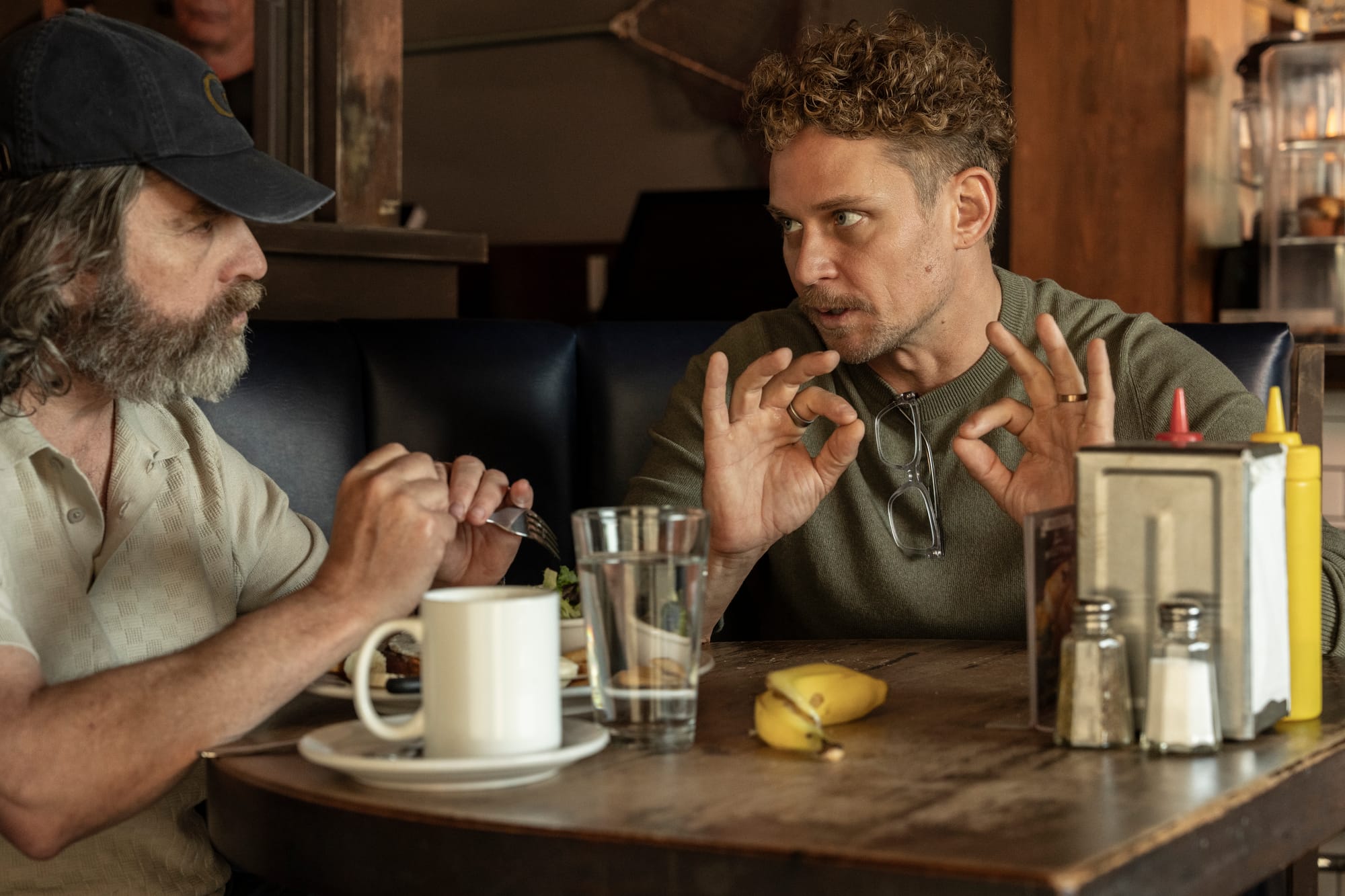
As the episodes roll forth, in spite of—and sometimes because of—their respective inner torments, Duncan and Carl ‘s agendas overlap. When the chance comes to unite Harper’s super-searching app with the monetizable data it can cough up for the likes of big pharma and God knows who else, their often-bitter interactions take on an irresistible savor. It’s a show that doesn’t so much ask for our snickers as it supplies the occasional forehead slap that somehow makes you laugh.
Once you tumble into this maelstrom of greed, the story's sagely cynical laughs do come, not as guffaws or giggles but more like the half-shocked snorts we saw in Glatzer’s earlier dark passages, when he was in the kindred writer’s rooms of both “Succession” and “Better Call Saul."
Somewhat to the side is Simon Hegberg’s Martin Phister, whose pathbreaking AGI ( Artificially Generated Intelligence) creation known as Xander is at once the most wheedling online invitation you could accept into your personal life, and a monster dopamine-rush drug of the sort many folks have embraced with their current Open AI and Anthropic addictions.
The old set of tech overlords who forgot not to be evil and exploited a generation growing up under them are a familiar cast of villains now (though we haven’t even taken time to cite Jeff Bezos, whose Amazon Web Services is printing money by serving the AI troupe), and Glatzer’s show has the er, audacity to show what we’ve leaned about the motives and morals. They’re mostly desperate as they age, but as labore economist told the Platformer site recently, “Tech, even 15 years ago, is an industry that eats its young.”
Duncan maybe a mess, but in the hands of Magnussen (the theatrically cruel and louche redneck crime boss of 2024’s Road House), he becomes our mess—an encyclopedia of tic-y gestures and jagged rictus grins. Even reduced to a face-down puddle sprawled by his pool on ayahuasca, calls out to his long-unavailable dad to, “Help me….” (cue a simpering final, prayerful confession of need)...”Stay…rich.”
A measure of the show’s clasp on us as viewers—and a measure of the alienation towards tech it allows us to vent—is that one can’t wait to see just how Duncan may manage to do that.
Comments ()